Shirts Michael R, Klein Christoph, Swails Jason M, Yin Jian, Gilson Michael K, Mobley David L, Case David A, Zhong Ellen D
Department of Chemical and Biological Engineering, University of Colorado Boulder, Boulder, CO, USA.
Department of Chemical Engineering, Vanderbilt University, Nashville, TN, USA.
J Comput Aided Mol Des. 2017 Jan;31(1):147-161. doi: 10.1007/s10822-016-9977-1. Epub 2016 Oct 27.
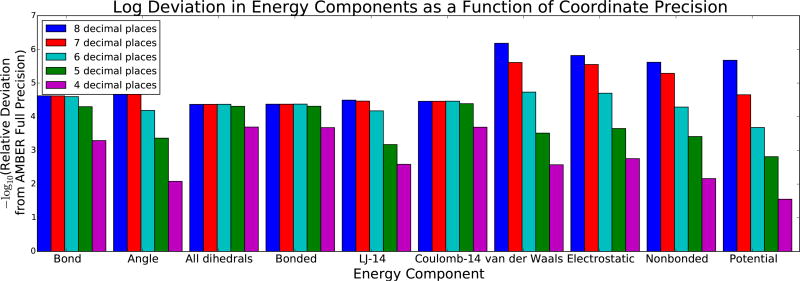
We describe our efforts to prepare common starting structures and models for the SAMPL5 blind prediction challenge. We generated the starting input files and single configuration potential energies for the host-guest in the SAMPL5 blind prediction challenge for the GROMACS, AMBER, LAMMPS, DESMOND and CHARMM molecular simulation programs. All conversions were fully automated from the originally prepared AMBER input files using a combination of the ParmEd and InterMol conversion programs. We find that the energy calculations for all molecular dynamics engines for this molecular set agree to better than 0.1 % relative absolute energy for all energy components, and in most cases an order of magnitude better, when reasonable choices are made for different cutoff parameters. However, there are some surprising sources of statistically significant differences. Most importantly, different choices of Coulomb's constant between programs are one of the largest sources of discrepancies in energies. We discuss the measures required to get good agreement in the energies for equivalent starting configurations between the simulation programs, and the energy differences that occur when simulations are run with program-specific default simulation parameter values. Finally, we discuss what was required to automate this conversion and comparison.
我们描述了为SAMPL5盲预测挑战准备通用起始结构和模型所做的努力。我们为GROMACS、AMBER、LAMMPS、DESMOND和CHARMM分子模拟程序生成了SAMPL5盲预测挑战中主客体的起始输入文件和单配置势能。所有转换均使用ParmEd和InterMol转换程序的组合,从最初准备的AMBER输入文件完全自动化。我们发现,对于该分子集,当为不同的截止参数做出合理选择时,所有分子动力学引擎的能量计算在所有能量分量上的相对绝对能量一致性优于0.1%,并且在大多数情况下要好一个数量级。然而,存在一些具有统计学显著差异的惊人来源。最重要的是,程序之间库仑常数的不同选择是能量差异的最大来源之一。我们讨论了在模拟程序之间获得等效起始配置能量良好一致性所需的措施,以及使用特定于程序的默认模拟参数值运行模拟时出现的能量差异。最后,我们讨论了自动化这种转换和比较所需的条件。