Wollenhaupt Jürgen, Ehlebracht-Koenig Inge, Groenewegen André, Fricke Dieter
Rheumatologikum Hamburg, Schön Klinik Hamburg Eilbek, Hamburg, Germany.
Center of Rehabilitation, Bad Eilsen, Germany.
Open Access Rheumatol. 2013 May 15;5:51-67. doi: 10.2147/OARRR.S38032. eCollection 2013.
A 40-question postal survey was developed to gain insight into the nature of difficulties experienced by patients due to rheumatoid arthritis (RA), as well as patient perceptions and priorities regarding their RA treatment.
A total of 3000 Lower Saxony, Germany members of Rheuma-Liga (RL), a patient support group for people with RA, were invited to participate between July 1, and August 20, 2009. The questionnaire was divided into four sections: (1) patient demographics, (2) quality of life (QOL), (3) treatment expectations and, (4) patient perceptions of RL. The questionnaire could be completed in writing or via the internet.
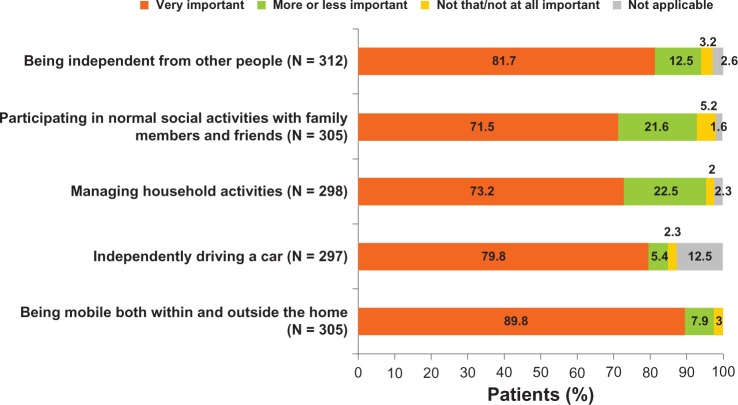
Of 959 respondents (response rate = 32.0%), 318 had diagnosed RA and were included in the analysis. The respondents were mostly retired (71.2%), female (83.3%), and >60 years of age (63.5%). Members' responses indicated that most were generally satisfied with their current treatment (67.3%), considered it efficacious (84.0%), and reported minimal (none or little) side-effects (61.2%). Patient involvement in treatment decisions, however, was reportedly low (49.6% felt insufficiently involved). Patients' primary impairments were reflected in their treatment priorities: mobility (97.0%), ability to run errands/do shopping (97.1%), do the housework (95.6%), and be independent of others (94.2%). The primary service provided by RL and used by respondents was physiotherapy (70.6%), which was reported to benefit physical function and mood by over 90.0% of respondents.
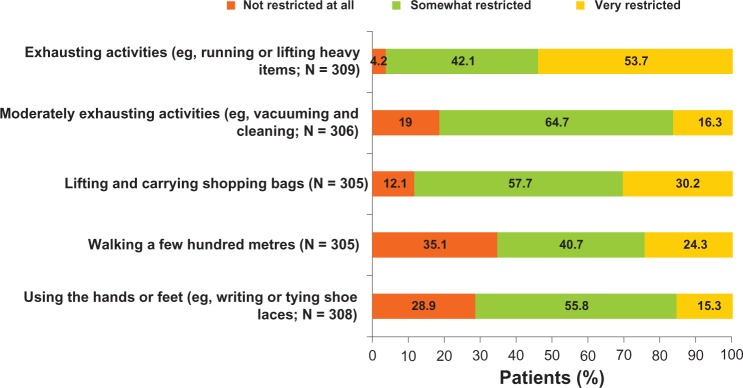
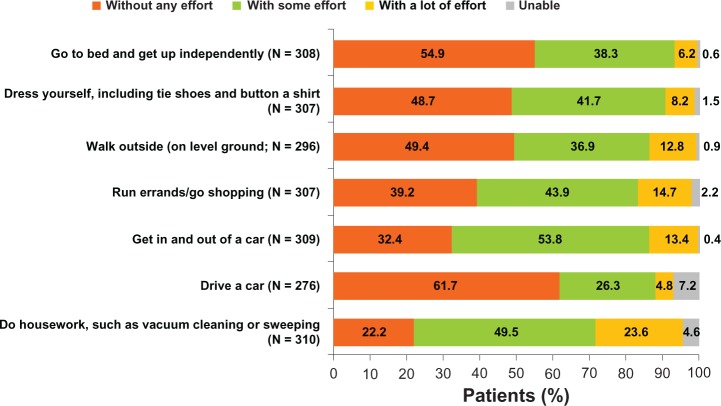
RA had a detrimental effect upon respondents' quality of life, specifically impairing their ability to perform daily tasks and causing pain/emotional distress. Independence and mobility were strong priorities for respondents. Physical therapy, provided by RL, was felt to help both physical and mental/emotional health.
开展一项包含40个问题的邮寄调查问卷,以深入了解类风湿关节炎(RA)患者所经历困难的性质,以及患者对其RA治疗的看法和优先事项。
2009年7月1日至8月20日期间,共邀请了德国下萨克森州3000名类风湿关节炎患者支持组织“风湿联盟”(RL)的成员参与。问卷分为四个部分:(1)患者人口统计学信息,(2)生活质量(QOL),(3)治疗期望,以及(4)患者对RL的看法。问卷可以书面形式或通过互联网完成。
在959名受访者中(回复率=32.0%),318人被诊断为RA并纳入分析。受访者大多已退休(71.2%),女性(83.3%),年龄>60岁(63.5%)。成员的回答表明,大多数人对当前治疗总体满意(67.3%),认为治疗有效(84.0%),且报告副作用最小(无或轻微)(61.2%)。然而,据报道患者参与治疗决策的程度较低(49.6%的人觉得参与不足)。患者的主要功能障碍反映在他们的治疗优先事项上:行动能力(97.0%)、跑腿/购物能力(97.1%)、做家务能力(95.6%)以及独立于他人的能力(94.2%)。RL提供并被受访者使用的主要服务是物理治疗(70.6%),超过90.0%的受访者报告称其对身体功能和情绪有益。
RA对受访者的生活质量有不利影响,特别是损害了他们执行日常任务的能力,并导致疼痛/情绪困扰。独立和行动能力是受访者的重要优先事项。RL提供的物理治疗被认为对身心健康都有帮助。