Metzger Florian G, Hobert Markus A, Ehlis Ann-Christine, Hasmann Sandra E, Hahn Tim, Eschweiler Gerhard W, Berg Daniela, Fallgatter Andreas J, Maetzler Walter
Department of Psychiatry and Psychotherapy, University Hospital TuebingenTuebingen, Germany; Center for Geriatric Medicine, University Hospital of TuebingenTuebingen, Germany.
Department of Neurodegenerative Diseases, Center of Neurology and Hertie Institute for Clinical Brain Research, University Hospital of TuebingenTuebingen, Germany; German Center for Neurodegenerative Diseases (DZNE), University Hospital of TuebingenTuebingen, Germany.
Front Aging Neurosci. 2016 Oct 13;8:235. doi: 10.3389/fnagi.2016.00235. eCollection 2016.
Differentiation of mild cognitive impairment from depression in elderly adults is a clinically relevant issue which is not sufficiently solved. Gait and dual task (DT) parameters may have the potential to complement current diagnostic work-up, as both dementia and depression are associated with changes of gait and DT parameters.
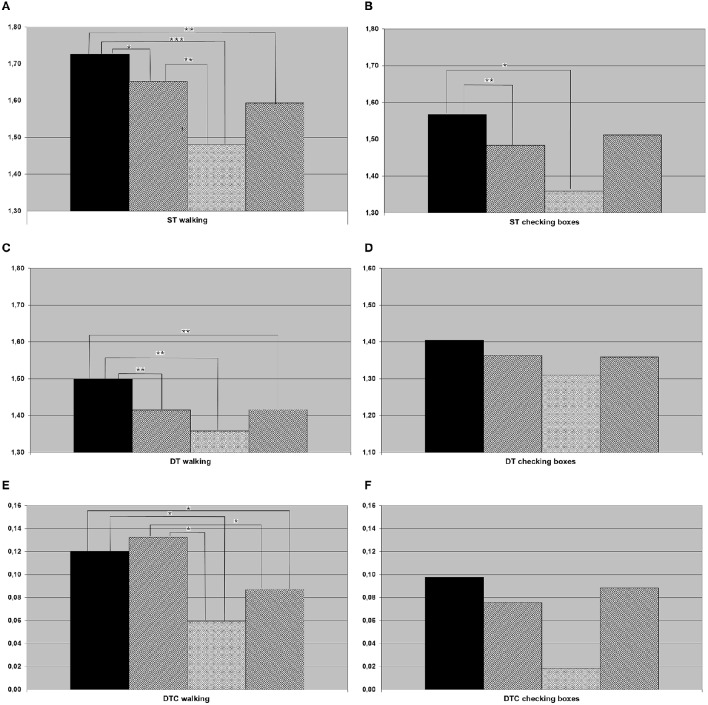
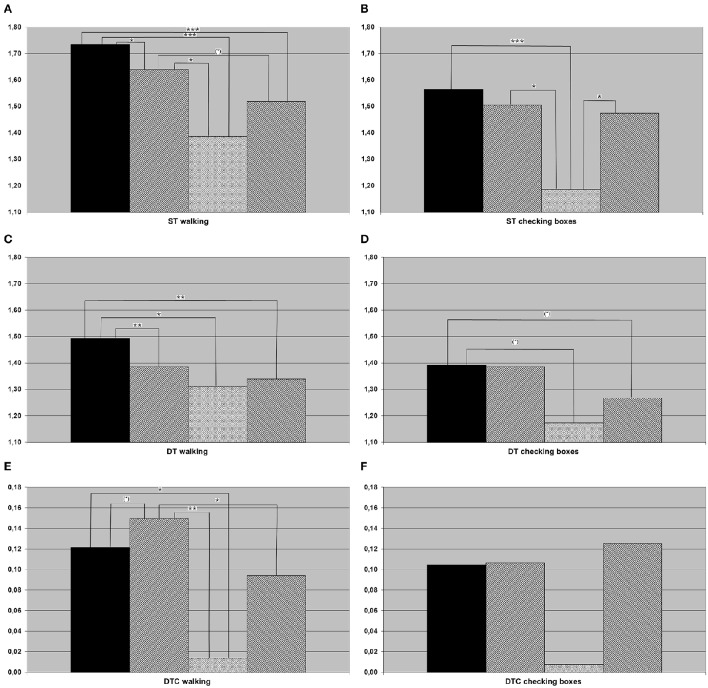
Seven hundred and four participants of the TREND study (Tübinger evaluation of Risk factors for Early detection of NeuroDegeneration) aged 50-80 years were assessed using the Consortium to Establish a Registry for Alzheimer's Disease Plus test battery for testing cognition and Beck's Depression Inventory for evaluation of depression. Based on these results, four groups were defined: acute depressed ( = 53), cognitively mildly impaired ( = 97), acute depressed, and cognitively mildly impaired ( = 15), and controls ( = 536). Participants underwent a 20 m walk and checking boxes task under single (ST) and DT conditions. ST and DT performance and dual task costs (DTC) were calculated. Due to the typical age of increasing incidence of depressive and also cognitive symptoms, the 7th decade was calculated separately.
ST speeds of gait and checking boxes, DT walking speed, and walking DTC were significantly different between groups. Healthy controls were the fastest in all paradigms and cognitively mildly impaired had higher DTC than depressed individuals. Additionally, we constructed a multivariate predictive model differentiating the groups on a single-subject level.
DT parameters are simply and comfortably measureable, and DTC can easily be determined. The combination of these parameters allows a differentiation of depressed and cognitively mildly impaired elderly adults.
区分老年人的轻度认知障碍和抑郁症是一个临床相关问题,但尚未得到充分解决。步态和双重任务(DT)参数可能有潜力补充当前的诊断检查,因为痴呆症和抑郁症都与步态和DT参数的变化有关。
对704名年龄在50 - 80岁的TREND研究(图宾根神经退行性疾病早期检测风险因素评估)参与者进行了评估,使用阿尔茨海默病注册协会加测试组合来测试认知能力,并使用贝克抑郁量表来评估抑郁情况。基于这些结果,定义了四组:急性抑郁组(n = 53)、轻度认知障碍组(n = 97)、急性抑郁且轻度认知障碍组(n = 15)和对照组(n = 536)。参与者在单任务(ST)和双重任务(DT)条件下进行了20米步行和勾选框任务。计算了ST和DT表现以及双重任务成本(DTC)。由于抑郁和认知症状发病率增加的典型年龄,对第七个十年单独进行了计算。
各组之间的步态和勾选框任务的ST速度、DT步行速度以及步行DTC存在显著差异。健康对照组在所有范式中速度最快,轻度认知障碍组的DTC高于抑郁个体。此外,我们构建了一个多变量预测模型,在个体水平上区分各组。
DT参数测量简单且舒适,DTC也能轻松确定。这些参数的组合能够区分抑郁和轻度认知障碍的老年人。