Institute of Neuroscience/Newcastle University Institute for Ageing, Clinical Ageing Research Unit, Campus for Ageing and Vitality, Newcastle University, Newcastle upon Tyne, UK.
Center for Neurology and Hertie Institute for Clinical Brain Research, Department of Neurodegenerative Diseases, University Hospital Tübingen, and Center for Neurodegenerative Diseases, Tübingen, Germany.
Ann Neurol. 2019 Sep;86(3):357-367. doi: 10.1002/ana.25548. Epub 2019 Jul 27.
Quantification of gait with wearable technology is promising; recent cross-sectional studies showed that gait characteristics are potential prodromal markers for Parkinson disease (PD). The aim of this longitudinal prospective observational study was to establish gait impairments and trajectories in the prodromal phase of PD, identifying which gait characteristics are potentially early diagnostic markers of PD.
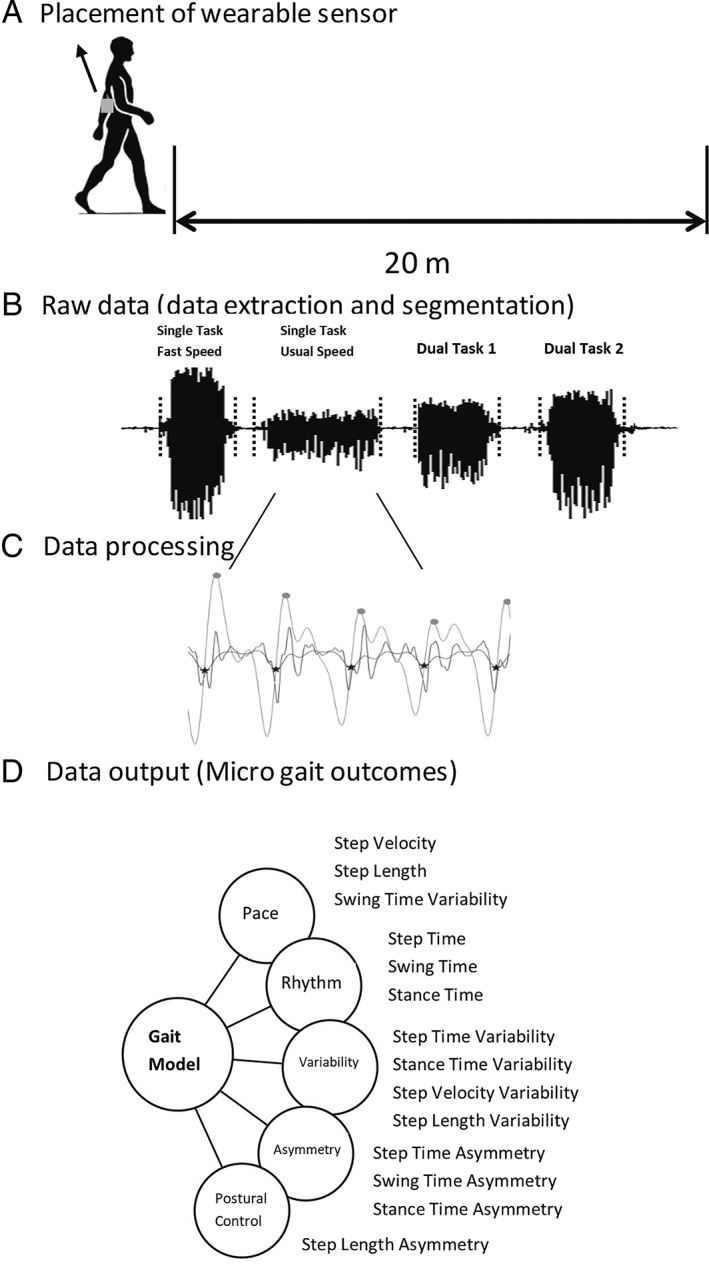
The 696 healthy controls (mean age = 63 ± 7 years) recruited in the Tubingen Evaluation of Risk Factors for Early Detection of Neurodegeneration study were included. Assessments were performed longitudinally 4 times at 2-year intervals, and people who converted to PD were identified. Participants were asked to walk at different speeds under single and dual tasking, with a wearable device placed on the lower back; 14 validated clinically relevant gait characteristics were quantified. Cox regression was used to examine whether gait at first visit could predict time to PD conversion after controlling for age and sex. Random effects linear mixed models (RELMs) were used to establish longitudinal trajectories of gait and model the latency between impaired gait and PD diagnosis.
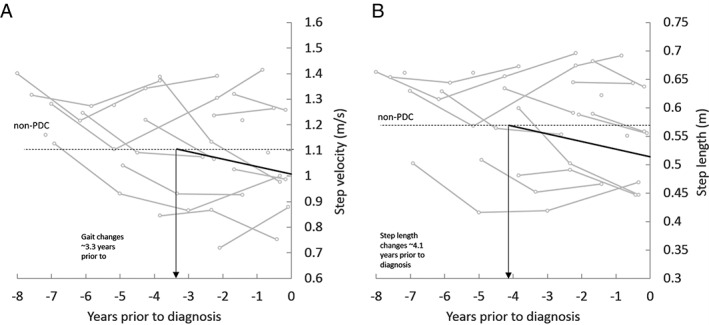
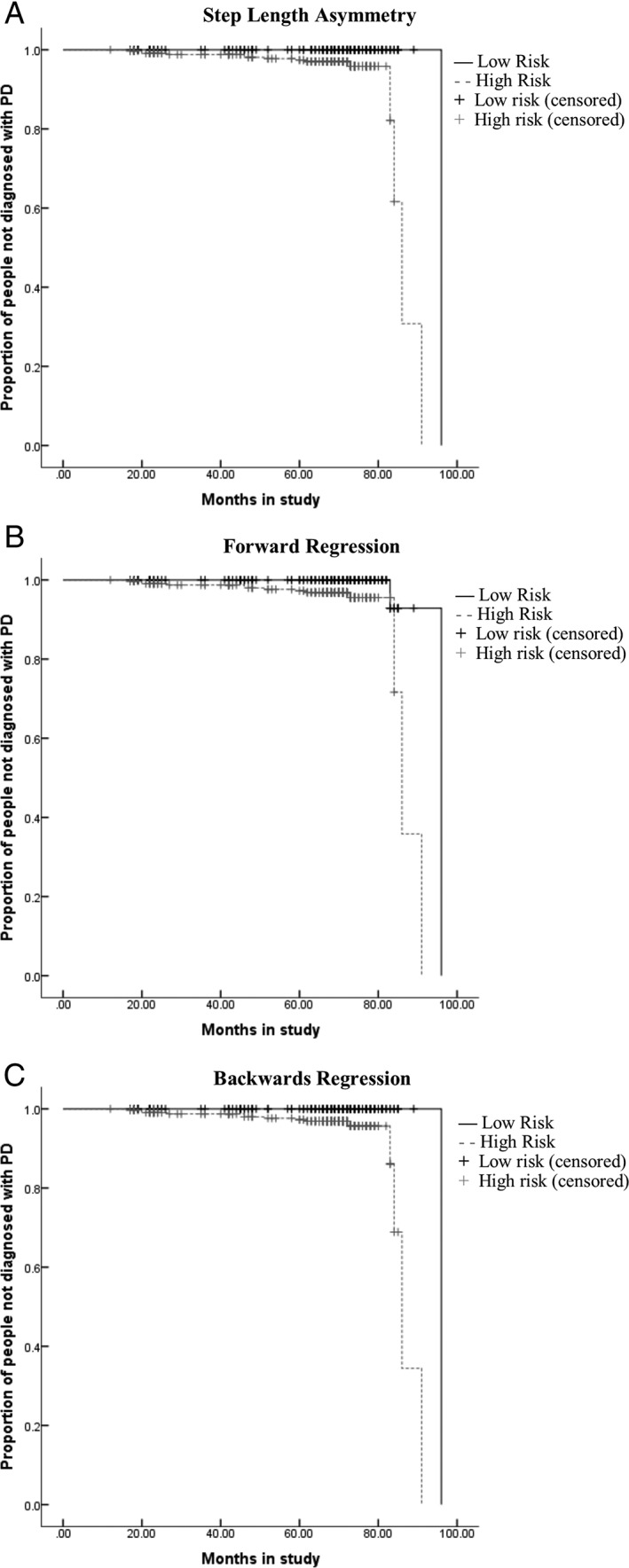
Sixteen participants were diagnosed with PD on average 4.5 years after first visit (converters; PDC). Higher step time variability and asymmetry of all gait characteristics were associated with a shorter time to PD diagnosis. RELMs indicated that gait (lower pace) deviates from that of non-PDC approximately 4 years prior to diagnosis.
Together with other prodromal markers, quantitative gait characteristics can play an important role in identifying prodromal PD and progression within this phase. ANN NEUROL 2019;86:357-367.
可穿戴技术对步态的定量分析具有广阔的前景;最近的横断面研究表明,步态特征可能是帕金森病(PD)的前驱标志物。本纵向前瞻性观察性研究的目的是在 PD 的前驱期确定步态障碍和轨迹,确定哪些步态特征可能是 PD 的早期诊断标志物。
本研究纳入了图宾根风险因素早期检测神经退行性变研究(Tubingen Evaluation of Risk Factors for Early Detection of Neurodegeneration study)中招募的 696 名健康对照者(平均年龄=63±7 岁)。评估在 2 年的时间间隔内进行了 4 次纵向评估,确定了转化为 PD 的患者。要求参与者在单任务和双任务下以不同速度行走,在下背部放置可穿戴设备;量化了 14 个经过验证的临床相关步态特征。使用 Cox 回归检验了首次就诊时的步态是否可以在控制年龄和性别后预测 PD 转化的时间。使用随机效应线性混合模型(RELMs)建立步态的纵向轨迹,并建立步态障碍与 PD 诊断之间的潜伏期模型。
平均在首次就诊后 4.5 年(转化者,PDC)诊断出 16 名参与者患有 PD。所有步态特征的步时变异性和不对称性越高,PD 诊断时间越短。RELMs 表明,步态(较低的步速)在诊断前大约 4 年就偏离了非 PDC。
定量步态特征与其他前驱标志物一起,可以在识别前驱 PD 及其在该阶段的进展中发挥重要作用。神经病学年鉴 2019;86:357-367。