van Bergenhenegouwen Jeroen, Kraneveld Aletta D, Rutten Lieke, Garssen Johan, Vos Arjan P, Hartog Anita
Nutricia Research, Utrecht, The Netherlands.
Department of Pharmacology, Utrecht Institute for Pharmaceutical Sciences, Utrecht University, Utrecht, The Netherlands.
BMC Immunol. 2016 Oct 28;17(1):42. doi: 10.1186/s12865-016-0180-x.
The small intestine is a specialized compartment were close interactions take place between host, microbes, food antigens and dietary fatty acids. Dietary fats get absorbed by epithelial cells and processed into a range of lipoprotein particles after which they are basolaterally secreted and collected in the lymphatics. In contrast to the colon, the small intestine is covered only by a thin mucus coat that allows for intimate interactions between host-cells and microbes. Lipoproteins have long been recognized as protective factors in infectious diseases via the neutralization of bacterial toxins like lipopolysaccharides. Much less attention has been given to the potential role of lipoproteins as factors contributing to the maintenance of small intestinal immune homeostasis via modulating bacteria-induced immune responses.
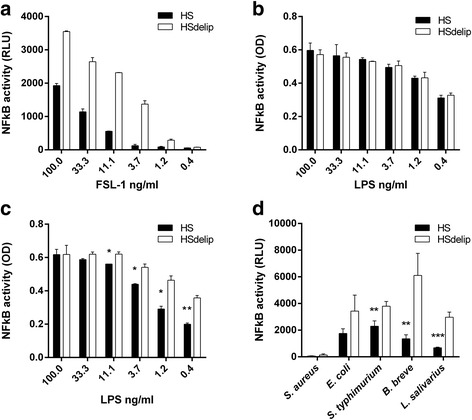
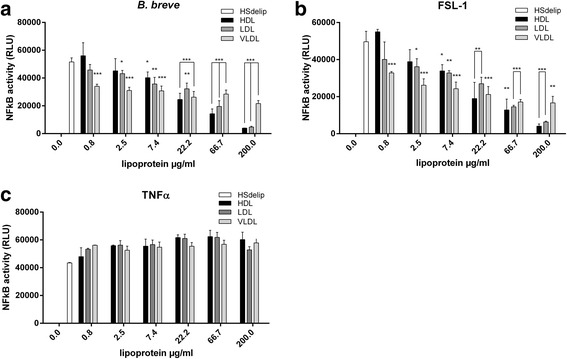
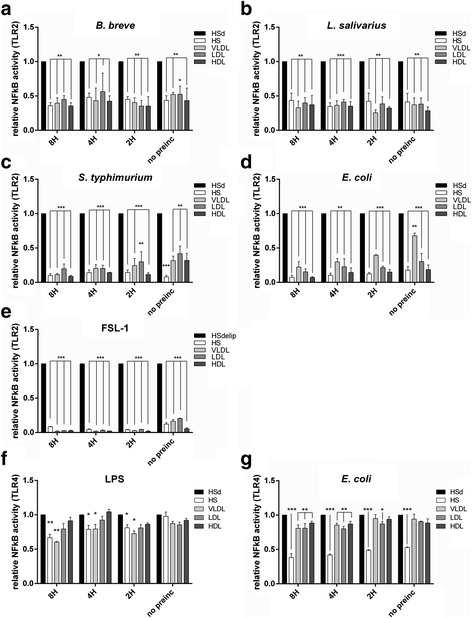
Lipoproteins VLDL, LDL and HDL were found to neutralize TLR responses towards specific TLR-ligands or a selection of gram-negative and gram-positive bacteria. Attenuation of TLR2 activity was acute and only slightly improved by longer pre-incubation times of ligands and lipoproteins with no differences between bacterial-lipopeptides or bacteria. In contrast, attenuation of TLR4 responses was only observed after extensive preincubation of lipoproteins and LPS. Preincubation of bacteria and lipoproteins led only to a modest attenuation of TLR4 activity. Moreover, compared to TLR2, TLR4 activity could only be attenuated by lipoproteins over a small ligand dose range.
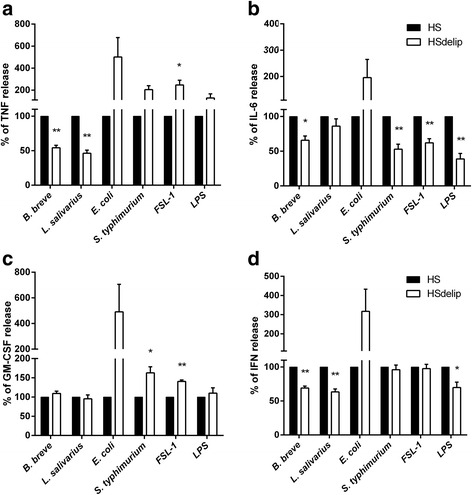
These results demonstrate the ability of lipoproteins VLDL, LDL and HDL to inhibit TLR responses towards bacterial-ligands and bacteria. Presence of lipoproteins was found to modulate the MAMP-induced cytokine release by primary human monocytes measured as changes in the release of IL-6, TNFα, GM-CSF and IFNγ. Using TLR2 and TLR4-reporter cells, lipoproteins were found to inhibit TLR responses with differences in affinity and kinetics. These data establish a role for lipoproteins as immunoregulatory molecules, attenuating TLR-responses and thereby positively contributing to mucosal homeostasis.
小肠是一个特殊的腔室,宿主、微生物、食物抗原和膳食脂肪酸之间会在此发生密切相互作用。膳食脂肪被上皮细胞吸收,并加工成一系列脂蛋白颗粒,然后从基底外侧分泌并收集到淋巴管中。与结肠不同,小肠仅覆盖一层薄的黏液层,这使得宿主细胞与微生物之间能够进行密切相互作用。长期以来,脂蛋白一直被认为是传染病中的保护因子,可中和脂多糖等细菌毒素。然而,脂蛋白作为通过调节细菌诱导的免疫反应来维持小肠免疫稳态的因子,其潜在作用却很少受到关注。
发现极低密度脂蛋白(VLDL)、低密度脂蛋白(LDL)和高密度脂蛋白(HDL)可中和针对特定Toll样受体(TLR)配体或一系列革兰氏阴性菌和革兰氏阳性菌的TLR反应。TLR2活性的减弱是急性的,延长配体与脂蛋白的预孵育时间仅能使其略有改善,细菌脂肽或细菌之间无差异。相比之下,仅在脂蛋白与脂多糖(LPS)进行长时间预孵育后,才观察到TLR4反应的减弱。细菌与脂蛋白的预孵育仅导致TLR4活性适度减弱。此外,与TLR2相比,仅在较小的配体剂量范围内,脂蛋白才能减弱TLR4活性。
这些结果表明,VLDL、LDL和HDL能够抑制TLR对细菌配体和细菌的反应。发现脂蛋白的存在可调节原代人单核细胞由微生物相关分子模式(MAMP)诱导的细胞因子释放,通过白细胞介素-6(IL-6)、肿瘤坏死因子α(TNFα)、粒细胞-巨噬细胞集落刺激因子(GM-CSF)和干扰素γ(IFNγ)释放的变化来衡量。使用TLR2和TLR4报告细胞,发现脂蛋白可抑制TLR反应,且在亲和力和动力学方面存在差异。这些数据确立了脂蛋白作为免疫调节分子的作用,减弱TLR反应,从而对黏膜稳态产生积极影响。