Wu Wenwen, Chen Xi, Liu Xiaohan, Liu Chengyuan, Lu Gendi
Department of Cardiothoracic Surgery, Changzheng Hospital, Second Military Medical University, Shanghai, China (mainland).
Department of Nursing, Changzheng Hospital, Second Military Medical University, Shanghai, China (mainland).
Med Sci Monit. 2016 Oct 30;22:4100-4106. doi: 10.12659/msm.896736.
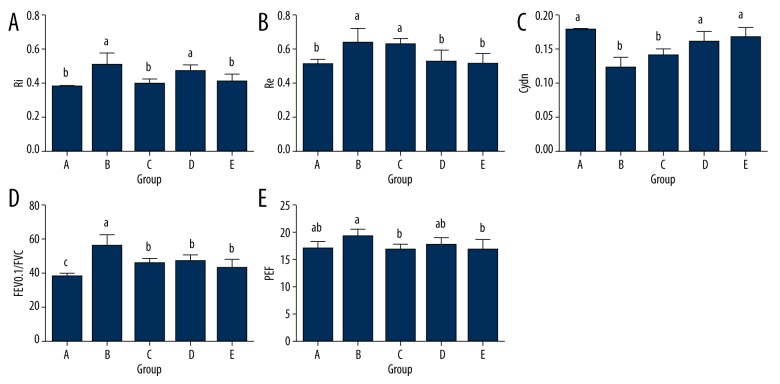
BACKGROUND Chronic obstructive pulmonary disease (COPD) is a serious lung disease that severely threatens people's health. This study aimed to investigate the effects of heliox-driven nebulization (HDN) on lung function and arterial blood gases in a COPD rat model. MATERIAL AND METHODS Twelve healthy male Wistar rats were selected as controls and 34 rats were used to establish a COPD model induced by lipopolysaccharide. Then 6 rats each from the control and model groups were selected for their symptoms to be observed. The remaining 6 normal rats were used as control group (group A) and the remaining 28 experimental COPD rats were randomly assigned to 4 groups: experimental COPD group (group B), medical oxygen group (group C), and heliox groups (group D, He/O2=63%/37%; group E, He/O2=71%/29%). The lung function indicators and arterial blood gases were analyzed to evaluate the effects of different driving gases on COPD rats. RESULTS The COPD model was successfully established with slow growth and severe lung dysfunction. Inspiratory resistance, expiratory resistance, and forced expiratory volume at 0.10 s (FEV0.10)/FVC were significantly decreased, whereas dynamic lung compliance was significantly increased in groups D and E, compared with the experimental COPD group (group B; P<0.05). Meanwhile, compared with the model group, the values of partial pressure of carbon dioxide in arterial blood were significantly higher, whereas the potential of hydrogen values were significantly lower after atomization in groups C and D but not in group E (P<0.05). The obvious increase in arterial oxygen saturation was found only in group E (P<0.05). CONCLUSIONS HDN improved the lung function and arterial blood gas analysis results in experimental COPD rats, with an optimal percentage of He/O2=71%/29%.
背景 慢性阻塞性肺疾病(COPD)是一种严重威胁人类健康的肺部疾病。本研究旨在探讨氦氧混合气驱动雾化(HDN)对COPD大鼠模型肺功能和动脉血气的影响。
材料与方法 选取12只健康雄性Wistar大鼠作为对照组,34只大鼠用于建立脂多糖诱导的COPD模型。然后从对照组和模型组中各选取6只大鼠观察其症状。其余6只正常大鼠作为对照组(A组),其余28只实验性COPD大鼠随机分为4组:实验性COPD组(B组)、医用氧气组(C组)和氦氧混合气组(D组,He/O2 = 63%/37%;E组,He/O2 = 71%/29%)。分析肺功能指标和动脉血气,以评估不同驱动气体对COPD大鼠的影响。
结果 成功建立了生长缓慢且伴有严重肺功能障碍的COPD模型。与实验性COPD组(B组)相比,D组和E组的吸气阻力、呼气阻力和0.10秒用力呼气量(FEV0.10)/用力肺活量(FVC)显著降低,而动态肺顺应性显著增加(P<0.05)。同时,与模型组相比,C组和D组雾化后动脉血二氧化碳分压值显著升高,而氢离子浓度值显著降低,但E组未出现此情况(P<0.05)。仅E组动脉血氧饱和度明显升高(P<0.05)。
结论 HDN改善了实验性COPD大鼠的肺功能和动脉血气分析结果,He/O2的最佳比例为71%/29%。