Millstein Rachel A, Celano Christopher M, Beale Eleanor E, Beach Scott R, Suarez Laura, Belcher Arianna M, Januzzi James L, Huffman Jeff C
Harvard Medical School, 55 Fruit St., Boston, MA 02114, USA; Department of Psychiatry, Massachusetts General Hospital, 55 Fruit St., Boston, MA 02114, USA.
Harvard Medical School, 55 Fruit St., Boston, MA 02114, USA; Department of Psychiatry, Massachusetts General Hospital, 55 Fruit St., Boston, MA 02114, USA.
Gen Hosp Psychiatry. 2016 Nov-Dec;43:17-22. doi: 10.1016/j.genhosppsych.2016.08.006. Epub 2016 Aug 30.
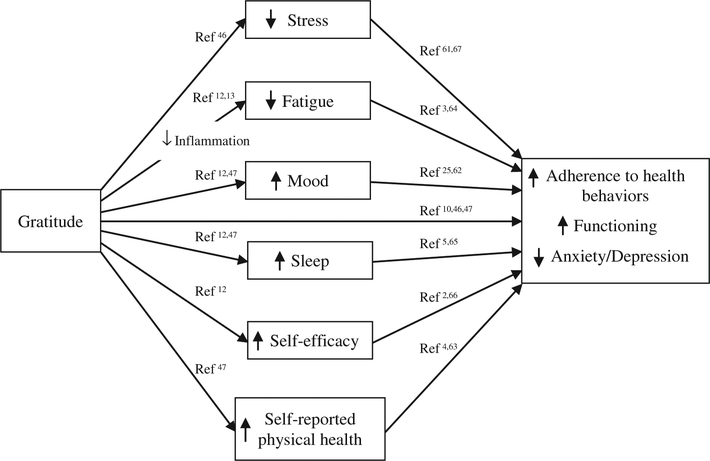
This study examined the effects of optimism and gratitude on self-reported health behavior adherence, physical functioning and emotional well-being after an acute coronary syndrome (ACS).
Among 156 patients, we examined associations between optimism and gratitude measured 2 weeks post-ACS and 6-month outcomes: adherence to medical recommendations, mental and physical health-related quality of life (HRQoL), physical functioning, depressive symptoms and anxiety. Multivariable linear regression models were used, controlling for increasing levels of adjustment.
Optimism [β=.11, standard error (S.E.)=.05, P=.038] and gratitude (β=.10, S.E.=.05, P=.027) at 2 weeks were associated with subsequent self-reported adherence to medical recommendations (diet, exercise, medication adherence, stress reduction) at 6 months in fully adjusted models. Two-week optimism and gratitude were associated with improvements in mental HRQoL (optimism: β=.44, S.E.=.13, P=.001; gratitude: β=.33, S.E.=.12, P=.005) and reductions in symptoms of depression (optimism: β=-.11, S.E.=.05, P=.039; gratitude: β=-.10, S.E.=.05, P=.028) and anxiety (optimism: β=-.15, S.E.=.05, P=.004; gratitude: β=-.10, S.E.=.05, P=.034) at 6 months.
Optimism and gratitude at 2 weeks post-ACS were associated with higher self-reported adherence and improved emotional well-being 6 months later, independent of negative emotional states. Optimism and gratitude may help recovery from an ACS. Interventions promoting these positive constructs could help improve adherence and well-being.
本研究探讨了乐观和感恩对急性冠状动脉综合征(ACS)后自我报告的健康行为依从性、身体功能和情绪健康的影响。
在156例患者中,我们研究了ACS后2周测量的乐观和感恩与6个月结局之间的关联:对医疗建议的依从性、与身心健康相关的生活质量(HRQoL)、身体功能、抑郁症状和焦虑。使用多变量线性回归模型,并控制调整水平的增加。
在完全调整的模型中,2周时的乐观情绪(β = 0.11,标准误(S.E.)= 0.05,P = 0.038)和感恩情绪(β = 0.10,S.E. = 0.05,P = 0.027)与6个月后自我报告的对医疗建议(饮食、运动、药物依从性、减压)的依从性相关。2周时的乐观和感恩与心理HRQoL的改善(乐观:β = 0.44,S.E. = 0.13,P = 0.001;感恩:β = 0.33,S.E. = 0.12,P = 0.005)以及6个月时抑郁症状(乐观:β = -0.11,S.E. = 0.05,P = 0.039;感恩:β = -0.10,S.E. = 0.05,P = 0.028)和焦虑症状(乐观:β = -0.15,S.E. = 0.05,P = 0.004;感恩:β = -0.10,S.E. = 0.05,P = 0.034)的减轻相关。
ACS后2周的乐观和感恩与6个月后更高的自我报告依从性和改善的情绪健康相关,与负面情绪状态无关。乐观和感恩可能有助于从ACS中恢复。促进这些积极因素的干预措施可能有助于提高依从性和幸福感。