Tomova L, Majdandžic J, Hummer A, Windischberger C, Heinrichs M, Lamm C
Social, Cognitive and Affective Neuroscience Unit, Department of Basic Psychological Research and Research Methods, Faculty of Psychology, University of Vienna, Vienna, Austria.
Institute of Normal and Pathological Physiology, Slovak Academy of Sciences, Bratislava, Slovakia.
Soc Cogn Affect Neurosci. 2017 Mar 1;12(3):401-408. doi: 10.1093/scan/nsw146.
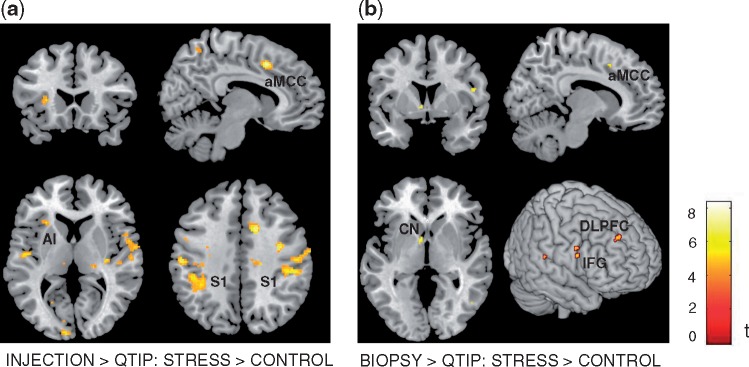
Recent behavioral investigations suggest that acute stress can increase prosocial behavior. Here, we investigated whether increased empathy represents a potential mechanism for this finding. Using functional magnetic resonance imaging, we assessed the effects of acute stress on neural responses related to automatic and regulatory components of empathy for pain as well as subsequent prosocial behavior. Stress increased activation in brain areas associated with the automatic sharing of others' pain, such as the anterior insula, the anterior midcingulate cortex, and the primary somatosensory cortex. In addition, we found increased prosocial behavior under stress. Furthermore, activation in the anterior midcingulate cortex mediated the effects of stress on prosocial behavior. However, stressed participants also displayed stronger and inappropriate other-related responses in situations which required them to take the perspective of another person, and to regulate their automatic affective responses. Thus, while acute stress may increase prosocial behavior by intensifying the sharing of others' emotions, this comes at the cost of reduced cognitive appraisal abilities. Depending on the contextual constraints, stress may therefore affect empathy in ways that are either beneficial or detrimental.
近期的行为学研究表明,急性应激能够增加亲社会行为。在此,我们探究了同理心增强是否是这一发现的潜在机制。通过功能磁共振成像,我们评估了急性应激对与疼痛同理心的自动和调节成分相关的神经反应以及随后的亲社会行为的影响。应激增加了与他人疼痛自动共享相关的脑区的激活,如前脑岛、前扣带回中部皮质和初级体感皮层。此外,我们发现应激状态下亲社会行为增加。而且,前扣带回中部皮质的激活介导了应激对亲社会行为的影响。然而,处于应激状态的参与者在需要他们从他人角度看待问题并调节自身自动情感反应的情境中,也表现出更强烈且不适当的与他人相关的反应。因此,虽然急性应激可能通过强化对他人情绪的共享来增加亲社会行为,但这是以认知评估能力下降为代价的。因此,根据情境限制,应激可能以有益或有害的方式影响同理心。