Chung Chungwon J, Cha Sang-Ho, Grimm Amanda L, Chung Grace, Gibson Kathleen A, Yoon Kyoung-Jin, Parish Steven M, Ho Chak-Sum, Lee Stephen S
VMRD Inc., Pullman, WA 99163, United States of America.
Department of Veterinary Microbiology and Pathology, Washington State University, Pullman, WA 99163, United States of America.
PLoS One. 2016 Oct 31;11(10):e0165450. doi: 10.1371/journal.pone.0165450. eCollection 2016.
BACKGROUND/AIM: Live attenuated vaccines confer partial protection in pigs before the appearance of neutralizing antibodies, suggesting the contribution of cell-mediated immunity (CMI). However, PRRSV-specific T-lymphocyte responses and protective mechanisms need to be further defined. To this end, the hypothesis was tested that PRRSV-specific T-lymphocytes induced by exposure to type-2 PRRSV can recognize diverse isolates.
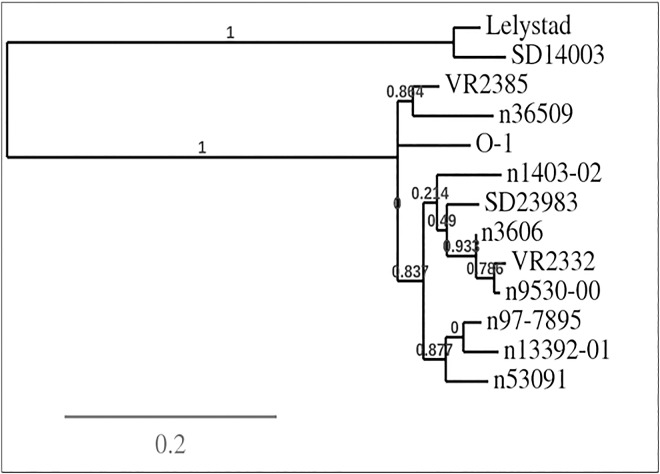
An IFN-gamma ELISpot assay was used to enumerate PRRSV-specific T-lymphocytes from PRRSVSD23983-infected gilts and piglets born after in utero infection against 12 serologically and genetically distinct type-1 and -2 PRRSV isolates. The IFN-gamma ELISpot assay using synthetic peptides spanning all open reading frames of PRRSVSD23983 was utilized to localize epitopes recognized by T-lymphocytes. Virus neutralization tests were carried out using the challenge strain (type-2 PRRSVSD23983) and another strain (type-2 PRRSVVR2332) with high genetic similarity to evaluate cross-reactivity of neutralizing antibodies in gilts after PRRSVSD23983 infection.
At 72 days post infection, T-lymphocytes from one of three PRRSVSD23983-infected gilts recognized all 12 diverse PRRSV isolates, while T-lymphocytes from the other two gilts recognized all but one isolate. Furthermore, five of nine 14-day-old piglets infected in utero with PRRSVSD23983 had broadly reactive T-lymphocytes, including one piglet that recognized all 12 isolates. Overlapping peptides encompassing all open reading frames of PRRSVSD23983 were used to identify ≥28 peptides with T-lymphocyte epitopes from 10 viral proteins. This included one peptide from the M protein that was recognized by T-lymphocytes from all three gilts representing two completely mismatched MHC haplotypes. In contrast to the broadly reactive T-lymphocytes, neutralizing antibody responses were specific to the infecting PRRSVSD23983 isolate.
These results demonstrated that T-lymphocytes recognizing antigenically and genetically diverse isolates were induced by infection with a type 2 PRRSV strain (SD23983). If these reponses have cytotoxic or other protective functions, they may help overcome the suboptimal heterologous protection conferred by conventional vaccines.
背景/目的:减毒活疫苗在猪体内中和抗体出现之前就能提供部分保护,这表明细胞介导免疫(CMI)发挥了作用。然而,猪繁殖与呼吸综合征病毒(PRRSV)特异性T淋巴细胞反应及保护机制仍需进一步明确。为此,我们验证了如下假设:暴露于2型PRRSV所诱导的PRRSV特异性T淋巴细胞能够识别多种毒株。
采用γ-干扰素酶联免疫斑点分析(IFN-γ ELISpot分析),从感染PRRSV SD23983的后备母猪以及子宫内感染后出生的仔猪体内,计数针对12种血清学和基因不同的1型及2型PRRSV毒株的PRRSV特异性T淋巴细胞。利用覆盖PRRSV SD23983所有开放阅读框的合成肽进行IFN-γ ELISpot分析,以定位T淋巴细胞识别的表位。使用攻毒株(2型PRRSV SD23983)和另一种具有高度基因相似性的毒株(2型PRRSV VR2332)进行病毒中和试验,以评估PRRSV SD23983感染后备母猪体内中和抗体的交叉反应性。
感染后72天,三只感染PRRSV SD23983的后备母猪中,有一只的T淋巴细胞识别所有12种不同的PRRSV毒株,而另外两只后备母猪的T淋巴细胞除一种毒株外识别所有其他毒株。此外,九只子宫内感染PRRSV SD23983的14日龄仔猪中有五只具有广泛反应性的T淋巴细胞,其中一只仔猪识别所有12种毒株。使用覆盖PRRSV SD23983所有开放阅读框的重叠肽,从10种病毒蛋白中鉴定出≥28种具有T淋巴细胞表位的肽。其中包括来自M蛋白的一种肽段,代表两种完全不匹配MHC单倍型的所有三只后备母猪的T淋巴细胞均可识别该肽段。与广泛反应性的T淋巴细胞不同,中和抗体反应具有针对感染的PRRSV SD23983毒株的特异性。
这些结果表明,感染2型PRRSV毒株(SD23983)可诱导识别抗原性和基因不同毒株的T淋巴细胞。如果这些反应具有细胞毒性或其他保护功能,它们可能有助于克服传统疫苗所提供的次优异源保护。