Department of Veterinary Microbiology and Pathology, Washington State University, Pullman, Washington, United States of America.
VMRD Inc., Pullman, Washington, United States of America.
PLoS One. 2018 Sep 6;13(9):e0203482. doi: 10.1371/journal.pone.0203482. eCollection 2018.
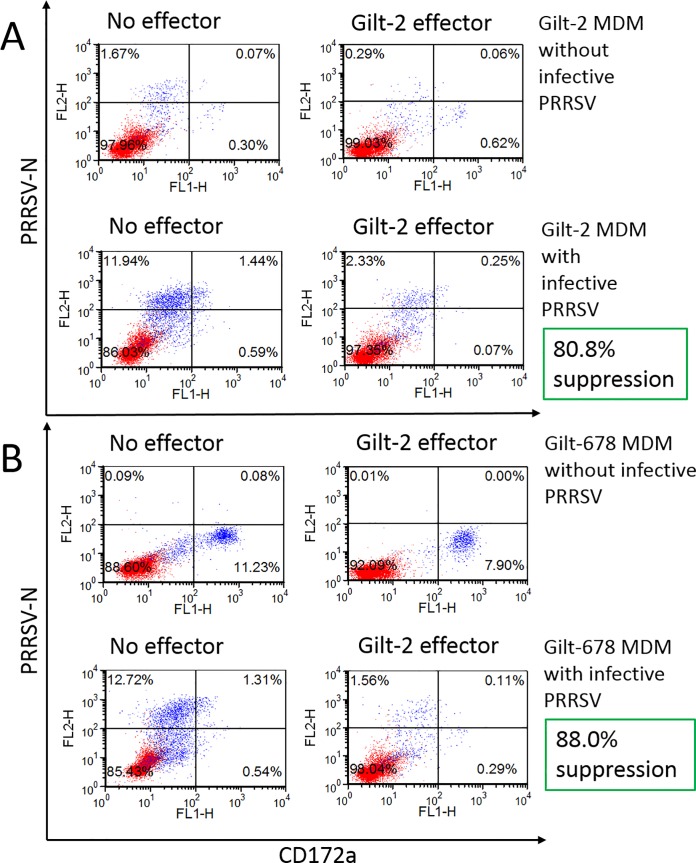
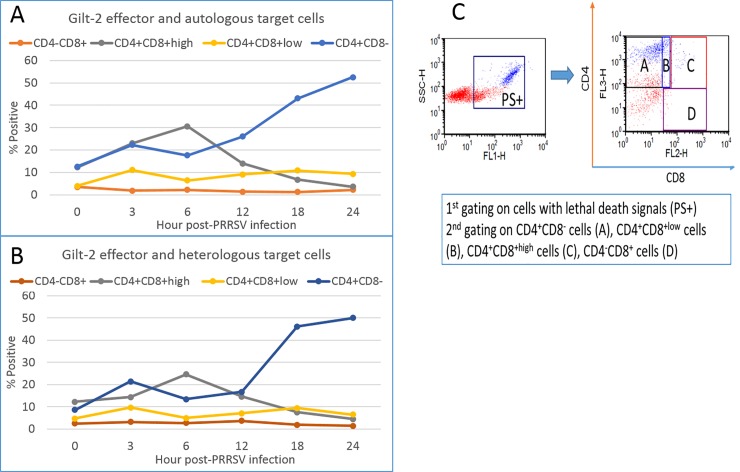
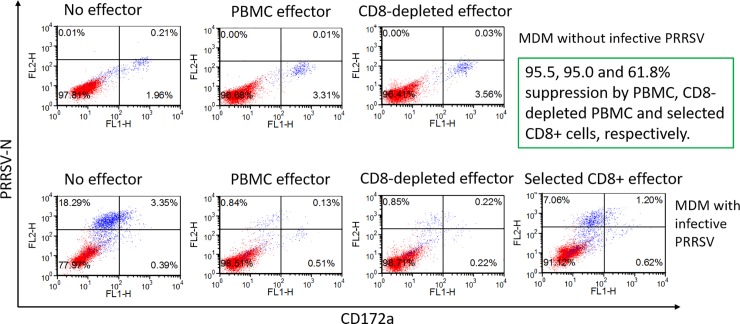
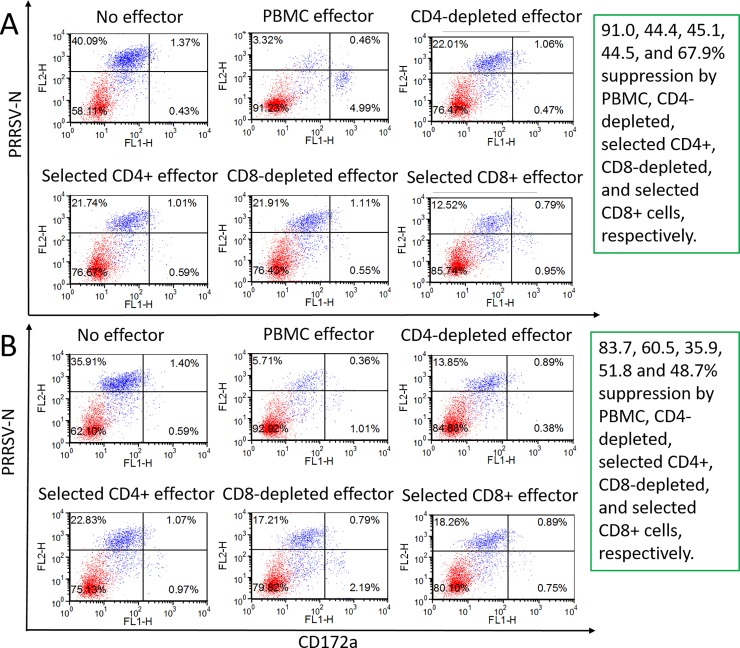
Porcine reproductive and respiratory syndrome virus (PRRSV) infection is difficult to control because the virus undergoes antigenic variation during infection and also modulates the protective host immune response. Although current vaccines do not provide full protection, they have provided insight into the mechanisms of protection. Live PRRSV vaccines induce partial protection before the appearance of neutralizing antibody, suggesting cell-mediated immunity or other mechanisms may be involved. Herein, we demonstrate recovery from infection is associated with development of cytotoxic T-lymphocytes (CTL) that can kill PRRSV-infected target cells. Initial experiments showed survival of PRRSV-infected monocyte derived macrophage (MDM) targets is reduced when overlaid with peripheral blood mononuclear cells (PBMC) from gilts that had recovered from PRRSV infection. Further studies with PBMC depleted of either CD4+ or CD8+ T-cells and positively selected subpopulations of CD4+ and CD8+ T-cells showed that both CD4+ and CD8+ T-cells were involved in killing. Examination of killing at different time points revealed killing was biphasic and mediated by CTL of different phenotypes. CD4+CD8+high were associated with killing target cells infected for 3-6 hours. CD4+CD8- CTL were associated with killing at 16-24 hours. Thus, all the anti-PRRSV CTL activity in pigs was attributed to two phenotypes of CD4+ cells which is different from the anti-viral CD4-CD8+ CTL phenotype found in most other animals. These findings will be useful for evaluating CTL responses induced by current and future vaccines, guiding to a novel direction for future vaccine development.
猪繁殖与呼吸综合征病毒(PRRSV)感染难以控制,因为病毒在感染过程中会发生抗原变异,并且还会调节保护性宿主免疫反应。尽管目前的疫苗不能提供完全的保护,但它们为保护机制提供了深入的了解。活 PRRSV 疫苗在中和抗体出现之前诱导部分保护,这表明细胞介导的免疫或其他机制可能参与其中。在此,我们证明从感染中恢复与细胞毒性 T 淋巴细胞(CTL)的发展有关,这些 CTL 可以杀死 PRRSV 感染的靶细胞。最初的实验表明,当用从 PRRSV 感染中恢复的母猪的外周血单核细胞(PBMC)覆盖 PRRSV 感染的单核细胞衍生的巨噬细胞(MDM)靶标时,靶标的存活率降低。用 PBMC 耗尽 CD4+或 CD8+T 细胞并对 CD4+和 CD8+T 细胞的阳性选择亚群进行进一步研究表明,CD4+和 CD8+T 细胞均参与杀伤。对不同时间点的杀伤进行检查表明,杀伤呈双相,由不同表型的 CTL 介导。CD4+CD8+高与感染后 3-6 小时的靶细胞杀伤有关。CD4+CD8-CTL 与 16-24 小时的杀伤有关。因此,猪中所有抗 PRRSV CTL 活性都归因于两种 CD4+细胞表型,这与在大多数其他动物中发现的抗病毒 CD4-CD8+CTL 表型不同。这些发现将有助于评估当前和未来疫苗引起的 CTL 反应,并为未来疫苗的开发提供新的方向。