Pathak Medha M, Tran Truc, Hong Liang, Joós Béla, Morris Catherine E, Tombola Francesco
Department of Physiology and Biophysics, University of California, Irvine, CA 92697.
Department of Physics, University of Ottawa, Ottawa, Ontario K1N 6N5, Canada.
J Gen Physiol. 2016 Nov;148(5):405-418. doi: 10.1085/jgp.201611672. Epub 2016 Oct 17.
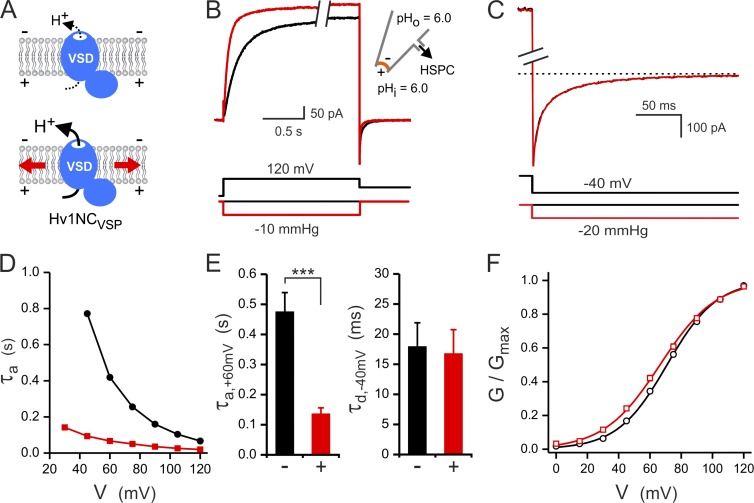
The voltage-gated proton channel, Hv1, is expressed in tissues throughout the body and plays important roles in pH homeostasis and regulation of NADPH oxidase. Hv1 operates in membrane compartments that experience strong mechanical forces under physiological or pathological conditions. In microglia, for example, Hv1 activity is potentiated by cell swelling and causes an increase in brain damage after stroke. The channel complex consists of two proton-permeable voltage-sensing domains (VSDs) linked by a cytoplasmic coiled-coil domain. Here, we report that these VSDs directly respond to mechanical stimuli. We find that membrane stretch facilitates Hv1 channel opening by increasing the rate of activation and shifting the steady-state activation curve to less depolarized potentials. In the presence of a transmembrane pH gradient, membrane stretch alone opens the channel without the need for strong depolarizations. The effect of membrane stretch persists for several minutes after the mechanical stimulus is turned off, suggesting that the channel switches to a "facilitated" mode in which opening occurs more readily and then slowly reverts to the normal mode observed in the absence of membrane stretch. Conductance simulations with a six-state model recapitulate all the features of the channel's response to mechanical stimulation. Hv1 mechanosensitivity thus provides a mechanistic link between channel activation in microglia and brain damage after stroke.
电压门控质子通道Hv1在全身各组织中均有表达,在pH稳态和NADPH氧化酶的调节中发挥重要作用。Hv1在生理或病理条件下会受到强大机械力作用的膜区室中发挥作用。例如,在小胶质细胞中,细胞肿胀会增强Hv1的活性,并导致中风后脑损伤增加。该通道复合体由两个通过胞质卷曲螺旋结构域相连的质子通透电压感应结构域(VSD)组成。在此,我们报告这些VSD可直接响应机械刺激。我们发现膜拉伸通过提高激活速率并将稳态激活曲线向去极化程度较低的电位移动来促进Hv1通道开放。在存在跨膜pH梯度的情况下,仅膜拉伸就能打开通道,而无需强去极化。机械刺激关闭后,膜拉伸的影响会持续几分钟,这表明通道会切换到一种“易化”模式,在此模式下通道更容易打开,然后缓慢恢复到在无膜拉伸情况下观察到的正常模式。用六态模型进行的电导模拟概括了通道对机械刺激响应的所有特征。因此,Hv1的机械敏感性在小胶质细胞中的通道激活与中风后脑损伤之间提供了一种机制联系。