Kravitz-Wirtz Nicole
University of Washington, Seattle, WA, USA
J Health Soc Behav. 2016 Dec;57(4):453-470. doi: 10.1177/0022146516671568. Epub 2016 Oct 31.
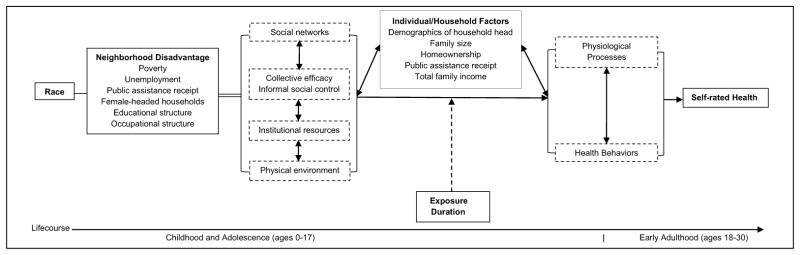
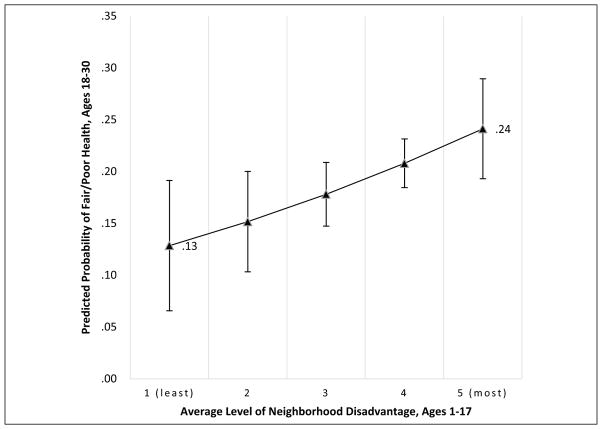
Evidence suggests that living in a socioeconomically deprived neighborhood is associated with worse health. Yet most research relies on cross-sectional data, which implicitly ignore variation in longer-term exposure that may be more consequential for health. Using data from the 1970 to 2011 waves of the Panel Study of Income Dynamics merged with census data on respondents' neighborhoods (N = 1,757), this study estimates a marginal structural model with inverse probability of treatment and censoring weights to examine: (1) whether cumulative exposure to neighborhood disadvantage from birth through age 17 affects self-rated health in early adulthood, and (2) the extent to which variation in such exposure helps to explain racial disparities therein. Findings reveal that prolonged exposure to neighborhood disadvantage throughout childhood and adolescence is strikingly more common among nonwhite versus white respondents and is associated with significantly greater odds of experiencing an incidence of fair or poor health in early adulthood.
有证据表明,生活在社会经济条件差的社区与健康状况较差有关。然而,大多数研究依赖于横断面数据,这些数据隐含地忽略了长期暴露的差异,而这种差异可能对健康更为重要。本研究使用1970年至2011年《收入动态面板研究》的数据,并与受访者社区的人口普查数据合并(N = 1,757),估计了一个具有治疗逆概率和审查权重的边际结构模型,以检验:(1)从出生到17岁期间社区劣势的累积暴露是否会影响成年早期的自评健康,以及(2)这种暴露的差异在多大程度上有助于解释其中的种族差异。研究结果表明,在整个童年和青少年时期长期暴露于社区劣势在非白人受访者中比白人受访者更为常见,并且与成年早期健康状况为“一般”或“较差”的发生率显著更高有关。