Das Ipsita, Jagger Pamela, Yeatts Karin
Department of Public Policy, University of North Carolina at Chapel Hill (UNC-CH), Campus Box #3435, Abernethy Hall, Chapel Hill, NC, 27599-3435, USA.
Curriculum for the Environment and Ecology, UNC-CH, Campus Box #3435, Abernethy Hall, Chapel Hill, NC, USA.
Ecohealth. 2017 Mar;14(1):7-19. doi: 10.1007/s10393-016-1190-0. Epub 2016 Oct 31.
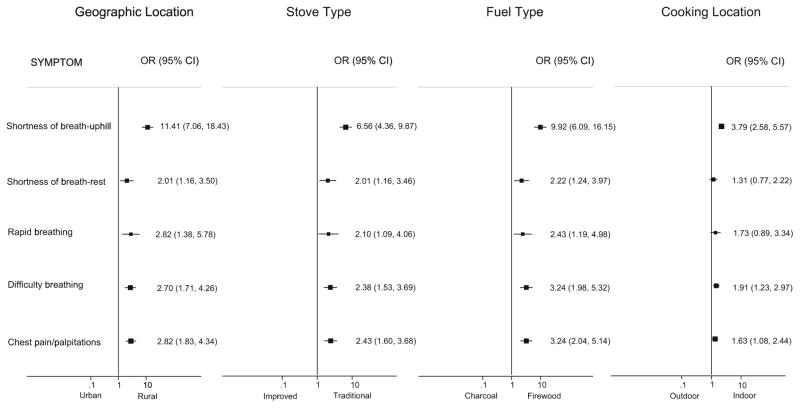
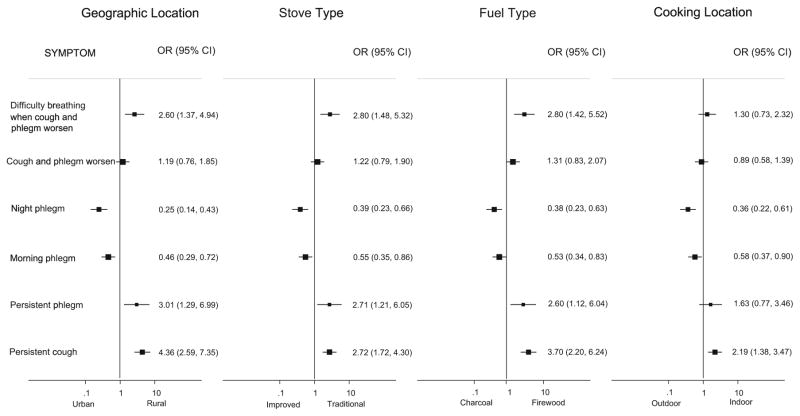
In sub-Saharan Africa, biomass fuels account for approximately 90% of household energy consumption. Limited evidence exists on the association between different biomass fuels and health outcomes. We report results from a cross-sectional sample of 655 households in Malawi. We calculated odds ratios between hypothesized determinants of household air pollution (HAP) exposure (fuel, stove type, and cooking location) and five categories of health outcomes (cardiopulmonary, respiratory, neurologic, eye health, and burns). Reliance on high- or low-quality firewood or crop residue (vs. charcoal) was associated with significantly higher odds of shortness of breath, difficulty breathing, chest pains, night phlegm, forgetfulness, dizziness, and dry irritated eyes. Use of high-quality firewood was associated with significantly lower odds of persistent phlegm. Cooks in rural areas (vs. urban areas) had significantly higher odds of experiencing shortness of breath, persistent cough, and phlegm, but significantly lower odds of phlegm, forgetfulness, and burns. With deforestation and population pressures increasing reliance on low-quality biomass fuels, prevalence of HAP-related cardiopulmonary and neurologic symptoms will likely increase among cooks. Short- to medium-term strategies are needed to secure access to high-quality biomass fuels given limited potential for scalable transitions to modern energy.
在撒哈拉以南非洲地区,生物质燃料约占家庭能源消耗的90%。关于不同生物质燃料与健康结果之间的关联,现有证据有限。我们报告了马拉维655户家庭横断面样本的研究结果。我们计算了家庭空气污染(HAP)暴露的假设决定因素(燃料、炉灶类型和烹饪地点)与五类健康结果(心肺、呼吸、神经、眼部健康和烧伤)之间的比值比。依赖高质量或低质量柴火或作物残渣(与木炭相比)与呼吸急促、呼吸困难、胸痛、夜间咳痰、健忘、头晕和眼睛干涩刺痛的几率显著更高有关。使用高质量柴火与持续性咳痰的几率显著更低有关。农村地区(与城市地区相比)的厨师出现呼吸急促、持续性咳嗽和咳痰的几率显著更高,但出现咳痰、健忘和烧伤的几率显著更低。随着森林砍伐和人口压力导致对低质量生物质燃料的依赖增加,厨师中与HAP相关的心肺和神经症状的患病率可能会上升。鉴于向现代能源进行可扩展转型的潜力有限,需要采取短期至中期战略来确保获得高质量生物质燃料。