Josyula Sowmya, Lin Juan, Xue Xiaonan, Rothman Nathaniel, Lan Qing, Rohan Thomas E, Hosgood H Dean
Department of Epidemiology & Population Health, Albert Einstein College of Medicine, 1309, Belfer, Bronx, New York, USA.
Division of Cancer Epidemiology and Genetics, National Cancer Institute, Bethesda, MD, USA.
Environ Health. 2015 Mar 15;14:24. doi: 10.1186/s12940-015-0001-3.
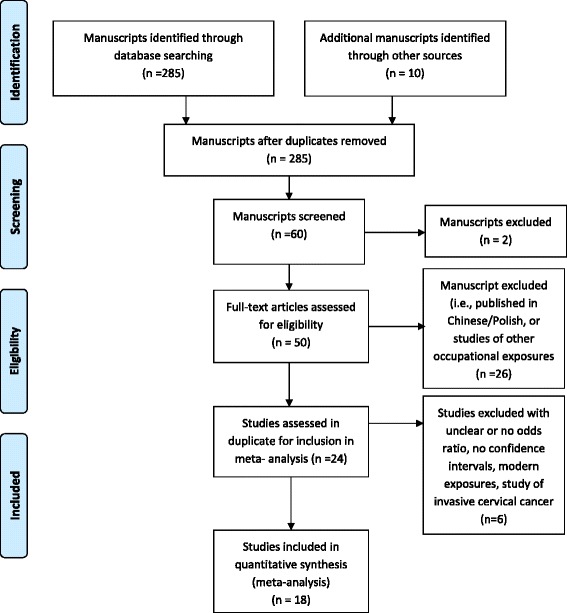
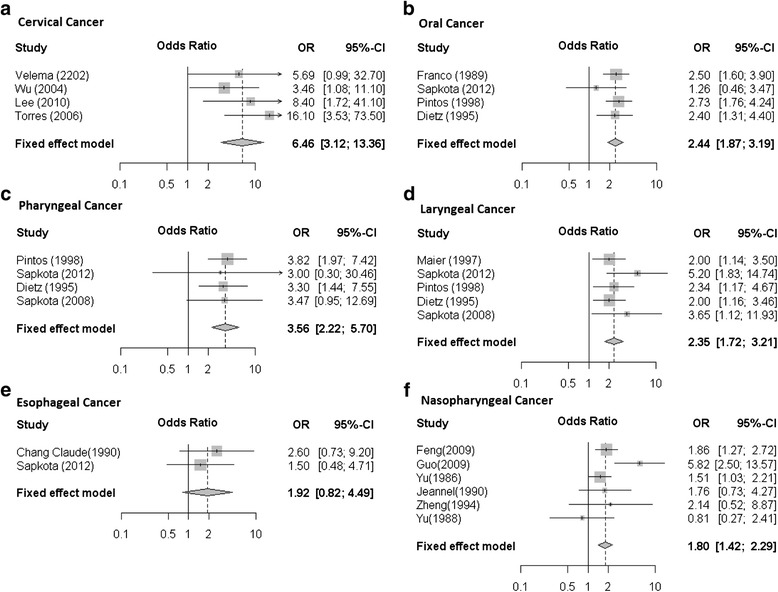
Household air pollution (HAP) from solid fuel combustion contributes to 2.6% of the global burden of disease. HAP emissions are an established lung carcinogen; however, associations with other cancer sites have not been fully explored. We conducted a meta-analysis of 18 case-control studies. Using fixed-effects models, utilizing the adjusted odds ratios (OR) and 95% confidence intervals (95% CI) from each study, we evaluated the association between HAP and cervical neoplasia (663 cases and 1747 controls) and upper aero-digestive tract cancers (6022 cases and 15 325 controls). We found that HAP was associated with cervical neoplasia (OR = 6.46; 95% CI = 3.12-13.36; 4 studies); oral (OR = 2.44; 95% CI = 1.87-3.19; 4 studies; 1000 cases/3450 controls); nasopharyngeal (OR = 1.80; 95% CI = 1.42-2.29; 6 studies; 2231 cases/2160 controls); pharyngeal (OR = 3.56; 95% CI = 2.22-5.70; 4 studies; 1036 cases/3746 controls); and laryngeal (OR = 2.35; 95% CI = 1.72- 3.21; 5 studies; 1416 cases/4514 controls) cancers. The elevated risk for esophageal cancer (OR = 1.92; 95% CI = 0.82-4.49; 2 studies; 339 cases/1455 controls) was non-significant. HAP was associated with cervical neoplasia among studies that accounted for HPV infection (OR = 9.60; 95% CI = 3.79-24.32) and smoking (OR = 4.72; 95% CI = 1.84-12.07). Similarly, our observed associations between HAP and upper aero-digestive tract cancers remained significantly elevated when analyses were restricted to studies that controlled for smoking. No significant publication bias was detected. Our results suggest that the carcinogenic effect of HAP observed for lung cancer may extend to other cancers, including those of the cervix and the upper aero-digestive tract. Further research is needed to confirm these associations in prospective studies.
固体燃料燃烧产生的家庭空气污染(HAP)导致了全球2.6%的疾病负担。HAP排放是一种已确定的肺癌致癌物;然而,与其他癌症部位的关联尚未得到充分研究。我们对18项病例对照研究进行了荟萃分析。使用固定效应模型,利用每项研究的调整比值比(OR)和95%置信区间(95%CI),我们评估了HAP与宫颈肿瘤(663例病例和1747例对照)以及上呼吸道消化道癌症(6022例病例和15325例对照)之间的关联。我们发现HAP与宫颈肿瘤有关(OR = 6.46;95%CI = 3.12 - 13.36;4项研究);口腔癌(OR = 2.44;95%CI = 1.87 - 3.19;4项研究;1000例病例/3450例对照);鼻咽癌(OR = 1.80;95%CI = 1.42 - 2.29;6项研究;2231例病例/2160例对照);咽癌(OR = 3.56;95%CI = 2.22 - 5.70;4项研究;1036例病例/3746例对照);以及喉癌(OR = 2.35;95%CI = 1.72 - 3.21;5项研究;1416例病例/4514例对照)。食管癌风险升高(OR = 1.92;95%CI = 0.82 - 4.49;2项研究;339例病例/1455例对照)无统计学意义。在考虑人乳头瘤病毒(HPV)感染(OR = 9.60;95%CI = 3.79 - 24.32)和吸烟(OR = 4.72;95%CI = 1.84 - 12.07)的研究中,HAP与宫颈肿瘤有关。同样,当分析仅限于控制了吸烟因素的研究时,我们观察到的HAP与上呼吸道消化道癌症之间的关联仍然显著升高。未检测到明显的发表偏倚。我们的结果表明,HAP对肺癌的致癌作用可能扩展到其他癌症,包括宫颈癌和上呼吸道消化道癌症。需要进一步的研究在前瞻性研究中证实这些关联。