Benzon B, Zhao S G, Haffner M C, Takhar M, Erho N, Yousefi K, Hurley P, Bishop J L, Tosoian J, Ghabili K, Alshalalfa M, Glavaris S, Simons B W, Tran P, Davicioni E, Karnes R J, Boudadi K, Antonarakis E S, Schaeffer E M, Drake C G, Feng F, Ross A E
Department of Urology, Johns Hopkins Hospital, Baltimore, MD, USA.
Department of Radiation Oncology, University of Michigan, Ann Arbor, MI, USA.
Prostate Cancer Prostatic Dis. 2017 Mar;20(1):28-35. doi: 10.1038/pcan.2016.49. Epub 2016 Nov 1.
B7-H3 (CD276), part of the B7 superfamily of immune checkpoint molecules, has been shown to have an immunomodulatory role. Its regulation, receptor and mechanism of action remain unclear. B7-H3 protein expression correlates with prostate cancer outcomes, and humanized monoclonal antibodies (that is, enoblituzumab) are currently being investigated for therapeutic use. Here we used genomic expression data to examine the relationship between B7-H3 mRNA expression and prostate cancer.
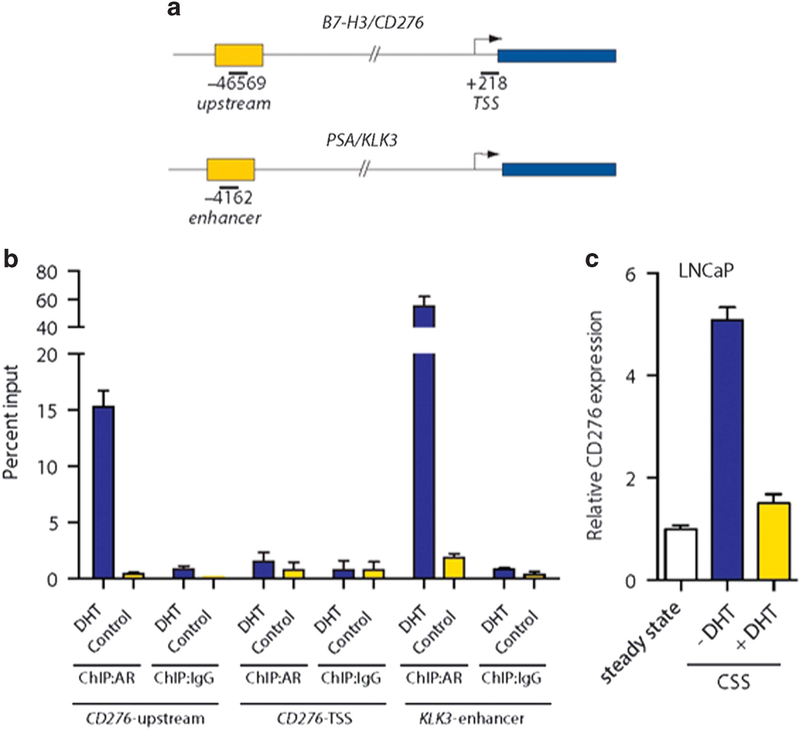
Prostatectomy tissue from 2781 patients were profiled using the Affymetrix HuEx 1.0 ST microarray. Pairwise comparisons were used to identify significant associations between B7-H3 expression and clinicopathologic variables, and survival analyses were used to evaluate the prognostic significance of B7-H3. Pearson's correlation analyses were performed to assess the relationship of B7-H3 expression with molecular subtypes and individual transcripts. Androgen receptor (AR) occupancy at the B7-H3 locus was determined using chromatin immunoprecipitation (ChIP), and androgen-dependent expression changes in B7-H3 was evaluated by quantitative reverse transcription PCR in LNCaP cell lines. Oncomine was queried to evaluate B7-H3 expression in metastatic disease.
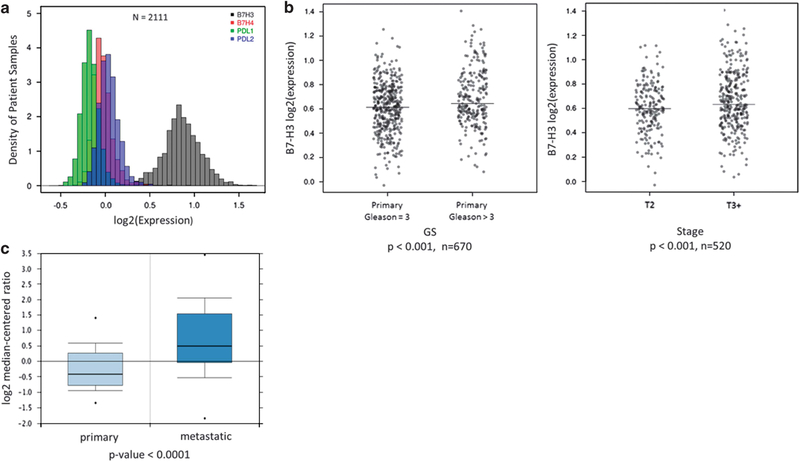
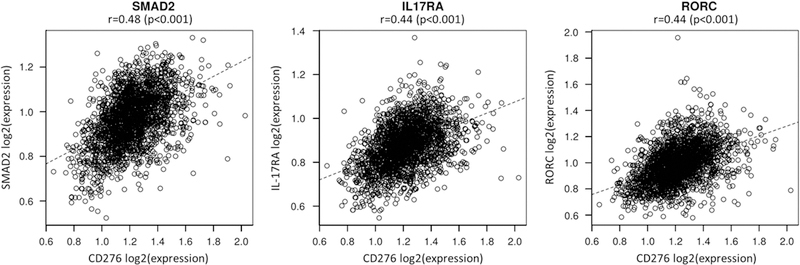
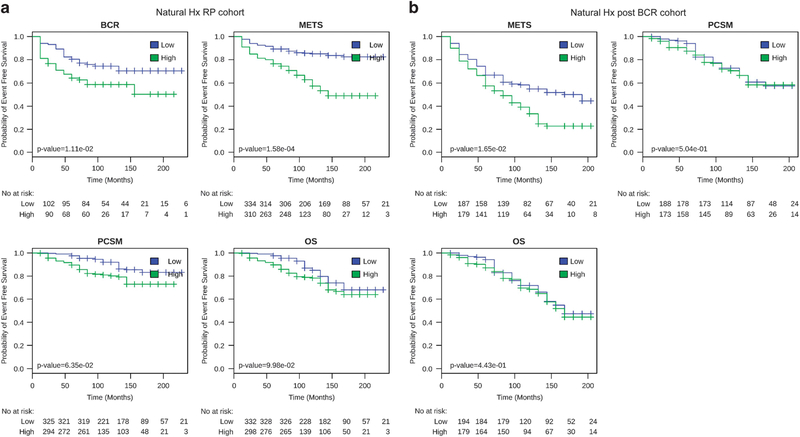
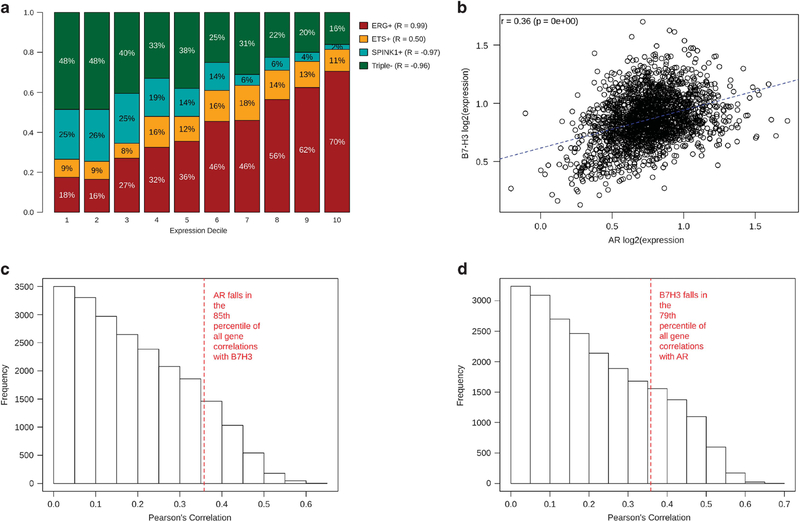
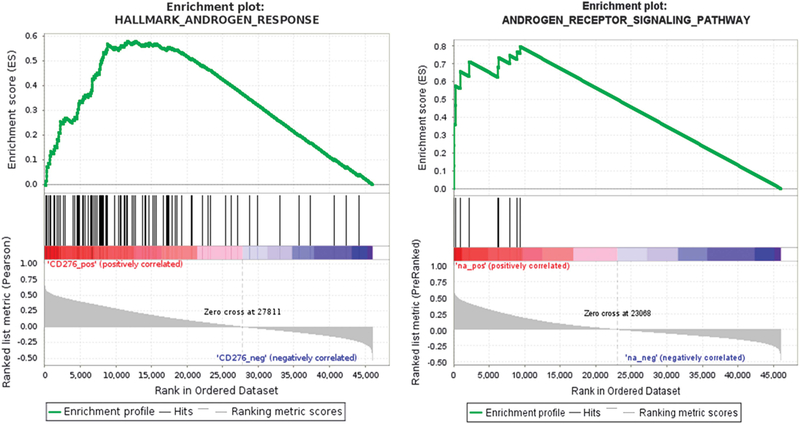
B7-H3 mRNA expression was positively associated with higher Gleason score (P<0.001), tumor stage (P<0.001), and castrate resistant metastatic disease (P<0.0001). High B7-H3 expression correlated with the development of metastasis and prostate cancer specific mortality, but this was not significant on multi-variable analysis. B7-H3 expression correlated with ERG-positive disease (r=0.99) and AR expression (r=0.36). ChIP revealed an AR-binding site upstream of B7-H3, and the presence of androgens decreased B7-H3 expression in LNCaP suggesting potential direct AR regulation. Gene set enrichment analysis demonstrated an association of B7-H3 with androgen signaling as well as immune regulatory pathways.
Higher B7-H3 expression correlates with Gleason grade, prostate cancer stage and poor oncologic outcomes in prostatectomy cohorts. B7-H3 expression appears to be related to androgen signaling as well as the immune reactome.
B7-H3(CD276)是免疫检查点分子B7超家族的一部分,已显示具有免疫调节作用。其调控、受体及作用机制仍不清楚。B7-H3蛋白表达与前列腺癌预后相关,目前正在研究人源化单克隆抗体(即恩诺单抗)的治疗用途。在此,我们使用基因组表达数据来研究B7-H3 mRNA表达与前列腺癌之间的关系。
使用Affymetrix HuEx 1.0 ST微阵列对2781例患者的前列腺切除组织进行分析。采用成对比较来确定B7-H3表达与临床病理变量之间的显著关联,并使用生存分析来评估B7-H3的预后意义。进行Pearson相关分析以评估B7-H3表达与分子亚型及单个转录本的关系。使用染色质免疫沉淀(ChIP)确定雄激素受体(AR)在B7-H3基因座的占有率,并通过定量逆转录PCR在LNCaP细胞系中评估B7-H3的雄激素依赖性表达变化。查询Oncomine以评估转移性疾病中B7-H3的表达。
B7-H3 mRNA表达与较高的Gleason评分(P<0.001)、肿瘤分期(P<0.001)和去势抵抗性转移性疾病(P<0.0001)呈正相关。高B7-H3表达与转移的发生及前列腺癌特异性死亡率相关,但在多变量分析中不显著。B7-H3表达与ERG阳性疾病(r=0.99)和AR表达(r=0.36)相关。ChIP显示在B7-H3上游有一个AR结合位点,雄激素的存在降低了LNCaP中B7-H3的表达,提示可能存在直接的AR调控。基因集富集分析表明B7-H3与雄激素信号传导以及免疫调节途径有关。
在前列腺切除队列中,较高的B7-H3表达与Gleason分级、前列腺癌分期及不良肿瘤学结局相关。B7-H3表达似乎与雄激素信号传导以及免疫反应组有关。