Imhann Floris, Vich Vila Arnau, Bonder Marc Jan, Fu Jingyuan, Gevers Dirk, Visschedijk Marijn C, Spekhorst Lieke M, Alberts Rudi, Franke Lude, van Dullemen Hendrik M, Ter Steege Rinze W F, Huttenhower Curtis, Dijkstra Gerard, Xavier Ramnik J, Festen Eleonora A M, Wijmenga Cisca, Zhernakova Alexandra, Weersma Rinse K
Department of Gastroenterology and Hepatology, University of Groningen, University Medical Center Groningen, Groningen, The Netherlands.
Department of Genetics, University of Groningen, University Medical Center Groningen, Groningen, The Netherlands.
Gut. 2018 Jan;67(1):108-119. doi: 10.1136/gutjnl-2016-312135. Epub 2016 Oct 8.
Patients with IBD display substantial heterogeneity in clinical characteristics. We hypothesise that individual differences in the complex interaction of the host genome and the gut microbiota can explain the onset and the heterogeneous presentation of IBD. Therefore, we performed a case-control analysis of the gut microbiota, the host genome and the clinical phenotypes of IBD.
Stool samples, peripheral blood and extensive phenotype data were collected from 313 patients with IBD and 582 truly healthy controls, selected from a population cohort. The gut microbiota composition was assessed by tag-sequencing the 16S rRNA gene. All participants were genotyped. We composed genetic risk scores from 11 functional genetic variants proven to be associated with IBD in genes that are directly involved in the bacterial handling in the gut: , , , and .
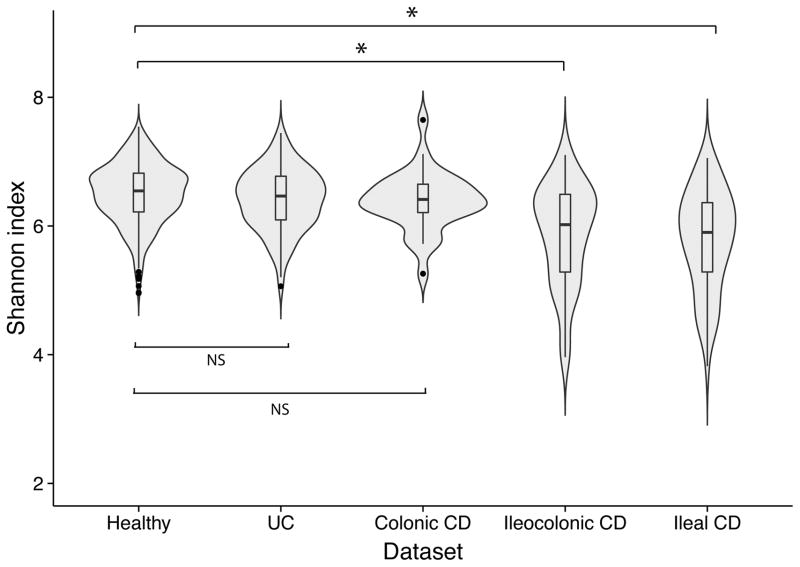
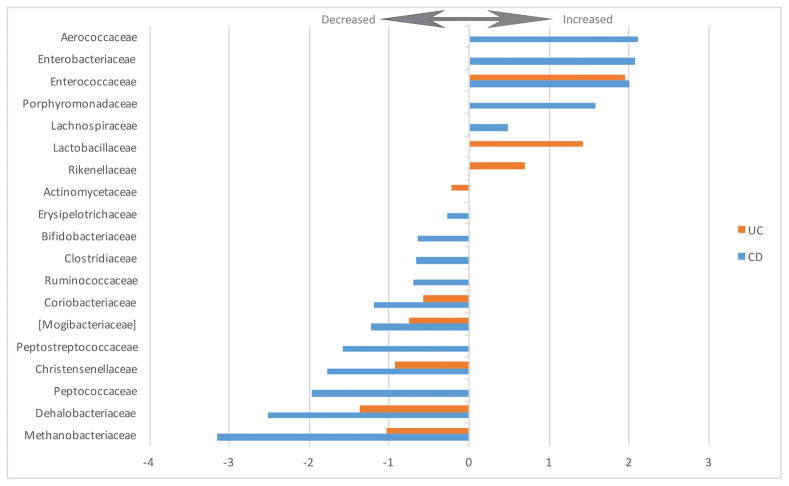
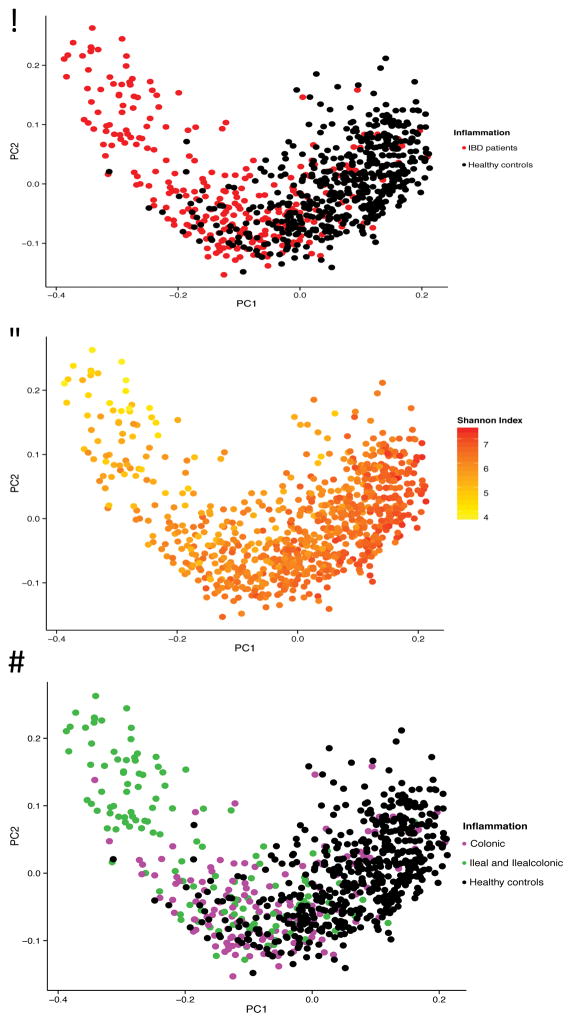
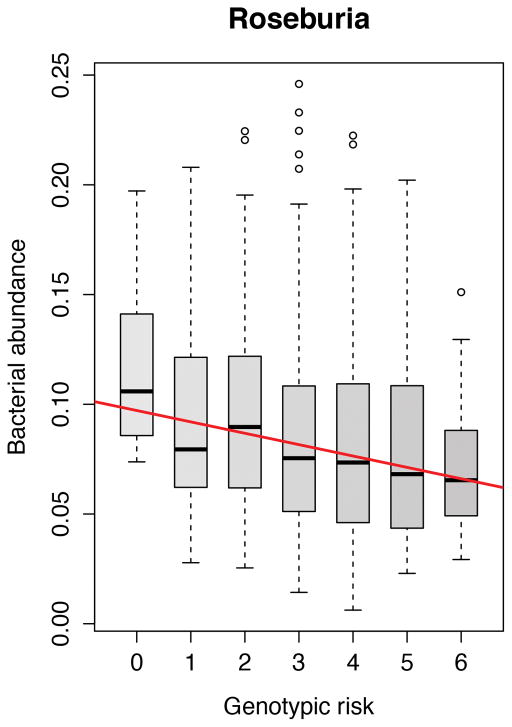
Strikingly, we observed significant alterations of the gut microbiota of healthy individuals with a high genetic risk for IBD: the IBD genetic risk score was significantly associated with a decrease in the genus in healthy controls (false discovery rate 0.017). Moreover, disease location was a major determinant of the gut microbiota: the gut microbiota of patients with colonic Crohn's disease (CD) is different from that of patients with ileal CD, with a decrease in alpha diversity associated to ileal disease (p=3.28×10).
We show for the first time that genetic risk variants associated with IBD influence the gut microbiota in healthy individuals. are acetate-to-butyrate converters, and a decrease has already been observed in patients with IBD.
炎症性肠病(IBD)患者在临床特征上表现出显著的异质性。我们推测宿主基因组与肠道微生物群复杂相互作用中的个体差异可以解释IBD的发病及其异质性表现。因此,我们对IBD患者的肠道微生物群、宿主基因组和临床表型进行了病例对照分析。
从一个人群队列中选取313例IBD患者和582名真正健康的对照者,收集其粪便样本、外周血和广泛的表型数据。通过对16S rRNA基因进行标签测序来评估肠道微生物群组成。对所有参与者进行基因分型。我们根据11个已被证明与IBD相关的功能性基因变异构建了遗传风险评分,这些基因直接参与肠道中的细菌处理过程: 、 、 、 和 。
令人惊讶的是,我们观察到具有高IBD遗传风险的健康个体的肠道微生物群有显著改变:在健康对照者中,IBD遗传风险评分与 属的减少显著相关(错误发现率为0.017)。此外,疾病部位是肠道微生物群的主要决定因素:结肠克罗恩病(CD)患者的肠道微生物群与回肠CD患者的不同,回肠疾病相关的α多样性降低(p = 3.28×10)。
我们首次表明与IBD相关的遗传风险变异会影响健康个体的肠道微生物群。 是乙酸盐向丁酸盐的转化菌,并且在IBD患者中已经观察到其数量减少。