Meyne J, Ratliff R L, Moyzis R K
Genetics Group, LS-3, Los Alamos National Laboratory, NM 87545.
Proc Natl Acad Sci U S A. 1989 Sep;86(18):7049-53. doi: 10.1073/pnas.86.18.7049.
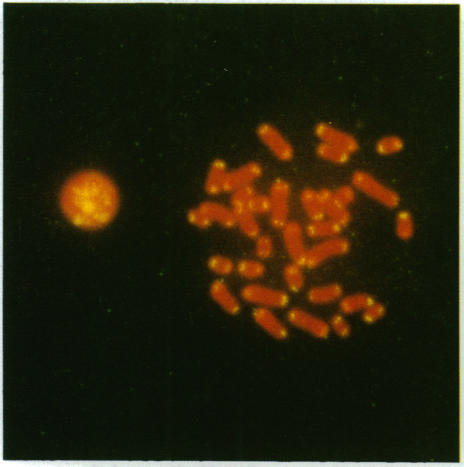
To determine the evolutionary origin of the human telomere sequence (TTAGGG)n, biotinylated oligodeoxynucleotides of this sequence were hybridized to metaphase spreads from 91 different species, including representative orders of bony fish, reptiles, amphibians, birds, and mammals. Under stringent hybridization conditions, fluorescent signals were detected at the telomeres of all chromosomes, in all 91 species. The conservation of the (TTAGGG)n sequence and its telomeric location, in species thought to share a common ancestor over 400 million years ago, strongly suggest that this sequence is the functional vertebrate telomere.
为了确定人类端粒序列(TTAGGG)n的进化起源,将该序列的生物素化寡脱氧核苷酸与来自91个不同物种的中期染色体铺展进行杂交,这些物种包括硬骨鱼、爬行动物、两栖动物、鸟类和哺乳动物的代表性目。在严格的杂交条件下,在所有91个物种的所有染色体端粒处均检测到荧光信号。(TTAGGG)n序列及其端粒位置在被认为在4亿多年前拥有共同祖先的物种中的保守性,强烈表明该序列是功能性脊椎动物端粒。