Sahimin Norhidayu, Lim Yvonne A L, Ariffin Farnaza, Behnke Jerzy M, Lewis John W, Mohd Zain Siti Nursheena
Institute of Biological Science, Faculty of Science, University of Malaya, Kuala Lumpur, Malaysia.
Department of Parasitology, Faculty of Medicine, University of Malaya, Kuala Lumpur, Malaysia.
PLoS Negl Trop Dis. 2016 Nov 2;10(11):e0005110. doi: 10.1371/journal.pntd.0005110. eCollection 2016 Nov.
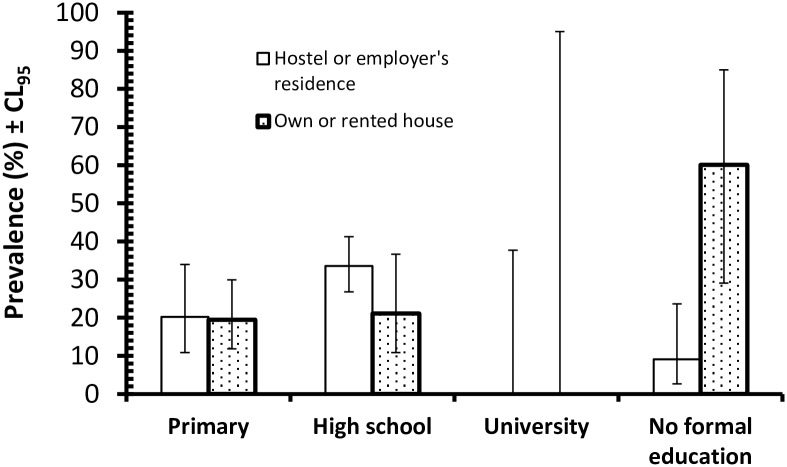
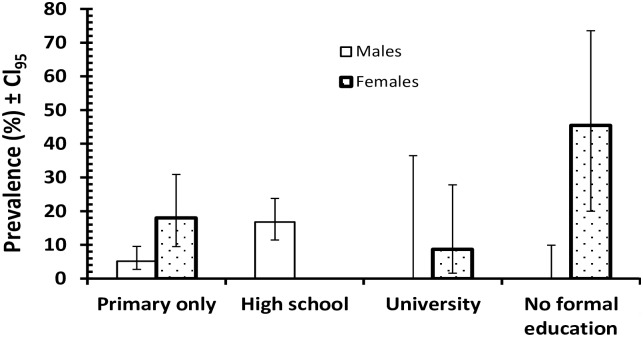
A cross-sectional study of intestinal parasitic infections amongst migrant workers in Malaysia was conducted. A total of 388 workers were recruited from five sectors including manufacturing, construction, plantation, domestic and food services. The majority were recruited from Indonesia (n = 167, 43.3%), followed by Nepal (n = 81, 20.9%), Bangladesh (n = 70, 18%), India (n = 47, 12.1%) and Myanmar (n = 23, 5.9.2%). A total of four nematode species (Ascaris lumbricoides, Trichuris trichiura, Enterobius vermicularis and hookworms), one cestode (Hymenolepis nana) and three protozoan species (Entamoeba histolytica/dispar, Giardia sp. and Cryptosporidium spp.) were identified. High prevalence of infections with A. lumbricoides (43.3%) was recorded followed by hookworms (13.1%), E. histolytica/dispar (11.6%), Giardia sp. (10.8%), T. trichura (9.5%), Cryptosporodium spp. (3.1%), H. nana (1.8%) and E. vermicularis (0.5%). Infections were significantly influenced by socio-demographic (nationality), and environmental characteristics (length of working years in the country, employment sector and educational level). Up to 84.0% of migrant workers from Nepal and 83.0% from India were infected with intestinal parasites, with the ascarid nematode A. lumbricoides occurring in 72.8% of the Nepalese and 68.1% of the Indian population. In addition, workers with an employment history of less than a year or newly arrived in Malaysia were most likely to show high levels of infection as prevalence of workers infected with A. lumbricoides was reduced from 58.2% to 35.4% following a year's residence. These findings suggest that improvement is warranted in public health and should include mandatory medical screening upon entry into the country.
在马来西亚进行了一项关于农民工肠道寄生虫感染情况的横断面研究。总共从制造业、建筑业、种植园、家政和食品服务业等五个行业招募了388名工人。大多数工人来自印度尼西亚(n = 167,43.3%),其次是尼泊尔(n = 81,20.9%)、孟加拉国(n = 70,18%)、印度(n = 47,12.1%)和缅甸(n = 23,5.9%)。共鉴定出四种线虫(蛔虫、鞭虫、蛲虫和钩虫)、一种绦虫(微小膜壳绦虫)和三种原生动物(溶组织内阿米巴/迪斯帕内阿米巴、贾第虫属和隐孢子虫属)。记录到蛔虫感染率很高(43.3%),其次是钩虫(13.1%)、溶组织内阿米巴/迪斯帕内阿米巴(11.6%)、贾第虫属(10.8%)、鞭虫(9.5%)、隐孢子虫属(3.1%)、微小膜壳绦虫(1.8%)和蛲虫(0.5%)。感染情况受到社会人口统计学因素(国籍)以及环境特征(在该国的工作年限、就业部门和教育水平)的显著影响。来自尼泊尔的农民工中有高达84.0%以及来自印度的农民工中有83.0%感染了肠道寄生虫,蛔虫线虫在72.8%的尼泊尔人和68.1%的印度人口中出现。此外,工作年限少于一年或刚到马来西亚的工人最有可能呈现高感染水平,因为在马来西亚居住一年后,感染蛔虫的工人患病率从58.2%降至35.4%。这些研究结果表明,公共卫生状况有待改善,应包括入境时的强制性医学筛查。