Le Minh T H, Holton Sara, Nguyen Huong T, Wolfe Rory, Fisher Jane
Jean Hailes Research Unit, School of Public Health and Preventive Medicine, Monash University, 6th Floor, the Alfred Centre, 99 Commercial Road, Melbourne, VIC, 3004, Australia.
Faculty of Social Sciences, Behaviours and Health Education, Hanoi School of Public Health, 138 Giang Vo street, Ba Dinh District, Hanoi, Vietnam.
Health Qual Life Outcomes. 2016 Nov 4;14(1):155. doi: 10.1186/s12955-016-0558-8.
In high and upper-middle income countries poly-victimisation (exposure to multiple forms of victimisation) is associated with worse health-related quality of life (HRQoL) among adolescents. There is a lack of empirical evidence about these associations from low- and lower-middle income countries. The aims of this study were to examine the associations between exposure to 1) individual forms of victimisation and 2) poly-victimisation and the HRQoL of adolescents in Vietnam.
A cross-sectional, anonymously-completed survey of high school students in Hanoi, Vietnam. Lifetime exposure to eight individual forms of victimisation and poly-victimisation were assessed using the Juvenile Victimisation Questionnaire Revised-2 (JVQ R2). Health-related quality of life was assessed using the Duke Health Profile Adolescent Version (DHP-A). Bi-variate analyses and multiple linear regressions were conducted to assess the associations between individual forms of victimisation, poly-victimisation and HRQoL among girls and boys.
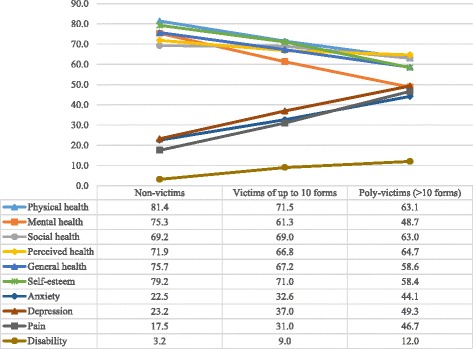
In total 1616/1745 students (92.6 %) completed the questionnaire. Adolescent girls had significantly worse HRQoL than boys in all domains, except disability. Different forms of victimisation were associated with different HRQoL domains among girls and boys. Cyber victimisation was the most detrimental to girls' HRQoL while for boys maltreatment was the most detrimental. Experiences of poly-victimisation were associated with worse HRQoL in physical, mental, social and general health, lower levels of self-esteem and increased levels of anxiety, depression and pain domains among both sexes.
Among Vietnamese adolescents, experiences of individual forms of victimisation were associated with poorer HRQoL in specific domains; the most detrimental forms of victimisation varied for girls and boys. However, it was experiences of poly-victimisation that had the most detrimental impacts on the HRQoL of both sexes. Recognition of violence, including poly-victimisation, is still low in Vietnam. These data indicate that community education, prevention and early intervention programs to reduce violent victimisation and assist adolescents who have experienced it, with attention to gender differences, are needed in Vietnam.
在高收入和中高收入国家,青少年遭受多种形式的侵害(多重受害)与较差的健康相关生活质量(HRQoL)相关。低收入和中低收入国家缺乏关于这些关联的实证证据。本研究的目的是探讨越南青少年遭受1)个体形式的侵害和2)多重侵害与HRQoL之间的关联。
对越南河内的高中生进行一项横断面、匿名完成的调查。使用修订后的青少年受害问卷-2(JVQ R2)评估一生当中遭受的八种个体形式的侵害和多重侵害。使用杜克健康概况青少年版(DHP-A)评估健康相关生活质量。进行双变量分析和多元线性回归,以评估女孩和男孩中个体形式的侵害、多重侵害与HRQoL之间的关联。
总共1616/1745名学生(92.6%)完成了问卷。除残疾领域外,青少年女孩在所有领域的HRQoL均显著差于男孩。女孩和男孩中,不同形式的侵害与不同的HRQoL领域相关。网络侵害对女孩的HRQoL危害最大,而对男孩来说,虐待危害最大。多重受害经历与身体、心理、社会和总体健康方面较差的HRQoL、较低的自尊水平以及两性中焦虑、抑郁和疼痛领域水平的增加相关。
在越南青少年中,个体形式的侵害经历与特定领域较差的HRQoL相关;对女孩和男孩来说,最具危害性的侵害形式各不相同。然而,多重受害经历对两性的HRQoL影响最大。在越南,对包括多重受害在内的暴力行为的认知仍然很低。这些数据表明,越南需要开展社区教育、预防和早期干预项目,以减少暴力侵害行为,并帮助遭受过暴力侵害的青少年,同时关注性别差异。