de Oliveira Rodrigo Bueno, Liabeuf Sophie, Okazaki Hirokazu, Lenglet Aurelie, Desjardins Lucie, Lemke Horst-Dieter, Vanholder Raymond, Choukroun Gabriel, Massy Ziad A
INSERM U-1088, The Jules Verne University of Picardy , Amiens , France.
INSERM U-1088, The Jules Verne University of Picardy, Amiens, France; Clinical Research Center, Division of Clinical Pharmacology, Amiens University Medical Center, Amiens, France; The Jules Verne University of Picardy, Amiens, France.
Clin Kidney J. 2013 Feb;6(1):63-70. doi: 10.1093/ckj/sfs176. Epub 2012 Jan 1.
Recent research has clarified the relationship between adipokines, metabolic syndrome (MS) and cardiovascular disease (CVD). The results of animal and clinical studies have revealed a positive relationship between leptin and vascular smooth muscle cell counts and calcification, arterial rigidity, carotid thickness and the incidence of CVD. However, despite leptin fulfilling the definition of a uremic toxin, its exact role in chronic kidney disease (CKD) has yet to be determined.
One hundred and forty-two CKD patients (stages 2-5D) participated in this study, and were followed for a minimum of 20 months at Amiens University Medical Center.
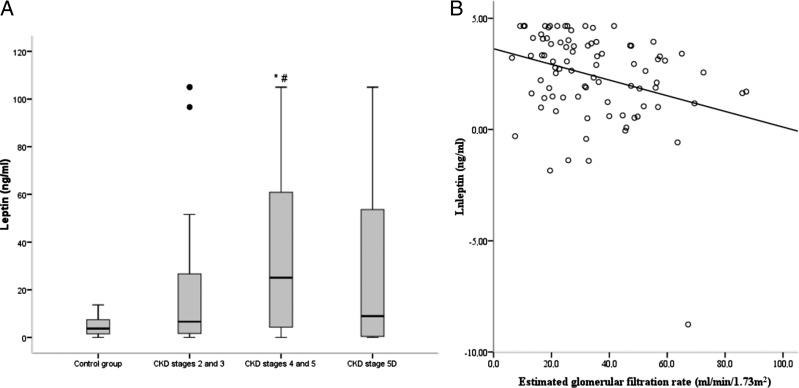
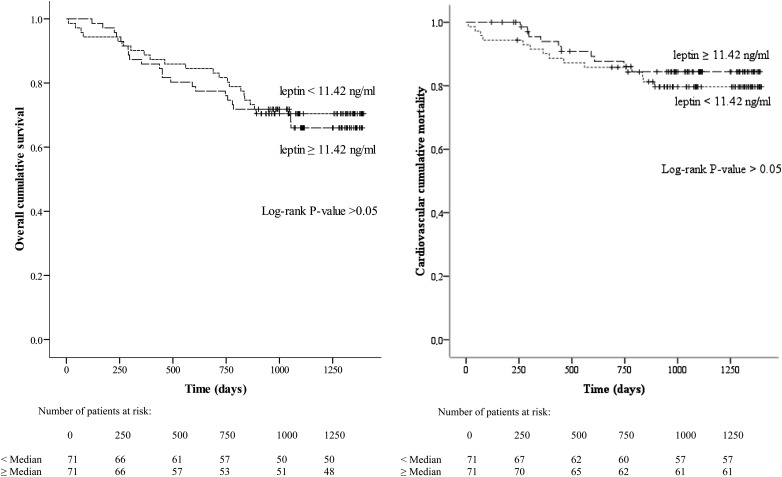
Leptin was negatively correlated with the glomerular filtration rate (GFR), total adiponectin (TAdip) and high-molecular weight adiponectin and positively correlated with age, waist circumference, body mass index (BMI), aortic calcification score (ACS), C-reactive protein (CRP), triglycerides, insulin and parathormone (PTH). Leptin and insulin were significantly correlated with the MS score. The BMI, insulin, MS score and PTH were independent predictors of leptin levels (P = 0.002, 0.016, 0.028 and 0.017, respectively). Leptin, insulin and TAdip were independent predictors of the presence of MS (P = 0.05, 0.04 and 0.04). However, leptin levels were not significantly predictive of the clinical outcomes.
Our study was the first to demonstrate a significant, independent link between leptin and MS (but not clinical outcomes) and PTH in patients at different CKD stages. Future studies will have to assess the involvement of leptin in MS and clinical outcomes in CKD, and the potential modulation of leptin by PTH.
近期研究已阐明脂肪因子、代谢综合征(MS)与心血管疾病(CVD)之间的关系。动物和临床研究结果显示,瘦素与血管平滑肌细胞数量及钙化、动脉僵硬度、颈动脉厚度和CVD发病率之间存在正相关关系。然而,尽管瘦素符合尿毒症毒素的定义,但其在慢性肾脏病(CKD)中的确切作用尚未确定。
142例CKD患者(2 - 5D期)参与了本研究,并在亚眠大学医学中心接受了至少20个月的随访。
瘦素与肾小球滤过率(GFR)、总脂联素(TAdip)和高分子量脂联素呈负相关,与年龄、腰围、体重指数(BMI)、主动脉钙化评分(ACS)、C反应蛋白(CRP)、甘油三酯、胰岛素和甲状旁腺激素(PTH)呈正相关。瘦素和胰岛素与MS评分显著相关。BMI、胰岛素、MS评分和PTH是瘦素水平的独立预测因素(分别为P = 0.002、0.016、0.028和0.017)。瘦素、胰岛素和TAdip是MS存在的独立预测因素(P = 0.05、0.04和0.04)。然而,瘦素水平对临床结局并无显著预测作用。
我们的研究首次证明了在不同CKD阶段的患者中,瘦素与MS(而非临床结局)及PTH之间存在显著的独立关联。未来的研究将必须评估瘦素在CKD中MS及临床结局中的作用,以及PTH对瘦素的潜在调节作用。