
2013年中国登革热的流行病学特征及传播动态
The Epidemiological Characteristics and Dynamic Transmission of Dengue in China, 2013.
作者信息
Sang Shaowei, Wang Shasha, Lu Liang, Bi Peng, Lv Ming, Liu Qiyong
机构信息
Clinical Epidemiology Unit, Qilu Hospital of Shandong University, Jinan, People's Republic of China.
Institute of Public Health and Management, Weifang Medical University, Weifang, People's Republic of China.
出版信息
PLoS Negl Trop Dis. 2016 Nov 7;10(11):e0005095. doi: 10.1371/journal.pntd.0005095. eCollection 2016 Nov.
BACKGROUND
There was a dengue epidemic in several regions of China in 2013. No study has explored the dynamics of dengue transmission between different geographical locations with dengue outbreaks in China. The purpose of the study is to analyze the epidemiological characteristics and to explore the dynamic transmission of dengue in China, 2013.
METHODOLOGY AND PRINCIPAL FINDINGS
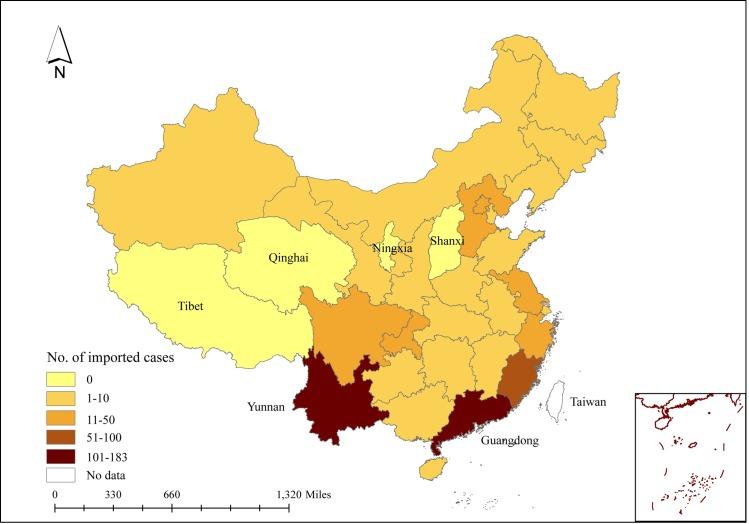
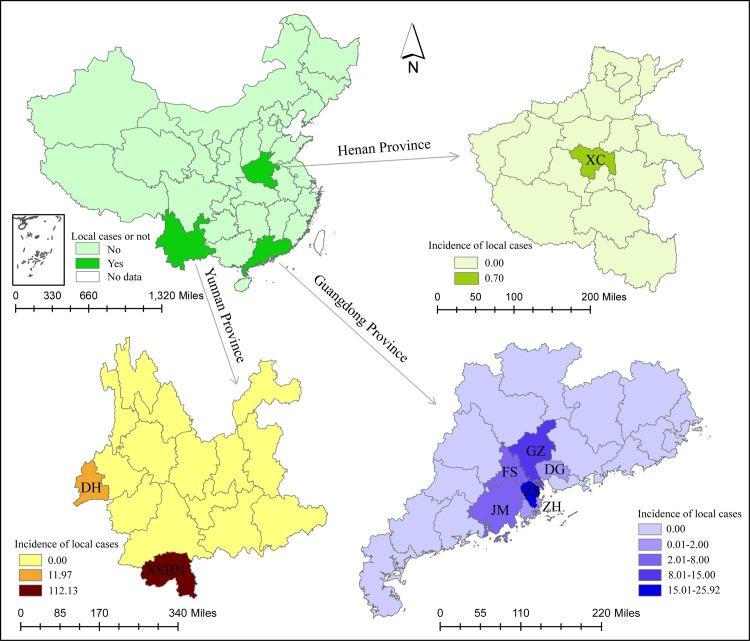
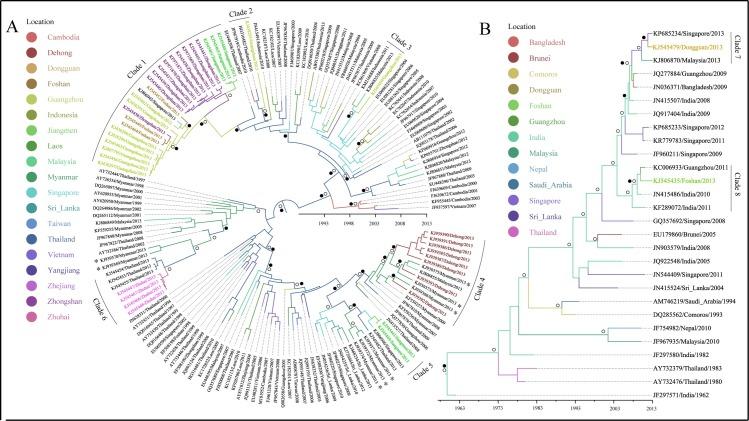
Records of dengue cases of 2013 were obtained from the China Notifiable Disease Surveillance System. Full E-gene sequences of dengue virus detected from the outbreak regions of China were download from GenBank. Geographical Information System and heatmaps were used to describe the epidemiological characteristics. Maximum Likelihood phylogenetic and Bayesian phylogeographic analyses were conducted to explore the dengue dynamic transmission. Yunnan Province and Guangdong Province had the highest imported cases in the 2013 epidemic. In the locations with local dengue transmission, most of imported cases occurred from June to November 2013 while local dengue cases developed from July to December, 2013. There were significant variations for the incidences of dengue, in terms of age distributions, among different geographic locations. However, gender differences were identified in Guangzhou, Foshan and Xishuangbanna. DENV 1-3 were detected in all locations with the disease outbreaks. Some genotypes were detected in more than one locations and more than one genotypes have been detected in several locations. The dengue viruses introduced to outbreak areas were predominantly from Southeast Asia. In Guangdong Province, the phylogeographical results indicated that dengue viruses of DENV 1 were transmitted to neighboring cities Foshan and Zhongshan from Guangzhou city, and then transmitted to Jiangmen city. The virus in DENV 3 was introduced to Guangzhou city, Guangdong Province from Xishuangbanna prefecture, Yunnan Province.
CONCLUSIONS
Repeated dengue virus introductions from Southeast Asia and subsequent domestic dengue transmission within different regions may have contributed to the dengue epidemics in China, 2013.
背景
2013年中国多个地区爆发了登革热疫情。尚无研究探讨中国登革热疫情爆发地区之间登革热传播的动态情况。本研究的目的是分析2013年中国登革热的流行病学特征并探讨其动态传播情况。
方法与主要发现
从中国法定传染病监测系统获取2013年登革热病例记录。从GenBank下载在中国疫情爆发地区检测到的登革热病毒完整E基因序列。利用地理信息系统和热图描述流行病学特征。进行最大似然系统发育分析和贝叶斯系统地理学分析以探讨登革热的动态传播。云南省和广东省在2013年疫情中输入病例最多。在有本地登革热传播的地区,大多数输入病例发生在2013年6月至11月,而本地登革热病例则在2013年7月至12月出现。不同地理位置的登革热发病率在年龄分布方面存在显著差异。然而,在广州、佛山和西双版纳发现了性别差异。在所有疫情爆发地区均检测到登革病毒1 - 3型。在多个地区检测到一些基因型,并且在几个地区检测到不止一种基因型。引入疫情爆发地区的登革热病毒主要来自东南亚。在广东省,系统地理学结果表明登革病毒1型从广州市传播到邻近城市佛山和中山,然后传播到江门市。登革病毒3型从云南省西双版纳州传入广东省广州市。
结论
2013年东南亚地区多次输入登革热病毒以及随后在不同地区的国内传播可能导致了中国的登革热疫情。





 Zotero 插件