• 文献检索
  • 文档翻译
  • 深度研究
  • 学术资讯
  • Suppr Zotero 插件Zotero 插件
  • 邀请有礼
  • 套餐&价格
  • 历史记录
应用&插件
Suppr Zotero 插件Zotero 插件浏览器插件Mac 客户端Windows 客户端微信小程序
定价
高级版会员购买积分包购买API积分包
服务
文献检索文档翻译深度研究API 文档MCP 服务
关于我们
关于 Suppr公司介绍联系我们用户协议隐私条款
关注我们

Suppr 超能文献

核心技术专利:CN118964589B侵权必究
粤ICP备2023148730 号-1Suppr @ 2026

文献检索

告别复杂PubMed语法,用中文像聊天一样搜索,搜遍4000万医学文献。AI智能推荐,让科研检索更轻松。

立即免费搜索

文件翻译

保留排版,准确专业,支持PDF/Word/PPT等文件格式,支持 12+语言互译。

免费翻译文档

深度研究

AI帮你快速写综述,25分钟生成高质量综述,智能提取关键信息,辅助科研写作。

立即免费体验

1990年至2019年主要流行地区的登革热发病率趋势及其负担

Dengue Incidence Trends and Its Burden in Major Endemic Regions from 1990 to 2019.

作者信息

Tian Na, Zheng Jin-Xin, Guo Zhao-Yu, Li Lan-Hua, Xia Shang, Lv Shan, Zhou Xiao-Nong

机构信息

National Institute of Parasitic Diseases, Chinese Center for Disease Control and Prevention (Chinese Center for Tropical Diseases Research), Shanghai 200025, China.

School of Public Health, Weifang Medical University, Weifang 261000, China.

出版信息

Trop Med Infect Dis. 2022 Aug 12;7(8):180. doi: 10.3390/tropicalmed7080180.

DOI:10.3390/tropicalmed7080180
PMID:36006272
原文链接:https://pmc.ncbi.nlm.nih.gov/articles/PMC9416661/
Abstract

BACKGROUND

Dengue has become one of the major vector-borne diseases, which has been an important public health concern. We aimed to estimate the disease burden of dengue in major endemic regions from 1990 to 2019, and explore the impact pattern of the socioeconomic factors on the burden of dengue based on the global burden of diseases, injuries, and risk factors study 2019 (GBD 2019).

METHODS

Using the analytical strategies and data from the GBD 2019, we described the incidence and disability-adjusted life years (DALYs) of dengue in major endemic regions from 1990 to 2019. Furthermore, we estimated the correlation between dengue burden and socioeconomic factors, and then established an autoregressive integrated moving average (ARIMA) model to predict the epidemic trends of dengue in endemic regions. All estimates were proposed as numbers and age-standardized rates (ASR) per 100,000 population, with uncertainty intervals (UIs). The ASRs of dengue incidence were compared geographically and five regions were stratified by a sociodemographic index (SDI).

RESULTS

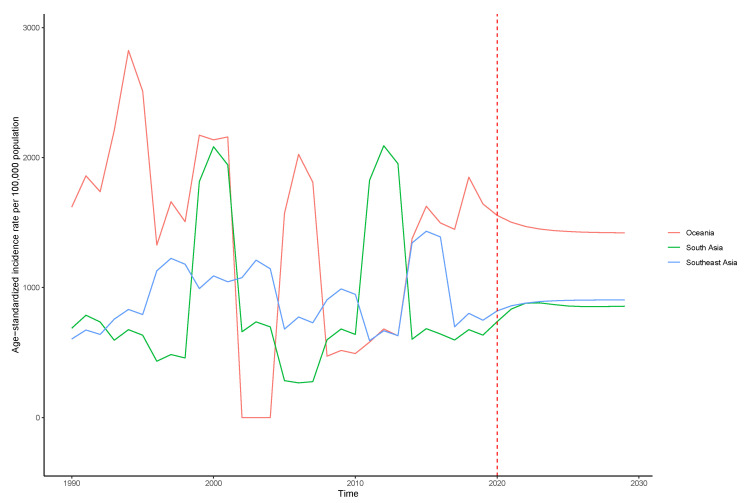
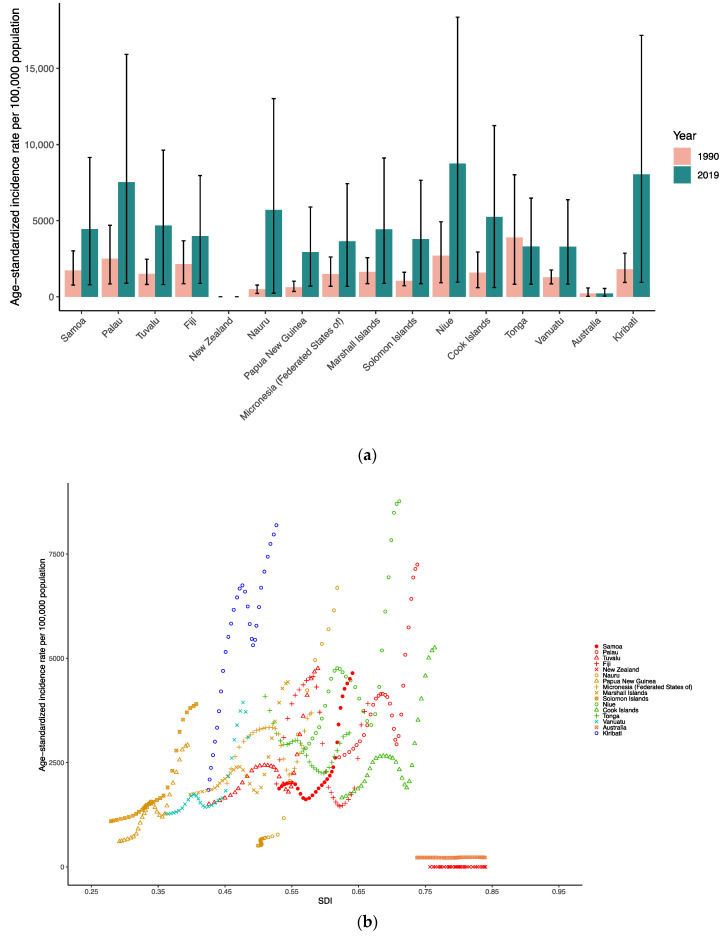
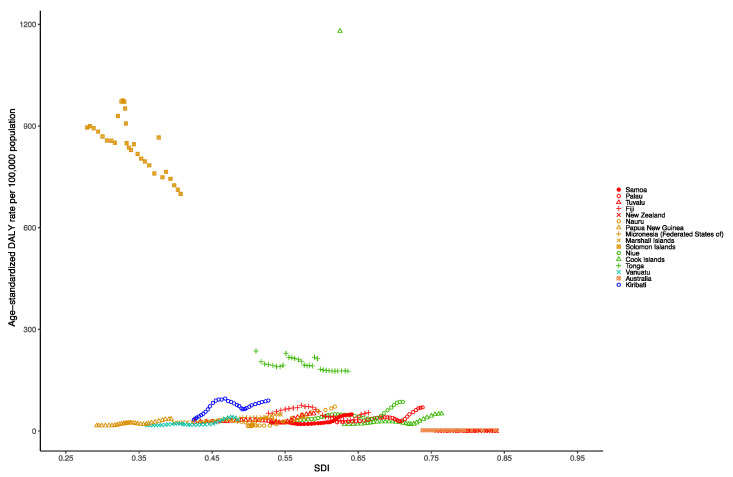
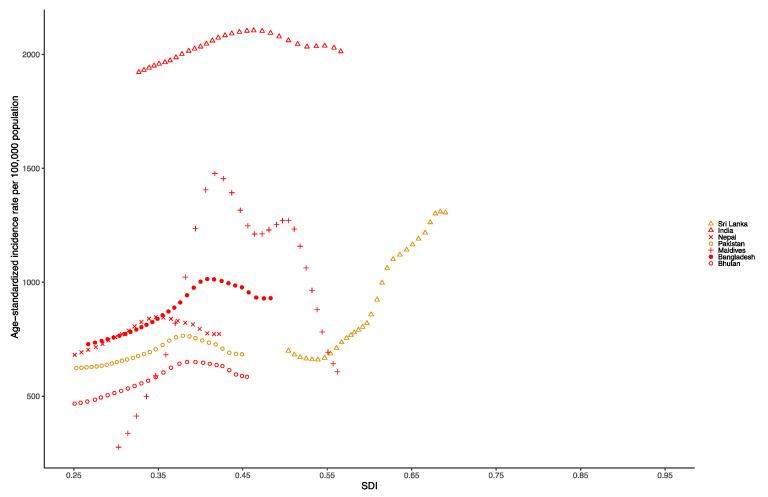
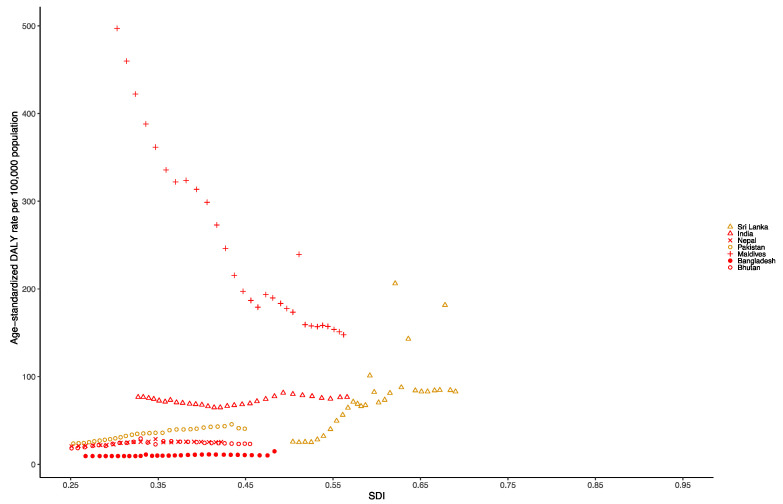
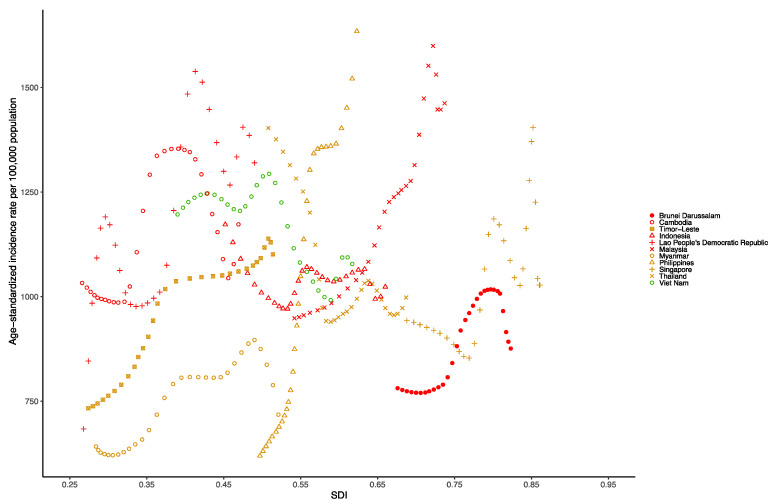
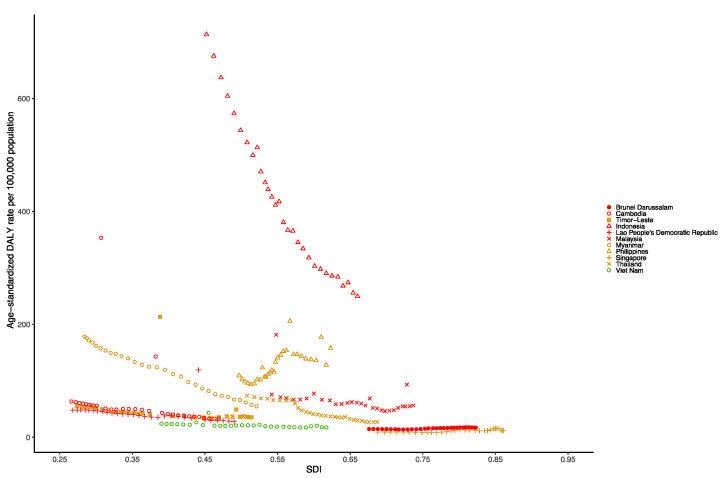
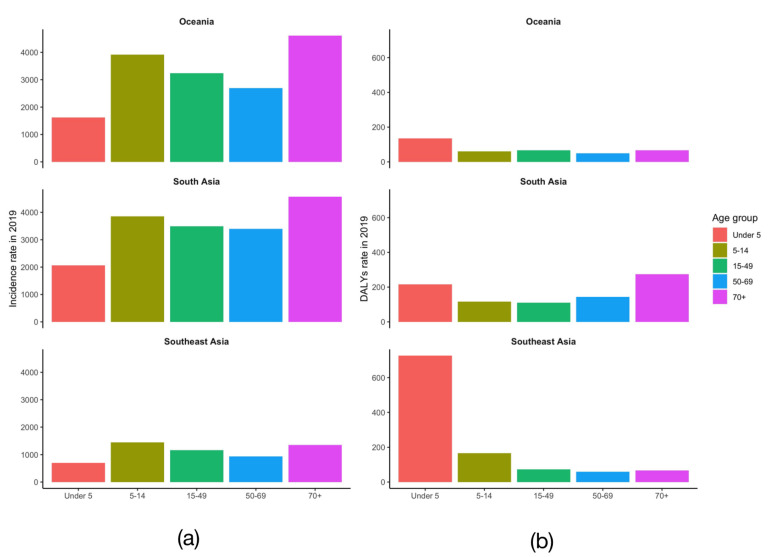
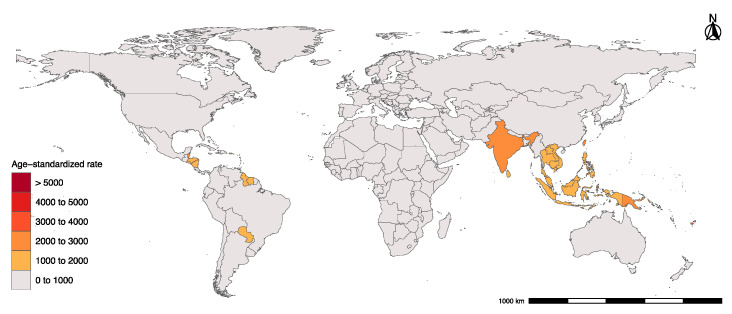
A significant rise was observed on a global scale between 1990 and 2019, with the overall age-standardized rate (ASR) increasing from 557.15 (95% UI 243.32-1212.53) per 100,000 in 1990 to 740.4 (95% UI 478.2-1323.1) per 100,000 in 2019. In 2019, the Oceania region had the highest age-standardized incidence rates per 100,000 population (3173.48 (95% UI 762.33-6161.18)), followed by the South Asia region (1740.79 (95% UI 660.93-4287.12)), and then the Southeast Asia region (1153.57 (95% UI 1049.49-1281.59)). In Oceania, South Asia, and Southeast Asia, increase trends were found in the burden of dengue fever measured by ASRs of DALY which were consistent with ASRs of dengue incidence at the national level. Most of the countries with the heaviest burden of dengue fever occurred in areas with low and medium SDI regions. However, the burden in high-middle and high-SDI countries is relatively low, especially the Solomon Islands and Tonga in Oceania, the Maldives in South Asia and Indonesia in Southeast Asia. The age distribution results of the incidence rate and disease burden of dengue fever of major endemic regions showed that the higher risk and disease burden are mainly concentrated in people under 14 or over 70 years old. The prediction by ARIMA showed that the risk of dengue fever in South and Southeast Asia is on the rise, and further prevention and control is warranted.

CONCLUSIONS

In view of the rapid population growth and urbanization in many dengue-endemic countries, our research results are of great significance for presenting the future trend in dengue fever. It is recommended to policy makers that specific attention needs to be paid to the negative impact of urbanization on dengue incidence and allocate more resources to the low-SDI areas and people under 14 or over 70 years old to reduce the burden of dengue fever.

摘要

背景

登革热已成为主要的媒介传播疾病之一,一直是重要的公共卫生问题。我们旨在估计1990年至2019年主要流行地区登革热的疾病负担,并基于2019年全球疾病、伤害和危险因素研究(GBD 2019)探讨社会经济因素对登革热负担的影响模式。

方法

利用GBD 2019的分析策略和数据,我们描述了1990年至2019年主要流行地区登革热的发病率和伤残调整生命年(DALYs)。此外,我们估计了登革热负担与社会经济因素之间的相关性,然后建立了自回归积分移动平均(ARIMA)模型来预测流行地区登革热的流行趋势。所有估计值均以每10万人口的数字和年龄标准化率(ASR)表示,并带有不确定性区间(UIs)。对登革热发病率的年龄标准化率进行了地理比较,并根据社会人口指数(SDI)对五个地区进行了分层。

结果

1990年至2019年全球范围内观察到显著上升,总体年龄标准化率从1990年的每10万人557.15(95% UI 243.32 - 1212.53)增至2019年的每10万人740.4(95% UI 478.2 - 1323.1)。2019年,大洋洲地区每10万人口的年龄标准化发病率最高(3173.48(95% UI 762.33 - 6161.18)),其次是南亚地区(1740.79(95% UI 660.93 - 4287.12)),然后是东南亚地区(1153.57(95% UI 1049.49 - 1281.59))。在大洋洲、南亚和东南亚,用DALY的年龄标准化率衡量的登革热负担呈上升趋势,这与国家层面登革热发病率的年龄标准化率一致。登革热负担最重的大多数国家出现在低和中等SDI地区。然而,高中等和高SDI国家的负担相对较低,特别是大洋洲的所罗门群岛和汤加、南亚的马尔代夫以及东南亚的印度尼西亚。主要流行地区登革热发病率和疾病负担的年龄分布结果表明,较高风险和疾病负担主要集中在14岁以下或70岁以上人群。ARIMA预测显示,南亚和东南亚登革热风险呈上升趋势,有必要进一步防控。

结论

鉴于许多登革热流行国家人口快速增长和城市化进程,我们的研究结果对于呈现登革热未来趋势具有重要意义。建议政策制定者特别关注城市化对登革热发病率的负面影响,并向低SDI地区以及14岁以下或70岁以上人群分配更多资源,以减轻登革热负担。
https://cdn.ncbi.nlm.nih.gov/pmc/blobs/80ea/9416661/275b6cb8ebf5/tropicalmed-07-00180-g009.jpg
https://cdn.ncbi.nlm.nih.gov/pmc/blobs/80ea/9416661/45247f504a2c/tropicalmed-07-00180-g001.jpg
https://cdn.ncbi.nlm.nih.gov/pmc/blobs/80ea/9416661/7cf0cf8e26b0/tropicalmed-07-00180-g002.jpg
https://cdn.ncbi.nlm.nih.gov/pmc/blobs/80ea/9416661/1bd272d3774b/tropicalmed-07-00180-g003.jpg
https://cdn.ncbi.nlm.nih.gov/pmc/blobs/80ea/9416661/d01fd2debc8c/tropicalmed-07-00180-g004.jpg
https://cdn.ncbi.nlm.nih.gov/pmc/blobs/80ea/9416661/aea1419f53b0/tropicalmed-07-00180-g005.jpg
https://cdn.ncbi.nlm.nih.gov/pmc/blobs/80ea/9416661/469c7b372280/tropicalmed-07-00180-g006.jpg
https://cdn.ncbi.nlm.nih.gov/pmc/blobs/80ea/9416661/ca1aa304ba12/tropicalmed-07-00180-g007.jpg
https://cdn.ncbi.nlm.nih.gov/pmc/blobs/80ea/9416661/bd9ef97dba33/tropicalmed-07-00180-g008.jpg
https://cdn.ncbi.nlm.nih.gov/pmc/blobs/80ea/9416661/275b6cb8ebf5/tropicalmed-07-00180-g009.jpg
https://cdn.ncbi.nlm.nih.gov/pmc/blobs/80ea/9416661/45247f504a2c/tropicalmed-07-00180-g001.jpg
https://cdn.ncbi.nlm.nih.gov/pmc/blobs/80ea/9416661/7cf0cf8e26b0/tropicalmed-07-00180-g002.jpg
https://cdn.ncbi.nlm.nih.gov/pmc/blobs/80ea/9416661/1bd272d3774b/tropicalmed-07-00180-g003.jpg
https://cdn.ncbi.nlm.nih.gov/pmc/blobs/80ea/9416661/d01fd2debc8c/tropicalmed-07-00180-g004.jpg
https://cdn.ncbi.nlm.nih.gov/pmc/blobs/80ea/9416661/aea1419f53b0/tropicalmed-07-00180-g005.jpg
https://cdn.ncbi.nlm.nih.gov/pmc/blobs/80ea/9416661/469c7b372280/tropicalmed-07-00180-g006.jpg
https://cdn.ncbi.nlm.nih.gov/pmc/blobs/80ea/9416661/ca1aa304ba12/tropicalmed-07-00180-g007.jpg
https://cdn.ncbi.nlm.nih.gov/pmc/blobs/80ea/9416661/bd9ef97dba33/tropicalmed-07-00180-g008.jpg
https://cdn.ncbi.nlm.nih.gov/pmc/blobs/80ea/9416661/275b6cb8ebf5/tropicalmed-07-00180-g009.jpg

相似文献

1
Dengue Incidence Trends and Its Burden in Major Endemic Regions from 1990 to 2019.1990年至2019年主要流行地区的登革热发病率趋势及其负担
Trop Med Infect Dis. 2022 Aug 12;7(8):180. doi: 10.3390/tropicalmed7080180.
2
Trends in the prevalence and disability-adjusted life years of eating disorders from 1990 to 2017: results from the Global Burden of Disease Study 2017.1990 年至 2017 年饮食失调症的流行趋势和残疾调整生命年数:2017 年全球疾病负担研究结果。
Epidemiol Psychiatr Sci. 2020 Dec 7;29:e191. doi: 10.1017/S2045796020001055.
3
The Global Trends and Regional Differences in Incidence of Dengue Infection from 1990 to 2019: An Analysis from the Global Burden of Disease Study 2019.1990年至2019年登革热感染发病率的全球趋势与地区差异:来自2019年全球疾病负担研究的分析
Infect Dis Ther. 2021 Sep;10(3):1625-1643. doi: 10.1007/s40121-021-00470-2. Epub 2021 Jun 26.
4
Global, regional, and national dengue burden from 1990 to 2017: A systematic analysis based on the global burden of disease study 2017.1990年至2017年全球、区域和国家登革热负担:基于2017年全球疾病负担研究的系统分析。
EClinicalMedicine. 2021 Jan 6;32:100712. doi: 10.1016/j.eclinm.2020.100712. eCollection 2021 Feb.
5
Global burden for dengue and the evolving pattern in the past 30 years.登革热的全球负担及过去30年的演变模式。
J Travel Med. 2021 Dec 29;28(8). doi: 10.1093/jtm/taab146.
6
Temporal trends of tracheal, bronchus, and lung cancer between 2010 and 2019, in Asian countries by geographical region and sociodemographic index, comparison with global data.2010 年至 2019 年亚洲国家按地理位置和社会人口指数划分的气管、支气管和肺癌的时间趋势,与全球数据比较。
Thorac Cancer. 2023 Jun;14(18):1668-1706. doi: 10.1111/1759-7714.14912. Epub 2023 May 1.
7
Temporal trends of thyroid cancer between 2010 and 2019 in Asian countries by geographical region and SDI, comparison with global data.2010年至2019年亚洲国家按地理区域和社会人口指数划分的甲状腺癌时间趋势,与全球数据的比较。
Aging Med (Milton). 2024 Jan 10;6(4):386-426. doi: 10.1002/agm2.12277. eCollection 2023 Dec.
8
Global burden and trends of neglected tropical diseases from 1990 to 2019.1990 年至 2019 年被忽视热带病的全球负担和趋势。
J Travel Med. 2022 May 31;29(3). doi: 10.1093/jtm/taac031.
9
Global, regional, and national burdens of hypertensive heart disease from 1990 to 2019 :A multilevel analysis based on the global burden of Disease Study 2019.1990年至2019年全球、区域和国家高血压性心脏病负担:基于2019年全球疾病负担研究的多层次分析
Heliyon. 2023 Nov 23;9(12):e22671. doi: 10.1016/j.heliyon.2023.e22671. eCollection 2023 Dec.
10
The global, regional and national burden of peptic ulcer disease from 1990 to 2019: a population-based study.全球、区域和国家的消化性溃疡疾病负担:1990 年至 2019 年的一项基于人群的研究。
BMC Gastroenterol. 2022 Feb 10;22(1):58. doi: 10.1186/s12876-022-02130-2.

引用本文的文献

1
Temporal Trends of Dengue in India (1990-2021): A Joinpoint and Age-Period-Cohort Analysis.印度登革热的时间趋势(1990 - 2021年):连接点及年龄-时期-队列分析
Ecohealth. 2025 Aug 19. doi: 10.1007/s10393-025-01745-7.
2
Mapping climate change-driven epidemics.绘制气候变化引发的流行病图谱。
Front Epidemiol. 2025 Jul 29;5:1605058. doi: 10.3389/fepid.2025.1605058. eCollection 2025.
3
Epidemiology of the global burden of atrial fibrillation among women of child-bearing age, 1990-2021: insights from the Global Burden of Disease Study 2021.

本文引用的文献

1
Learning-by-Teaching Approach Improves Dengue Knowledge in Children and Parents.教学相长法提高儿童及其家长的登革热知识水平。
Am J Trop Med Hyg. 2021 Sep 7;105(6):1536-1543. doi: 10.4269/ajtmh.21-0253.
2
A Challenge for a Unique Dengue Vector Control Programme: Assessment of the Spatial Variation of Insecticide Resistance Status amongst and Populations in Gampaha District, Sri Lanka.斯里兰卡加姆波哈地区登革热媒介控制项目面临的挑战:评估 和 种群的杀虫剂抗性空间变异。
Biomed Res Int. 2021 Apr 2;2021:6619175. doi: 10.1155/2021/6619175. eCollection 2021.
3
Global, regional, and national dengue burden from 1990 to 2017: A systematic analysis based on the global burden of disease study 2017.
1990 - 2021年育龄女性心房颤动全球负担的流行病学:来自《2021年全球疾病负担研究》的见解
BMC Womens Health. 2025 Jul 7;25(1):335. doi: 10.1186/s12905-025-03871-4.
4
Dengue Severity Prediction in a Hyperendemic Region in Colombia.哥伦比亚一个高度流行地区的登革热严重程度预测。
Viruses. 2025 May 22;17(6):740. doi: 10.3390/v17060740.
5
Aging China's cardiac challenge: Projected growth of atrial arrhythmia cases and healthcare preparedness through 2045 - A global burden disease analysis.老龄化中国面临的心脏挑战:到2045年心房心律失常病例的预计增长及医疗准备情况——一项全球疾病负担分析
Geriatr Gerontol Int. 2025 Aug;25(8):1047-1057. doi: 10.1111/ggi.70089. Epub 2025 Jun 25.
6
Proper pandemic preparedness requires an integrated cross-regional effort, the case of the ECLIPSE consortium in America: a narrative review.适当的大流行防范需要跨区域的综合努力,以美国的ECLIPSE联盟为例:一项叙述性综述。
J Health Popul Nutr. 2025 Jun 20;44(1):211. doi: 10.1186/s41043-025-00850-1.
7
Development of New Live-Attenuated Vaccine Candidates Lacking Antibody-Dependent Enhancement (ADE) Against Dengue.新型登革热减毒活疫苗候选株的研发:无抗体依赖增强(ADE)作用
Vaccines (Basel). 2025 May 16;13(5):532. doi: 10.3390/vaccines13050532.
8
Arboviruses: the hidden danger of the tropics.虫媒病毒:热带地区的隐藏危险。
Arch Virol. 2025 May 26;170(7):140. doi: 10.1007/s00705-025-06314-5.
9
Neglected Tropical Diseases and Female Infertility: Possible Pathophysiological Mechanisms.被忽视的热带病与女性不孕症:可能的病理生理机制
J Trop Med. 2025 Apr 30;2025:2126664. doi: 10.1155/jotm/2126664. eCollection 2025.
10
Assessing the influencing factors of dengue fever in Chinese mainland based on causal analysis.基于因果分析评估中国大陆登革热的影响因素。
Sci Rep. 2025 May 1;15(1):15311. doi: 10.1038/s41598-025-00218-9.
1990年至2017年全球、区域和国家登革热负担:基于2017年全球疾病负担研究的系统分析。
EClinicalMedicine. 2021 Jan 6;32:100712. doi: 10.1016/j.eclinm.2020.100712. eCollection 2021 Feb.
4
Comparison of ARIMA model and XGBoost model for prediction of human brucellosis in mainland China: a time-series study.中国内地人群布鲁氏菌病预测的 ARIMA 模型和 XGBoost 模型比较:时间序列研究。
BMJ Open. 2020 Dec 7;10(12):e039676. doi: 10.1136/bmjopen-2020-039676.
5
How to engage communities on a large scale? Lessons from World Mosquito Program in Rio de Janeiro, Brazil.如何大规模地让社区参与进来?来自巴西里约热内卢世界蚊子计划的经验教训。
Gates Open Res. 2021 Feb 4;4:109. doi: 10.12688/gatesopenres.13153.2. eCollection 2020.
6
An update on dengue vaccine development, challenges, and future perspectives.登革热疫苗研发的最新进展、挑战与未来展望。
Expert Opin Drug Discov. 2021 Jan;16(1):47-58. doi: 10.1080/17460441.2020.1811675. Epub 2020 Aug 25.
7
Elimination of Aedes aegypti in northern Australia, 2004-2006.2004-2006 年在澳大利亚北部消灭埃及伊蚊。
J Vector Ecol. 2020 Jun;45(1):118-126. doi: 10.1111/jvec.12379.
8
Time series analysis and forecasting of chlamydia trachomatis incidence using surveillance data from 2008 to 2019 in Shenzhen, China.基于 2008 年至 2019 年中国深圳的监测数据对沙眼衣原体发病率的时间序列分析与预测。
Epidemiol Infect. 2020 Mar 17;148:e76. doi: 10.1017/S0950268820000680.
9
Spatiotemporal variability in dengue transmission intensity in Jakarta, Indonesia.印度尼西亚雅加达登革热传播强度的时空变异性。
PLoS Negl Trop Dis. 2020 Mar 6;14(3):e0008102. doi: 10.1371/journal.pntd.0008102. eCollection 2020 Mar.
10
A generic arboviral model framework for exploring trade-offs between vector control and environmental concerns.一个用于探索病媒控制与环境问题之间权衡的通用虫媒病毒模型框架。
J Theor Biol. 2020 Apr 7;490:110161. doi: 10.1016/j.jtbi.2020.110161. Epub 2020 Jan 14.