Keshavarz Khosro, Kebriaeezadeh Abbas, Alavian Seyed Moayed, Akbari Sari Ali, Rezaei Hemami Mohsen, Lotfi Farhad, Hashemi Meshkini Amir, Javanbakht Mehdi, Keshvari Maryam, Nikfar Shekoufeh
Health Human Resource Research Center, School of Management and Information Sciences, Shiraz University of Medical Sciences, Shiraz, IR Iran.
Department of Pharmacoeconomics and Pharmaceutical Administration, Faculty of Pharmacy, Tehran University of Medical Sciences, Tehran, IR Iran.
Hepat Mon. 2016 Aug 14;16(9):e37435. doi: 10.5812/hepatmon.37435. eCollection 2016 Sep.
Although hepatitis B infection is the major cause of chronic liver disease in Iran, no studies have employed economic evaluations of the medications used to treat Iranian patients with chronic hepatitis B (CHB). Therefore, the cost-effectiveness of the different treatment options for this disease in Iran is unknown.
The aim of this study was to compare the cost utility and cost-effectiveness of medication strategies tailored to local conditions in patients with HB e antigen (HBeAg)-negative CHB infection in Iran.
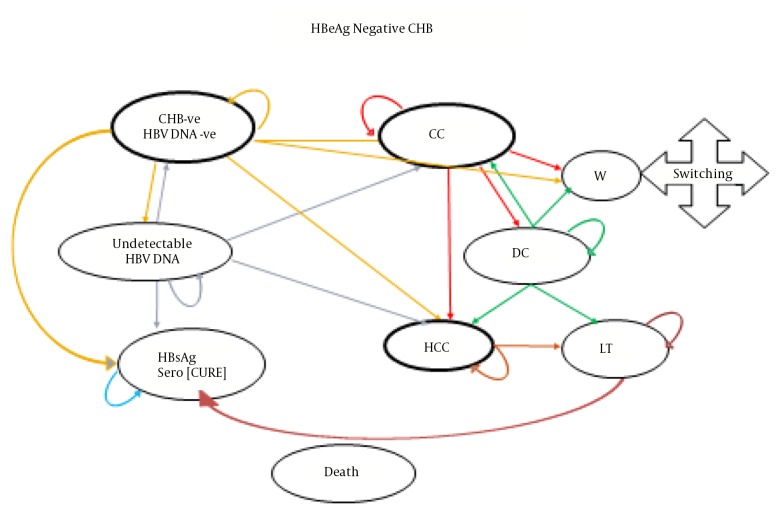
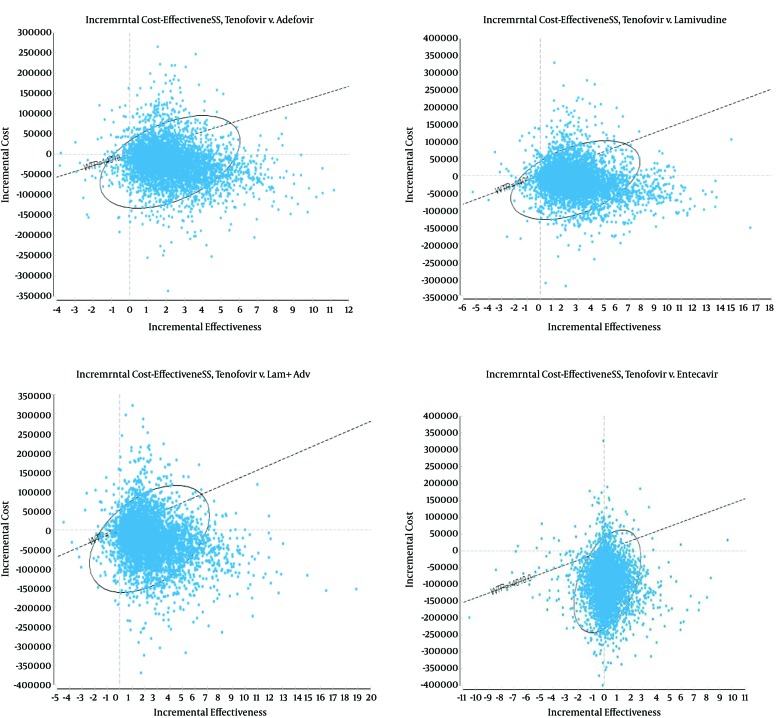
An economic evaluation of the cost utility of the following five oral medication strategies was conducted: adefovir (ADV), lamivudine (LAM), ADV + LAM, entecavir (ETV), and tenofovir (TDF). A Markov microsimulation model was used to estimate the clinical and economic outcomes over the course of the patient's lifetime and based on a societal perspective. Medical and nonmedical direct costs and indirect costs were included in the study and life-years gained (LYG) and quality-adjusted life-years (QALY) were determined as measures of effectiveness. The results are presented in terms of the incremental cost-effectiveness ratio (ICER) per QALY or LYG. The model consisted of nine stages of the disease. The transition probabilities for the movement between the different stages were based on clinical evidence and international expert opinion. A probabilistic sensitivity analysis (PSA) was used to measure the effects of uncertainty in the model parameters.
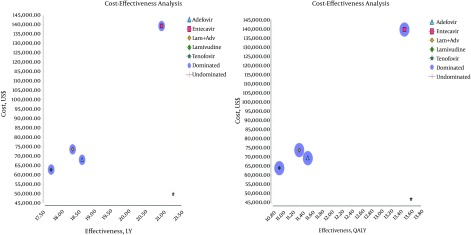
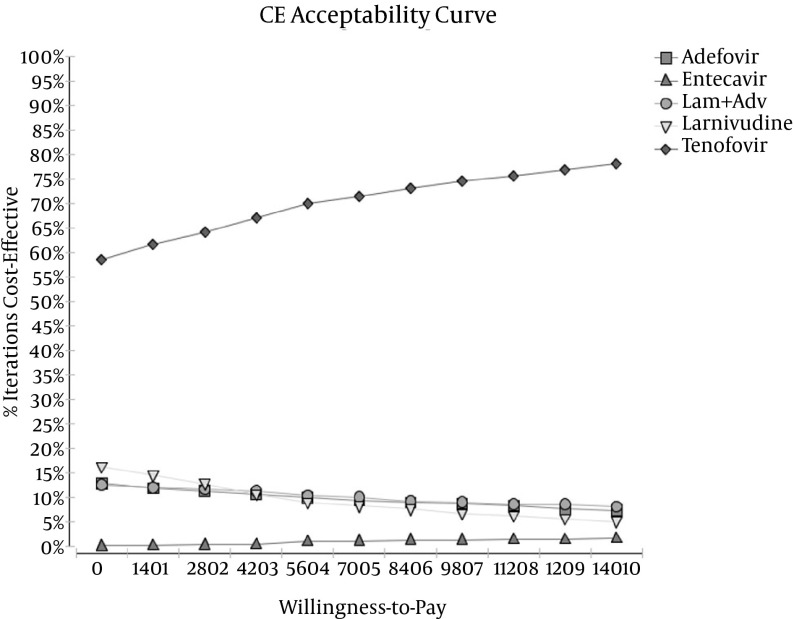
The results revealed that the TDF treatment strategy was more effective and less costly than the other options. In addition, TDF had the highest QALY and LYG in the HBeAg-negative CHB patients, with 13.58 and 21.26 (discounted) in all comparisons. The PSA proved the robustness of the model results. The cost-effectiveness acceptability curves showed that TDF was the most cost-effective treatment in 59% - 78% of the simulations of HBeAg-negative patients, with WTP thresholds less than $14010 (maximum WTP per QALY).
The use of TDF in patients with HBeAg-negative CHB seemed to be a highly cost-effective strategy. Compared with the other available medication options, TDF was the most cost-saving strategy. Thus, TDF may be the best option as a first-line medication. Patients can also be switched from other medications to TDF.
尽管乙型肝炎感染是伊朗慢性肝病的主要病因,但尚无研究对用于治疗伊朗慢性乙型肝炎(CHB)患者的药物进行经济学评估。因此,伊朗针对该疾病的不同治疗方案的成本效益尚不清楚。
本研究旨在比较伊朗HBeAg阴性CHB感染患者中根据当地情况量身定制的药物治疗策略的成本效用和成本效益。
对以下五种口服药物治疗策略的成本效用进行了经济学评估:阿德福韦(ADV)、拉米夫定(LAM)、ADV+LAM、恩替卡韦(ETV)和替诺福韦(TDF)。使用马尔可夫微观模拟模型,从社会角度估计患者一生中的临床和经济结果。研究纳入了医疗和非医疗直接成本以及间接成本,并将获得的生命年(LYG)和质量调整生命年(QALY)确定为有效性指标。结果以每QALY或LYG的增量成本效益比(ICER)表示。该模型由疾病的九个阶段组成。不同阶段之间转移的概率基于临床证据和国际专家意见。使用概率敏感性分析(PSA)来衡量模型参数不确定性的影响。
结果显示,TDF治疗策略比其他方案更有效且成本更低。此外,在HBeAg阴性CHB患者中,TDF的QALY和LYG最高,在所有比较中分别为13.58和21.26(贴现后)。PSA证明了模型结果的稳健性。成本效益可接受性曲线表明,在HBeAg阴性患者的59%-78%的模拟中,TDF是最具成本效益的治疗方法,支付意愿阈值低于14010美元(每QALY的最大支付意愿)。
在HBeAg阴性CHB患者中使用TDF似乎是一种极具成本效益的策略。与其他可用的药物选择相比,TDF是最节省成本的策略。因此,TDF可能是作为一线药物的最佳选择。患者也可以从其他药物转换为TDF。