Keshavarz Khosro, Kebriaeezadeh Abbas, Alavian Seyed Moayed, Akbari Sari Ali, Abedin Dorkoosh Farid, Keshvari Maryam, Malekhosseini Seyed Ali, Nikeghbalian Saman, Nikfar Shekoufeh
Department of Pharmacoeconomics and Pharmaceutical Administration, Faculty of Pharmacy, Tehran University of Medical Sciences, Tehran, IR Iran ; Health Human Resource Research Center, School of Management and Information Sciences, Shiraz University of Medical Sciences, Shiraz, IR Iran.
Department of Pharmacoeconomics and Pharmaceutical Administration, Faculty of Pharmacy, Tehran University of Medical Sciences, Tehran, IR Iran.
Hepat Mon. 2015 Apr 25;15(4):e25854. doi: 10.5812/hepatmon.15(4)2015.25854. eCollection 2015 Apr.
Hepatitis B infection is still the main cause of chronic liver disease in Iran, which is associated with significant economic and social costs.
This study aimed to estimate the financial burden caused by CHB infection and its complications in Iran.
Prevalence-based and bottom-up approaches were used to collect the data. Data on direct medical costs were extracted from outpatient medical records in a referral gastroenterology and hepatology research center, inpatient medical records in several major hospitals in Tehran and Shiraz in 2013, and the self-reports of specialists. Data on direct non-medical and indirect costs were collected based on the patients' self-reports through face-to-face interviews performed in the mentioned centers. To calculate the indirect costs, friction cost approach was used. To calculate the total cost-of-illness in Iran, the total cost per patient at each stage of the disease was estimated and multiplied by the total number of patients.
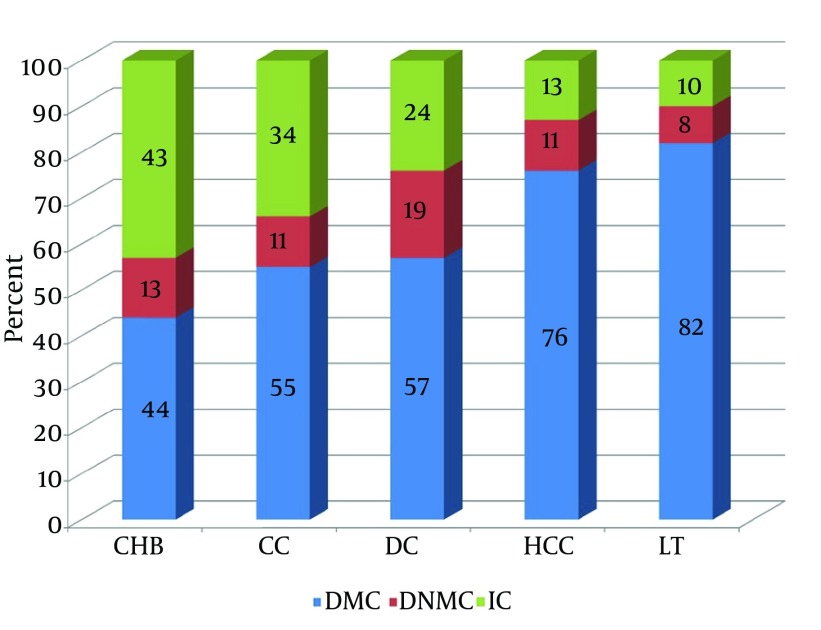
The total annual cost for the activate population of CHB patients and for those receiving treatment at various disease stages were respectively 450 million and 226 million dollars, with 64% and 70% of which allocated to direct costs respectively, and 36% and 30% to indirect costs respectively. The total direct costs alone for each group were respectively 1.17% and 0.6% of the total health expenditure. Furthermore, the cost spent on drugs encompasses the largest proportion of the direct medical cost for all stages of the disease.
According to the perspectives of payers, patients, and community, CHB infection can be considered as one of the diseases with a substantial economic burden; the disease, specifically in extreme cases, can be too expensive and costly for patients. Therefore, patients should be protected against more severe stages of the disease through proper treatment and early diagnosis.
乙型肝炎感染仍是伊朗慢性肝病的主要病因,这与巨大的经济和社会成本相关。
本研究旨在估算伊朗慢性乙型肝炎(CHB)感染及其并发症所造成的经济负担。
采用基于患病率和自下而上的方法收集数据。直接医疗成本数据来自一家转诊胃肠病学和肝病研究中心的门诊病历、2013年德黑兰和设拉子几家主要医院的住院病历以及专家的自我报告。直接非医疗成本和间接成本数据通过在上述中心进行的面对面访谈,根据患者的自我报告收集。为计算间接成本,采用了摩擦成本法。为计算伊朗的疾病总成本,估算了疾病各阶段每位患者的总成本,并乘以患者总数。
CHB患者活跃人群以及处于不同疾病阶段接受治疗患者的年度总成本分别为4.5亿美元和2.26亿美元,其中分别有64%和70%分配给直接成本,36%和30%分配给间接成本。每组仅直接成本就分别占卫生总支出的1.17%和0.6%。此外,药物支出在疾病所有阶段的直接医疗成本中占比最大。
从支付方、患者和社会的角度来看,CHB感染可被视为经济负担较重的疾病之一;这种疾病,特别是在极端情况下,对患者来说可能过于昂贵且成本高昂。因此,应通过适当治疗和早期诊断保护患者避免疾病进入更严重阶段。