Jin Xiao, Gou Jin-Ying
State Key Laboratory of Genetic Engineering, Institute of Plant Biology, Collaborative Innovation Center for Genetics and Development, School of Life Sciences, Fudan University, Shanghai, 200438 China.
Plant Methods. 2016 Nov 3;12:43. doi: 10.1186/s13007-016-0143-5. eCollection 2016.
Protein phosphorylation is one of the most important post-translational modifications catalyzed by protein kinases in living organisms. The advance of genome sequencing provided the information of protein kinase families in many organisms, including both model and non-model plants. The development of proteomics technologies also enabled scientists to efficiently reveal a large number of protein phosphorylations of an organism. However, kinases and phosphorylation targets are still to be connected to illustrate the complicated network in life.
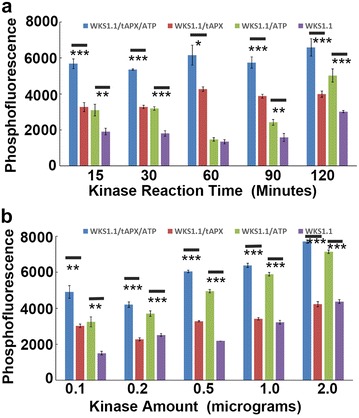
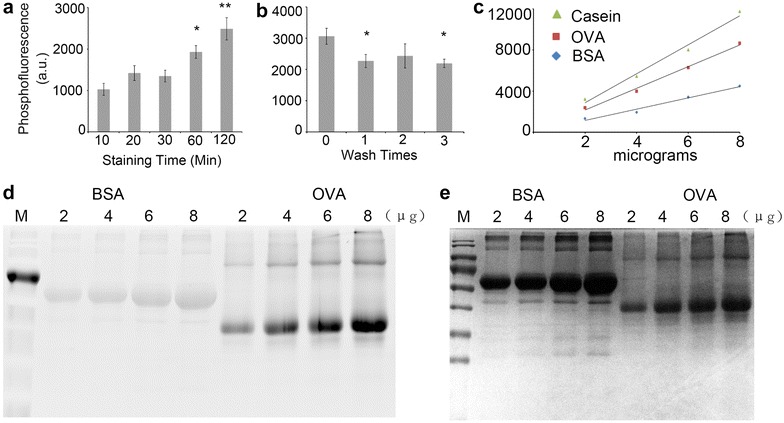
Here we adapted Pro-Q Diamond (Pro-Q Diamond Phosphoprotein Gel Stain), a widely used phosphoprotein gel-staining fluorescence dye, to establish a rapid, economical and non-radioactive fluorescence detection in tube (FDIT) method to analyze phosphorylated proteins. Taking advantages of high sensitivity and specificity of Pro-Q diamond, the FDIT method is also demonstrated to be rapid and reliable, with a suitable linear range for in vitro protein phosphorylation. A significant and satisfactory protein kinase reaction was detected as fast as 15 min from Wheat Kinase START 1.1 (WKS1.1) on a thylakoid ascorbate peroxidase (tAPX), an established phosphorylation target in our earlier study.
The FDIT method saves up to 95% of the dye consumed in a gel staining method. The FDIT method is remarkably quick, highly reproducible, unambiguous and capable to be scaled up to dozens of samples. The FDIT method could serve as a simple and sensitive alternative procedure to determine protein kinase reactions with zero radiation exposure, as a supplementation to other widely used radioactive and in-gel assays.
蛋白质磷酸化是生物体中由蛋白激酶催化的最重要的翻译后修饰之一。基因组测序的进展提供了许多生物体中蛋白激酶家族的信息,包括模式植物和非模式植物。蛋白质组学技术的发展也使科学家能够有效地揭示生物体中大量的蛋白质磷酸化。然而,激酶和磷酸化靶点仍有待关联,以阐明生命中的复杂网络。
在这里,我们采用了一种广泛使用的磷蛋白凝胶染色荧光染料——Pro-Q Diamond(Pro-Q Diamond磷蛋白凝胶染色剂),建立了一种快速、经济且无放射性的管内荧光检测(FDIT)方法来分析磷酸化蛋白。利用Pro-Q Diamond的高灵敏度和特异性,FDIT方法还被证明是快速可靠的,在体外蛋白质磷酸化方面具有合适的线性范围。在我们早期研究中已确定的磷酸化靶点——类囊体抗坏血酸过氧化物酶(tAPX)上,从小麦激酶START 1.1(WKS1.1)开始,在15分钟内就检测到了显著且令人满意的蛋白激酶反应。
FDIT方法比凝胶染色法节省多达95%的染料。FDIT方法非常快速、高度可重复、结果明确,并且能够扩展到数十个样本。作为一种补充其他广泛使用的放射性和凝胶内检测方法的手段,FDIT方法可以作为一种简单且灵敏的替代程序,用于在零辐射暴露的情况下测定蛋白激酶反应。