Kuriakose Robin K, Kukreja Rakesh C, Xi Lei
Pauley Heart Center, Division of Cardiology, Department of Internal Medicine, Virginia Commonwealth University, Richmond, VA 23298-0204, USA.
Pauley Heart Center, Division of Cardiology, Department of Internal Medicine, Virginia Commonwealth University, Richmond, VA 23298-0204, USA; School of Sports Medicine and Health, Chengdu Sport University, Chengdu 610041, China.
Oxid Med Cell Longev. 2016;2016:8139861. doi: 10.1155/2016/8139861. Epub 2016 Oct 17.
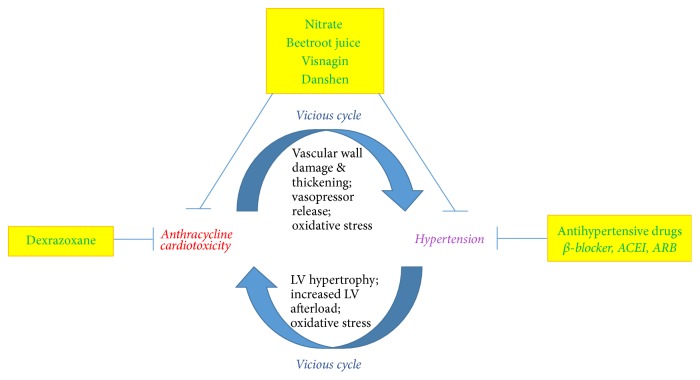
Despite their recognized cardiotoxic effects, anthracyclines remain an essential component in many anticancer regimens due to their superior antitumor efficacy. Epidemiologic data revealed that about one-third of cancer patients have hypertension, which is the most common comorbidity in cancer registries. The purpose of this review is to assess whether anthracycline chemotherapy exacerbates cardiotoxicity in patients with hypertension. A link between hypertension comorbidity and anthracycline-induced cardiotoxicity (AIC) was first suggested in 1979. Subsequent preclinical and clinical studies have supported the notion that hypertension is a major risk factor for AIC, along with the cumulative anthracycline dosage. There are several common or overlapping pathological mechanisms in AIC and hypertension, such as oxidative stress. Current evidence supports the utility of cardioprotective modalities as adjunct treatment prior to and during anthracycline chemotherapy. Several promising cardioprotective approaches against AIC pathologies include dexrazoxane, early hypertension management, and dietary supplementation of nitrate with beetroot juice or other medicinal botanical derivatives (e.g., visnagin and Danshen), which have both antihypertensive and anti-AIC properties. Future research is warranted to further elucidate the mechanisms of hypertension and AIC comorbidity and to conduct well-controlled clinical trials for identifying effective clinical strategies to improve long-term prognoses in this subgroup of cancer patients.
尽管蒽环类药物具有公认的心脏毒性作用,但由于其卓越的抗肿瘤疗效,它们仍是许多抗癌方案中的重要组成部分。流行病学数据显示,约三分之一的癌症患者患有高血压,这是癌症登记中最常见的合并症。本综述的目的是评估蒽环类化疗是否会加重高血压患者的心脏毒性。高血压合并症与蒽环类药物所致心脏毒性(AIC)之间的联系最早于1979年被提出。随后的临床前和临床研究支持了高血压与累积蒽环类药物剂量一样是AIC主要危险因素的观点。AIC和高血压存在几种常见或重叠的病理机制,如氧化应激。目前的证据支持在蒽环类化疗之前及期间采用心脏保护措施作为辅助治疗的效用。几种针对AIC病理的有前景的心脏保护方法包括右丙亚胺、早期高血压管理以及用甜菜根汁或其他药用植物衍生物(如紫铆因和丹参)进行硝酸盐膳食补充,这些方法兼具抗高血压和抗AIC特性。有必要开展进一步研究以进一步阐明高血压与AIC合并症的机制,并进行严格对照的临床试验,以确定有效的临床策略来改善这一亚组癌症患者的长期预后。