Joshi Ramila, Buchanan James Carlton, Paruchuri Sailaja, Morris Nathan, Tavana Hossein
Department of Biomedical Engineering, The University of Akron, Akron, Ohio 44325, United States of America.
Department of Chemistry, The University of Akron, Akron, Ohio 44325, United States of America.
PLoS One. 2016 Nov 10;11(11):e0166316. doi: 10.1371/journal.pone.0166316. eCollection 2016.
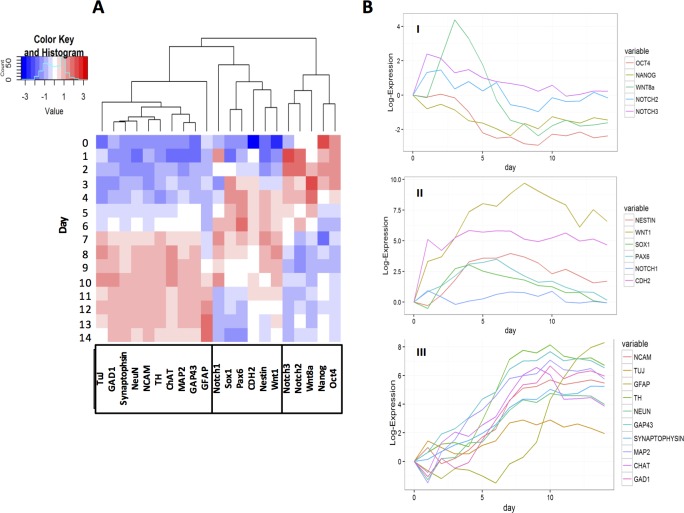
Deriving specific neural cells from embryonic stem cells (ESCs) is a promising approach for cell replacement therapies of neurodegenerative diseases. When co-cultured with certain stromal cells, mouse ESCs (mESCs) differentiate efficiently to neural cells. In this study, a comprehensive gene and protein expression analysis of differentiating mESCs is performed over a two-week culture period to track temporal progression of cells from a pluripotent state to specific terminally-differentiated neural cells such as neurons, astrocytes, and oligodendrocytes. Expression levels of 26 genes consisting of marker genes for pluripotency, neural progenitors, and specific neuronal, astroglial, and oligodendrocytic cells are tracked using real time q-PCR. The time-course gene expression analysis of differentiating mESCs is combined with the hierarchal clustering and functional principal component analysis (FPCA) to elucidate the evolution of specific neural cells from mESCs at a molecular level. These statistical analyses identify three major gene clusters representing distinct phases of transition of stem cells from a pluripotent state to a terminally-differentiated neuronal or glial state. Temporal protein expression studies using immunohistochemistry demonstrate the generation of neural stem/progenitor cells and specific neural lineages and show a close agreement with the gene expression profiles of selected markers. Importantly, parallel gene and protein expression analysis elucidates long-term stability of certain proteins compared to those with a quick turnover. Describing the molecular regulation of neural cells commitment of mESCs due to stromal signaling will help identify major promoters of differentiation into specific cell types for use in cell replacement therapy applications.
从胚胎干细胞(ESC)中获取特定神经细胞是神经退行性疾病细胞替代疗法的一种有前景的方法。当与某些基质细胞共培养时,小鼠胚胎干细胞(mESC)可高效分化为神经细胞。在本研究中,在为期两周的培养期内对分化中的mESC进行了全面的基因和蛋白质表达分析,以追踪细胞从多能状态到特定终末分化神经细胞(如神经元、星形胶质细胞和少突胶质细胞)的时间进程。使用实时定量PCR追踪由多能性、神经祖细胞以及特定神经元、星形胶质细胞和少突胶质细胞的标记基因组成的26个基因的表达水平。将分化中的mESC的时间进程基因表达分析与层次聚类和功能主成分分析(FPCA)相结合,以在分子水平上阐明从mESC中产生特定神经细胞的过程。这些统计分析确定了三个主要基因簇,代表干细胞从多能状态到终末分化神经元或神经胶质状态转变的不同阶段。使用免疫组织化学的时间进程蛋白质表达研究证明了神经干/祖细胞和特定神经谱系的产生,并与所选标记的基因表达谱显示出密切一致。重要的是,平行的基因和蛋白质表达分析阐明了某些蛋白质与周转迅速的蛋白质相比的长期稳定性。描述由于基质信号导致的mESC神经细胞定向分化的分子调控将有助于识别用于细胞替代治疗应用中分化为特定细胞类型的主要促进因子。