Aust Gabriela, Zhu Dan, Van Meir Erwin G, Xu Lei
Department of Surgery, Research Laboratories, University of Leipzig, Liebigstraße 19, Leipzig, 04103, Germany.
Department of Neurosurgery and Hematology & Medical Oncology, School of Medicine and Winship Cancer Institute, Emory University, Atlanta, GA, 30322, USA.
Handb Exp Pharmacol. 2016;234:369-396. doi: 10.1007/978-3-319-41523-9_17.
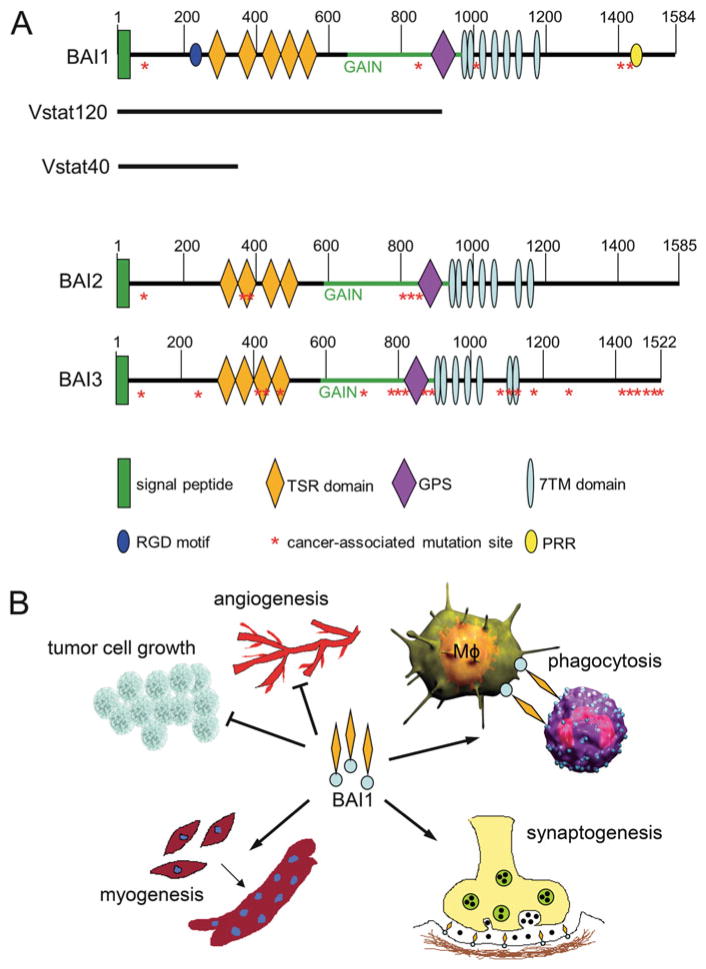
Alterations in the homeostasis of several adhesion GPCRs (aGPCRs) have been observed in cancer. The main cellular functions regulated by aGPCRs are cell adhesion, migration, polarity, and guidance, which are all highly relevant to tumor cell biology. Expression of aGPCRs can be induced, increased, decreased, or silenced in the tumor or in stromal cells of the tumor microenvironment, including fibroblasts and endothelial and/or immune cells. For example, ADGRE5 (CD97) and ADGRG1 (GPR56) show increased expression in many cancers, and initial functional studies suggest that both are relevant for tumor cell migration and invasion. aGPCRs can also impact the regulation of angiogenesis by releasing soluble fragments following the cleavage of their extracellular domain (ECD) at the conserved GPCR-proteolytic site (GPS) or other more distal cleavage sites as typical for the ADGRB (BAI) family. Interrogation of in silico cancer databases suggests alterations in other aGPCR members and provides the impetus for further exploration of their potential role in cancer. Integration of knowledge on the expression, regulation, and function of aGPCRs in tumorigenesis is currently spurring the first preclinical studies to examine the potential of aGPCR or the related pathways as therapeutic targets.
在癌症中已观察到几种粘附性G蛋白偶联受体(aGPCRs)的稳态发生改变。aGPCRs调节的主要细胞功能包括细胞粘附、迁移、极性和导向,这些都与肿瘤细胞生物学高度相关。在肿瘤或肿瘤微环境的基质细胞(包括成纤维细胞、内皮细胞和/或免疫细胞)中,aGPCRs的表达可被诱导、增加、降低或沉默。例如,ADGRE5(CD97)和ADGRG1(GPR56)在许多癌症中表达增加,初步功能研究表明两者都与肿瘤细胞迁移和侵袭有关。aGPCRs还可以通过在其胞外结构域(ECD)的保守GPCR蛋白水解位点(GPS)或其他更远端的蛋白水解位点(如ADGRB(BAI)家族典型的位点)切割后释放可溶性片段,来影响血管生成的调节。对计算机癌症数据库的研究表明其他aGPCR成员存在改变,并为进一步探索它们在癌症中的潜在作用提供了动力。目前,整合aGPCRs在肿瘤发生中的表达、调节和功能方面的知识,正在推动首批临床前研究,以检验aGPCR或相关途径作为治疗靶点的潜力。