Yuan Shuofeng, Chu Hin, Ye Jiahui, Singh Kailash, Ye Ziwei, Zhao Hanjun, Kao Richard Y T, Chow Billy K C, Zhou Jie, Zheng Bo-Jian
Department of Microbiology, Li Ka Shing Faculty of Medicine, The University of Hong Kong, Hong Kong, China.
School of Biological Sciences, Faculty of Science, The University of Hong Kong, Hong Kong, China.
Antiviral Res. 2017 Jan;137:58-66. doi: 10.1016/j.antiviral.2016.11.005. Epub 2016 Nov 10.
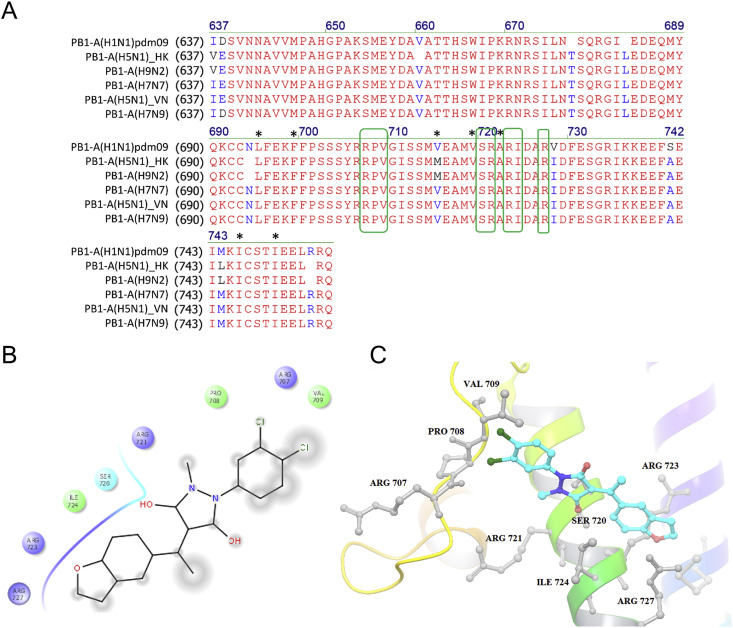
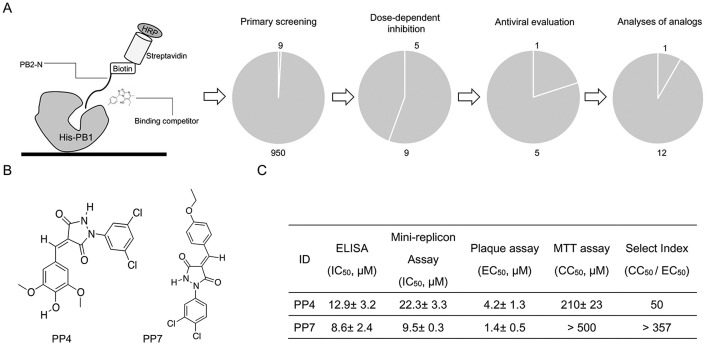
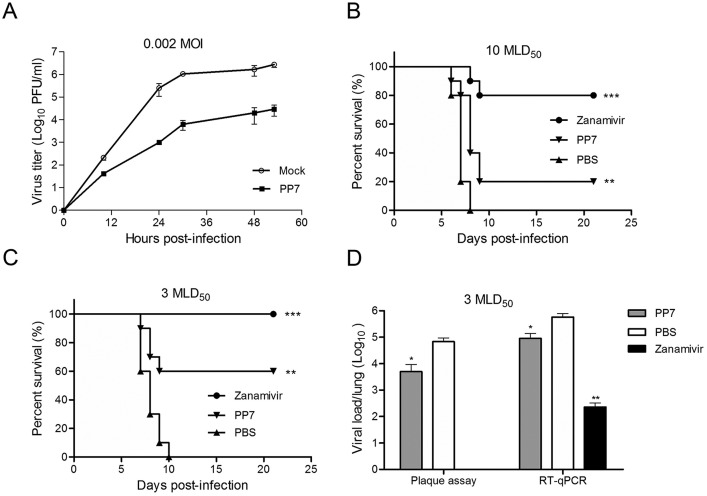
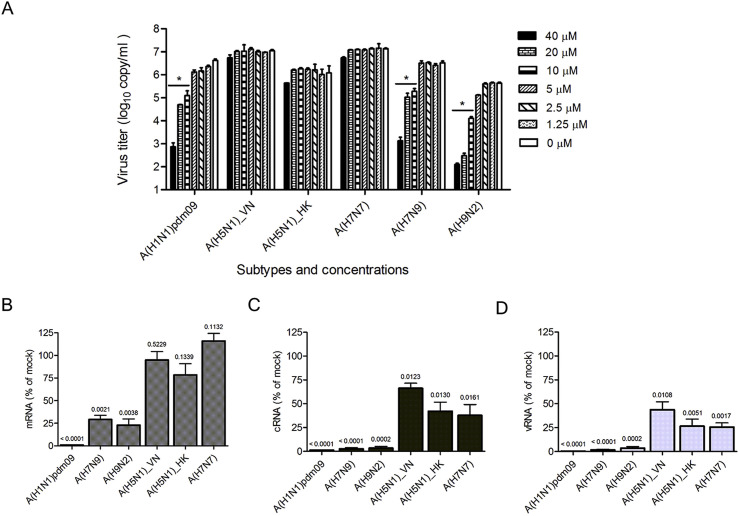
The PB1 C-terminal domain and PB2 N-terminal domain interaction of the influenza A polymerase, which modulates the assembly of PB1 and PB2 subunits, may serve as a valuable target for the development of novel anti-influenza therapeutics. In this study, we performed a systematic screening of a chemical library, followed by the antiviral evaluation of primary hits and their analogues. Eventually, a novel small-molecule compound PP7 that abrogated the PB1-PB2 association and impaired viral polymerase activity was identified. PP7 exhibited antiviral activities against influenza virus subtypes A (H1N1)pdm09, A(H7N9) and A(H9N2) in cell cultures and partially protected mice against lethal challenge of mouse-adapted influenza A (H1N1)pdm09 virus. Surprisingly, a panel of other subtypes of influenza virus, including A(H5N1) and A(H7N7), showed various degrees of resistance to the compound. Biochemical studies revealed a similar pattern of resistance on the impairment of polymerase activity. Molecular docking analyses suggested a PP7-binding site that appeared to be completely conserved among the subtypes of the virus mentioned above. Thus, we propose that alternative/additional binding site (s) may exist for the regulation of PB1-PB2 subunits assembly of influenza A virus.
甲型流感病毒聚合酶的PB1 C末端结构域与PB2 N末端结构域相互作用可调节PB1和PB2亚基的组装,这可能成为开发新型抗流感疗法的重要靶点。在本研究中,我们对一个化学文库进行了系统筛选,随后对初步筛选出的化合物及其类似物进行了抗病毒评估。最终,鉴定出一种新型小分子化合物PP7,它可消除PB1-PB2的结合并损害病毒聚合酶活性。PP7在细胞培养中对甲型流感病毒亚型A(H1N1)pdm09、A(H7N9)和A(H9N2)表现出抗病毒活性,并能部分保护小鼠免受适应小鼠的甲型流感病毒A(H1N1)pdm09病毒的致死性攻击。令人惊讶的是,包括A(H5N1)和A(H7N7)在内的一组其他流感病毒亚型对该化合物表现出不同程度的抗性。生化研究揭示了在聚合酶活性受损方面类似的抗性模式。分子对接分析表明,PP7结合位点在上述病毒亚型中似乎完全保守。因此,我们认为可能存在其他/额外的结合位点来调节甲型流感病毒PB1-PB2亚基的组装。