Alaverdashvili Mariam, Paterson Phyllis G
Neuroscience Research Cluster, Saskatoon, SK, S7N 5E5, Canada; College of Pharmacy and Nutrition, Saskatoon, SK, S7N 5E5, Canada; College of Medicine, University of Saskatchewan, Saskatoon, SK, S7N 5E5, Canada.
Neuroscience Research Cluster, Saskatoon, SK, S7N 5E5, Canada; College of Pharmacy and Nutrition, Saskatoon, SK, S7N 5E5, Canada.
Behav Brain Res. 2017 Feb 1;318:52-60. doi: 10.1016/j.bbr.2016.11.002. Epub 2016 Nov 11.
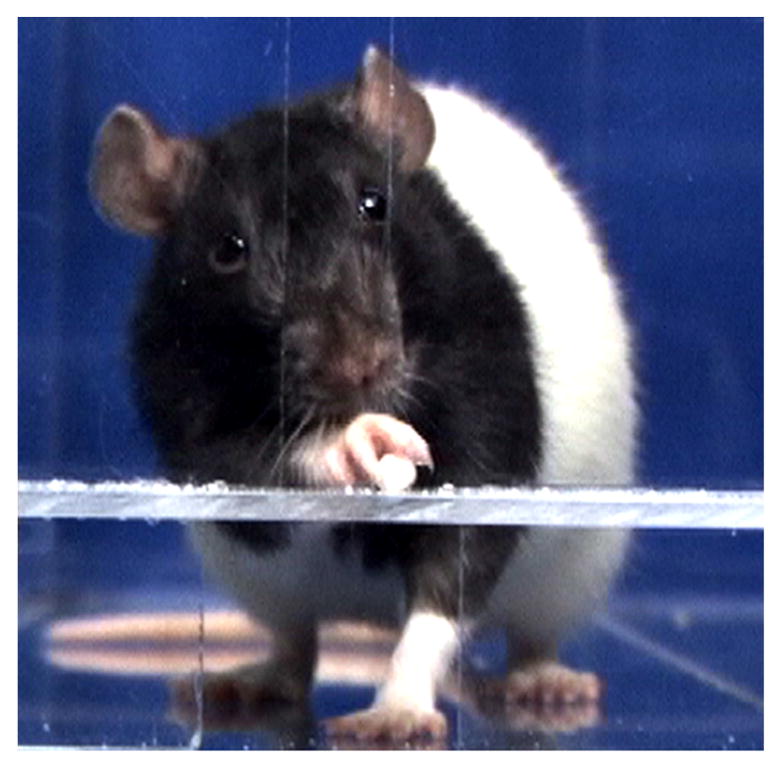
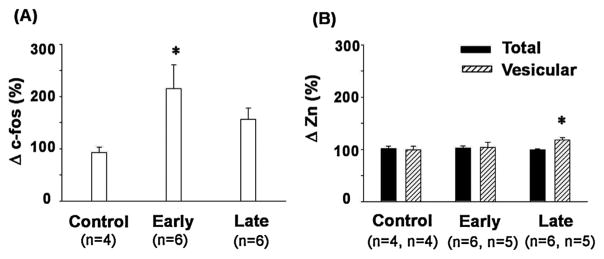
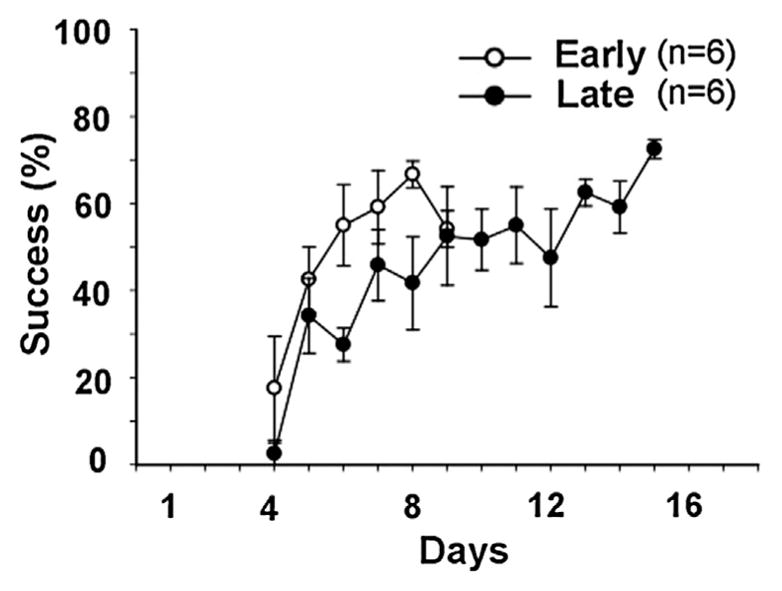
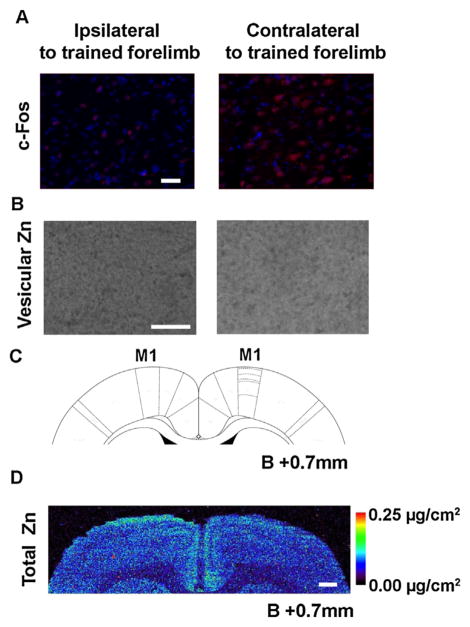
Synchrotron-based X-ray fluorescence imaging (XFI) of zinc (Zn) has been recently implemented to understand the efficiency of various therapeutic interventions targeting post-stroke neuroprotection and neuroplasticity. However, it is uncertain if micro XFI can resolve neuroplasticity-induced changes. Thus, we explored if learning-associated behavioral changes would be accompanied by changes in cortical Zn concentration measured by XFI in healthy adult rats. Proficiency in a skilled reach-to-eat task during early and late stages of motor learning served as a functional measure of neuroplasticity. c-Fos protein and vesicular Zn expression were employed as indirect neuronal measures of brain plasticity. A total Zn map (20×20×30μm resolution) generated by micro XFI failed to reflect increases in either c-Fos or vesicular Zn in the motor cortex contralateral to the trained forelimb or improved proficiency in the skilled reaching task. Remarkably, vesicular Zn increased in the late stage of motor learning along with a concurrent decrease in the number of c-fos-ip neurons relative to the early stage of motor learning. This inverse dynamics of c-fos and vesicular Zn level as the motor skill advances suggest that a qualitatively different neural population, comprised of fewer active but more efficiently connected neurons, supports a skilled action in the late versus early stage of motor learning. The lack of sensitivity of the XFI-generated Zn map to visualize the plasticity-associated changes in vesicular Zn suggests that the Zn level measured by micro XFI should not be used as a surrogate marker of neuroplasticity in response to the acquisition of skilled motor actions. Nanoscopic XFI could be explored in future as a means of imaging these subtle physiological changes.
基于同步加速器的锌(Zn)X射线荧光成像(XFI)最近已被用于了解针对中风后神经保护和神经可塑性的各种治疗干预措施的效果。然而,微型XFI是否能够分辨神经可塑性引起的变化尚不确定。因此,我们探究了在健康成年大鼠中,与学习相关的行为变化是否会伴随着通过XFI测量的皮质锌浓度的变化。在运动学习的早期和晚期,熟练完成一项熟练的伸手取食任务作为神经可塑性的功能指标。c-Fos蛋白和囊泡锌表达被用作大脑可塑性的间接神经元指标。微型XFI生成的总锌图(分辨率为20×20×30μm)未能反映训练前肢对侧运动皮层中c-Fos或囊泡锌的增加,也未反映熟练伸手任务熟练度的提高。值得注意的是,与运动学习早期相比,运动学习后期囊泡锌增加,同时c-fos免疫阳性神经元数量减少。随着运动技能的提高,c-fos和囊泡锌水平的这种反向动态变化表明,在运动学习的后期与早期,由较少活跃但连接更高效的神经元组成的性质不同的神经群体支持熟练动作。XFI生成的锌图缺乏可视化囊泡锌中可塑性相关变化的敏感性,这表明微型XFI测量的锌水平不应用作响应熟练运动动作习得的神经可塑性替代标志物。未来可以探索纳米级XFI作为成像这些细微生理变化的一种手段。