Bianchi Valentina, Brambilla Paolo, Garzitto Marco, Colombo Paola, Fornasari Livia, Bellina Monica, Bonivento Carolina, Tesei Alessandra, Piccin Sara, Conte Stefania, Perna Giampaolo, Frigerio Alessandra, Castiglioni Isabella, Fabbro Franco, Molteni Massimo, Nobile Maria
Scientific Institute, IRCCS Eugenio Medea, Bosisio Parini, Lecco, Italy.
Institute of Molecular Bioimaging and Physiology, National Research Council, Milan, Italy.
Eur Child Adolesc Psychiatry. 2017 May;26(5):549-557. doi: 10.1007/s00787-016-0918-2. Epub 2016 Nov 14.
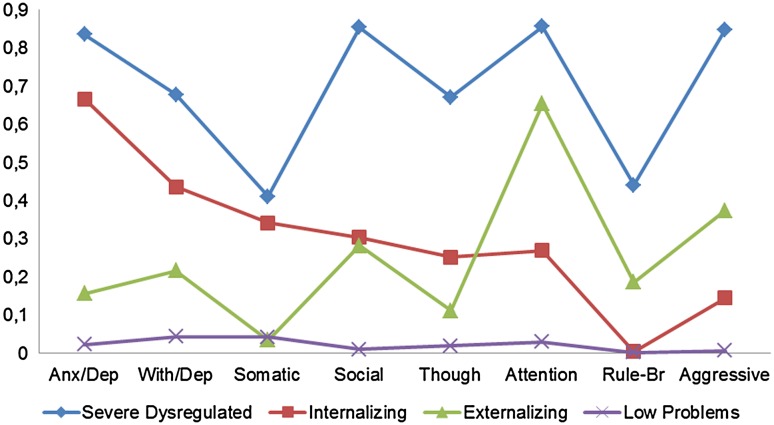
Researchers' interest have recently moved toward the identification of recurrent psychopathological profiles characterized by concurrent elevations on different behavioural and emotional traits. This new strategy turned to be useful in terms of diagnosis and outcome prediction. We used a person-centred statistical approach to examine whether different groups could be identified in a referred sample and in a general-population sample of children and adolescents, and we investigated their relation to DSM-IV diagnoses. A latent class analysis (LCA) was performed on the Child Behaviour Checklist (CBCL) syndrome scales of the referred sample (N = 1225), of the general-population sample (N = 3418), and of the total sample. Models estimating 1-class through 5-class solutions were compared and agreement in the classification of subjects was evaluated. Chi square analyses, a logistic regression, and a multinomial logistic regression analysis were used to investigate the relations between classes and diagnoses. In the two samples and in the total sample, the best-fitting models were 4-class solutions. The identified classes were Internalizing Problems (15.68%), Severe Dysregulated (7.82%), Attention/Hyperactivity (10.19%), and Low Problems (66.32%). Subsequent analyses indicated a significant relationship between diagnoses and classes as well as a main association between the severe dysregulated class and comorbidity. Our data suggested the presence of four different psychopathological profiles related to different outcomes in terms of psychopathological diagnoses. In particular, our results underline the presence of a profile characterized by severe emotional and behavioural dysregulation that is mostly associated with the presence of multiple diagnosis.
研究人员的兴趣最近转向识别以不同行为和情绪特征同时升高为特征的复发性精神病理特征。这种新策略在诊断和结果预测方面被证明是有用的。我们采用以人为主的统计方法,研究在转诊样本以及儿童和青少年的一般人群样本中是否可以识别出不同的组,并调查它们与DSM-IV诊断的关系。对转诊样本(N = 1225)、一般人群样本(N = 3418)和总样本的儿童行为检查表(CBCL)综合征量表进行了潜在类别分析(LCA)。比较了估计1类至5类解决方案的模型,并评估了受试者分类的一致性。使用卡方分析、逻辑回归和多项逻辑回归分析来研究类别与诊断之间的关系。在两个样本和总样本中,拟合度最佳的模型是4类解决方案。识别出的类别为内化问题(15.68%)、严重失调(7.82%)、注意力/多动(10.19%)和低问题(66.32%)。后续分析表明诊断与类别之间存在显著关系,以及严重失调类别与共病之间存在主要关联。我们的数据表明,在精神病理诊断方面存在四种与不同结果相关的不同精神病理特征。特别是,我们的结果强调存在一种以严重情绪和行为失调为特征的特征,这种特征大多与多重诊断的存在相关。