Trujillano Daniel, Bertoli-Avella Aida M, Kumar Kandaswamy Krishna, Weiss Maximilian Er, Köster Julia, Marais Anett, Paknia Omid, Schröder Rolf, Garcia-Aznar Jose Maria, Werber Martin, Brandau Oliver, Calvo Del Castillo Maria, Baldi Caterina, Wessel Karen, Kishore Shivendra, Nahavandi Nahid, Eyaid Wafaa, Al Rifai Muhammad Talal, Al-Rumayyan Ahmed, Al-Twaijri Waleed, Alothaim Ali, Alhashem Amal, Al-Sannaa Nouriya, Al-Balwi Mohammed, Alfadhel Majid, Rolfs Arndt, Abou Jamra Rami
Centogene AG, Rostock, Germany.
Division of Genetics, Department of Pediatrics, King Abdulaziz Medical City, Riyadh, Saudi Arabia.
Eur J Hum Genet. 2017 Feb;25(2):176-182. doi: 10.1038/ejhg.2016.146. Epub 2016 Nov 16.
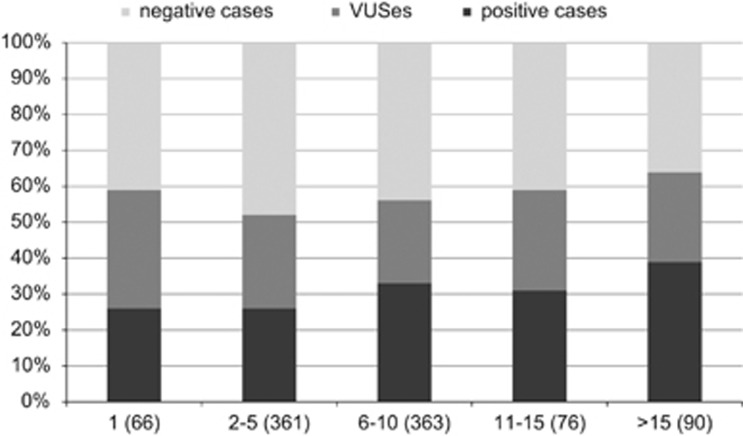
We report our results of 1000 diagnostic WES cases based on 2819 sequenced samples from 54 countries with a wide phenotypic spectrum. Clinical information given by the requesting physicians was translated to HPO terms. WES processes were performed according to standardized settings. We identified the underlying pathogenic or likely pathogenic variants in 307 families (30.7%). In further 253 families (25.3%) a variant of unknown significance, possibly explaining the clinical symptoms of the index patient was identified. WES enabled timely diagnosing of genetic diseases, validation of causality of specific genetic disorders of PTPN23, KCTD3, SCN3A, PPOX, FRMPD4, and SCN1B, and setting dual diagnoses by detecting two causative variants in distinct genes in the same patient. We observed a better diagnostic yield in consanguineous families, in severe and in syndromic phenotypes. Our results suggest that WES has a better yield in patients that present with several symptoms, rather than an isolated abnormality. We also validate the clinical benefit of WES as an effective diagnostic tool, particularly in nonspecific or heterogeneous phenotypes. We recommend WES as a first-line diagnostic in all cases without a clear differential diagnosis, to facilitate personal medical care.
我们报告了基于来自54个国家的2819个测序样本的1000例诊断性全外显子测序(WES)病例的结果,这些病例具有广泛的表型谱。请求医生提供的临床信息被转化为人类表型本体(HPO)术语。WES流程按照标准化设置进行。我们在307个家系(30.7%)中鉴定出潜在的致病或可能致病的变异。在另外253个家系(25.3%)中,鉴定出一个意义未明的变异,可能解释了先证者的临床症状。WES能够及时诊断遗传疾病,验证PTPN23、KCTD3、SCN3A、PPOX、FRMPD4和SCN1B等特定遗传疾病的因果关系,并通过在同一患者的不同基因中检测到两个致病变异来进行双重诊断。我们观察到在近亲家系、严重表型和综合征型表型中诊断率更高。我们的结果表明,WES在出现多种症状而非孤立异常的患者中诊断率更高。我们还验证了WES作为一种有效诊断工具的临床益处,特别是在非特异性或异质性表型中。我们建议在所有没有明确鉴别诊断的病例中,将WES作为一线诊断方法,以促进个性化医疗。