He Xue, Zhu Xikai, Li Lei, Zhang Jiayi, Wu Ruipeng, Zhang Yuan, Kang Longli, Yuan Dongya, Jin Tianbo
Key Laboratory for Molecular Genetic Mechanisms and Intervention Research on High Altitude Disease of Tibet Autonomous Region, School of Medicine, Xizang Minzu University, Xianyang, Shaanxi 712082, China.
Key Laboratory for Basic Life Science Research of Tibet Autonomous Region, School of Medicine, Xizang Minzu University, Xianyang, Shaanxi 712082, China.
Oncotarget. 2016 Dec 20;7(51):85283-85290. doi: 10.18632/oncotarget.13297.
Gliomas are highly malignant with a poor prognosis. Studies have reported that DNA repair genes influence risk for glioma, but its relationship with prognosis is unclear. In this study, we want to explore the relationship between DNA repair genes (XRCC3, XRCC4 and XRCC5) and prognosis of astrocytoma in the Chinese Han population.
160 astrocytoma cases were recruited in our study. Survival probabilities were estimated by using Kaplan-Meier analysis, and significant differences were analyzed by using the log-rank test. Cox proportional hazards models were used to analyze the associations between genotypes with astrocytoma survival. Hazard ratios (HR) and 95% confidence intervals (CI) were estimated using multivariable models. All tests were two-sided and p < 0.05 was considered to be significant.
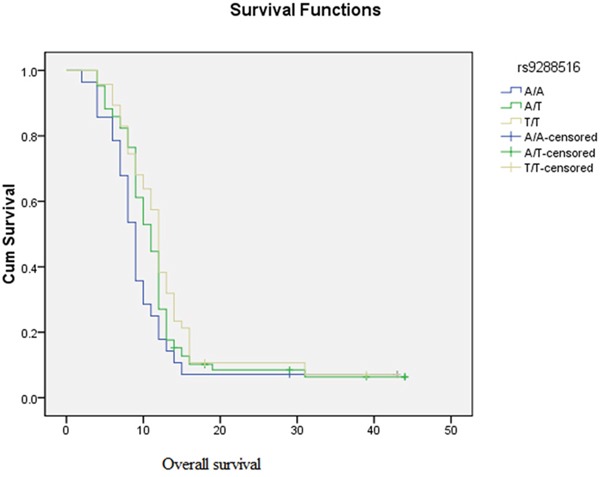
The SNP (rs9288516) in XRCC5 (HR: 1.69, 95%CI: 1.04 - 2.77, p = 0.049), surgical approach (HR: 0.61, 95%CI: 0.43 - 0.88, p = 0.003) and chemotherapy (HR: 0.71, 95%CI: 0.50 - 0.99, p = 0.029) were associated with astrocytoma prognosis. Further, the "A/A" genotype of rs9288516 in XRCC5 (HR: 1.67, 95%CI: 1.02 - 2.72, p = 0.042) had significantly outcomes after adjusting for potential confounders, patients with poor tumor differentiation and the coexistence of the unfavorable genotypes.
These results suggest that polymorphisms of XRCC5 play an important role in astrocytoma prognosis in the Chinese Han population which could be used in the determination of astrocytoma prognosis in clinical researches.
胶质瘤具有高度恶性,预后较差。研究报道DNA修复基因会影响患胶质瘤的风险,但其与预后的关系尚不清楚。在本研究中,我们想要探讨DNA修复基因(XRCC3、XRCC4和XRCC5)与中国汉族人群星形细胞瘤预后之间的关系。
本研究纳入了160例星形细胞瘤病例。采用Kaplan-Meier分析估计生存概率,并使用对数秩检验分析显著差异。采用Cox比例风险模型分析基因型与星形细胞瘤生存之间的关联。使用多变量模型估计风险比(HR)和95%置信区间(CI)。所有检验均为双侧检验,p<0.05被认为具有统计学意义。
XRCC5中的单核苷酸多态性(rs9288516)(HR:1.69,95%CI:1.04 - 2.77,p = 0.049)、手术方式(HR:0.61,95%CI:0.43 - 0.88,p = 0.003)和化疗(HR:0.71,95%CI:0.50 - 0.99,p = 0.029)与星形细胞瘤预后相关。此外,在调整潜在混杂因素、肿瘤分化差的患者以及不利基因型共存后,XRCC5中rs9288516的“A/A”基因型(HR:1.67,95%CI:1.02 - 2.72,p = 0.042)具有显著的预后结果。
这些结果表明,XRCC5基因多态性在中国汉族人群星形细胞瘤预后中起重要作用,可用于临床研究中星形细胞瘤预后的判定。