Mével Hermine, Demange Valérie, Penven Emmanuelle, Trontin Christian, Wild Pascal, Paris Christophe
INRS, Institut National de Recherche et de Sécurité, Vandoeuvre-lès-Nancy, France.
EA7298 INGRES, Université de Lorraine, Nancy, France.
BMC Public Health. 2016 Nov 16;16(1):1164. doi: 10.1186/s12889-016-3824-0.
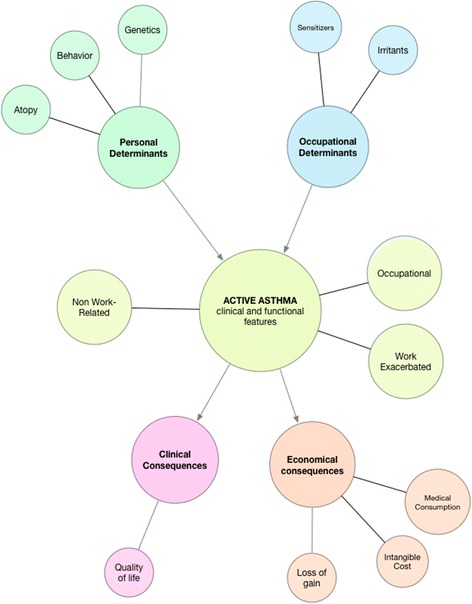
There are still uncertainties regarding the respective prevalence, diagnosis and management of occupational asthma (OA) and work-exacerbated asthma (WEA). There is as yet no standardized methodology to differentiate their diagnosis. A proper management of both OA and WEA requires tools for a good phenotyping in terms of control, severity and quality of life in order to propose case-specific therapeutical and preventive measures. Moreover, there is a lack of knowledge concerning their actual costs.
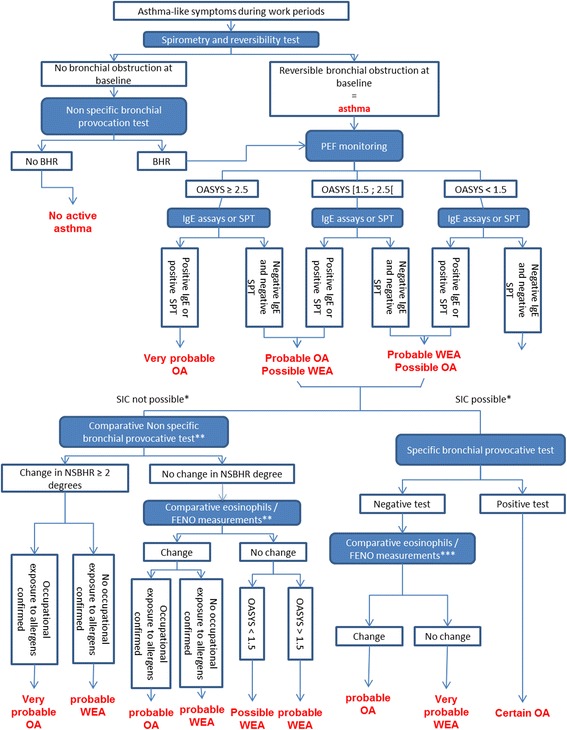
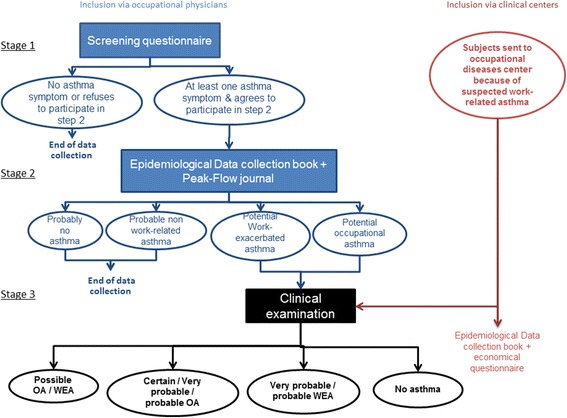
This project aims at comparing 3 groups of asthmatic subjects at work: subjects with OA, with WEA, and with non-work-related asthma (NWRA) in terms of control, severity and quality of life on the one hand, and estimating the prevalence of OA, WEA and NWRA in active workers and the economic costs of OA and WEA, on the other hand. Control will be assessed using the Asthma Control Test questionnaire and the daily Peak Exploratory Flow variability, severity from the treatment level, and quality of life using the Asthma Quality of Life Questionnaire. A first step will be to apply a standardized diagnosis procedure of WEA and OA. This study includes an epidemiological part in occupational health services by volunteering occupational physicians, and a clinical case-study based on potentially asthmatic subjects referred to ten participating University Hospital Occupational Diseases Departments (UHODD) because of a suspected WRA. The subjects' characterization with respect to OA and WEA is organized in three steps. In Step 1 (epidemiological part), occupational physicians screen for potentially actively asthmatics through a questionnaire given to workers seen in mandatory medical visit. In step 2 (both parts), the subjects with a suspicion of work-related respiratory symptoms answer a detailed questionnaire and perform a two-week OASYS protocol enabling us, using a specifically developed algorithm, to classify them into probably NWRA, suspected OA, suspected WEA. The two latter groups are referred to UHODD for a final harmonized diagnosis (step 3). Finally, direct and indirect disease-related costs during the year preceding the diagnosis will be explored among WRA cases, as well as these costs and the intangible costs, during the year following the diagnosis.
This project is an attempt to obtain a global picture of occupational asthma in France thanks to a multidisciplinary approach.
职业性哮喘(OA)和工作加重性哮喘(WEA)各自的患病率、诊断和管理仍存在不确定性。目前尚无区分它们诊断的标准化方法。对OA和WEA进行恰当管理需要具备控制、严重程度和生活质量方面良好表型分析的工具,以便提出针对具体病例的治疗和预防措施。此外,关于它们的实际成本缺乏了解。
本项目旨在比较三组在职哮喘患者:OA患者、WEA患者和非工作相关哮喘(NWRA)患者,一方面比较其控制情况、严重程度和生活质量,另一方面估计在职劳动者中OA、WEA和NWRA的患病率以及OA和WEA的经济成本。使用哮喘控制测试问卷和每日呼气峰流速变异性评估控制情况,根据治疗水平评估严重程度,使用哮喘生活质量问卷评估生活质量。第一步将应用WEA和OA的标准化诊断程序。本研究包括职业健康服务中的一个流行病学部分,由志愿参与的职业医生进行,以及一个基于因疑似工作相关哮喘(WRA)而转诊至十家参与研究的大学医院职业病科(UHODD)的潜在哮喘患者的临床病例研究。关于OA和WEA的受试者特征描述分三个步骤进行。在第1步(流行病学部分),职业医生通过向在强制医疗检查中见到的工人发放问卷来筛查潜在的活动性哮喘患者。在第2步(两个部分),怀疑有工作相关呼吸道症状的受试者回答详细问卷并执行为期两周的OASYS方案,通过专门开发的算法,使我们能够将他们分类为可能的NWRA、疑似OA、疑似WEA。后两组被转诊至UHODD进行最终的统一诊断(第3步)。最后,将在WRA病例中探讨诊断前一年与疾病相关的直接和间接成本,以及诊断后一年的这些成本和无形损失。
本项目试图通过多学科方法全面了解法国的职业性哮喘情况。