Jeong Ho Jung, Lee Hyun, Carriere Keumhee C, Kim Jung Hoon, Han Jin-Hyung, Shin Beomsu, Jeong Byeong-Ho, Koh Won-Jung, Kwon O Jung, Park Hye Yun
Division of Pulmonary and Critical Care Medicine, Department of Medicine, Samsung Medical Center, Sungkyunkwan University of Medicine, Seoul, South Korea.
Department of Mathematical and Statistical Sciences, University of Alberta, Edmonton, AB, Canada; Biostatistics and Clinical Epidemiology Center, Samsung Medical Center, Seoul, South Korea.
Int J Chron Obstruct Pulmon Dis. 2016 Nov 7;11:2757-2764. doi: 10.2147/COPD.S115581. eCollection 2016.
The association between positive bronchodilator response (BDR) at baseline and the effect of long-term bronchodilator therapy has not been well elucidated in patients with bronchiectasis. The aims of our study were to explore the association between positive BDR at baseline and lung-function improvement following long-term (3-12 months) bronchodilator therapy in bronchiectasis patients with airflow limitation.
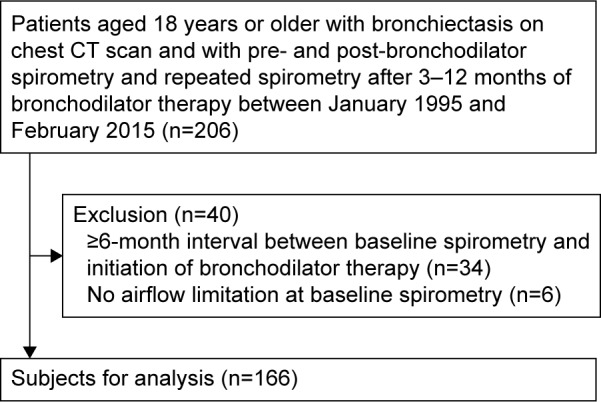
The medical records of 166 patients with clinically stable bronchiectasis who underwent baseline pre- and postbronchodilator spirometry and repeated spirometry after 3-12 months of bronchodilator therapy were retrospectively reviewed. For analysis, patients were divided into two groups, responders and poor responders, based on achievement of at least 12% and 200 mL in forced expiratory volume in 1 second (FEV) following bronchodilator therapy from baseline FEV.
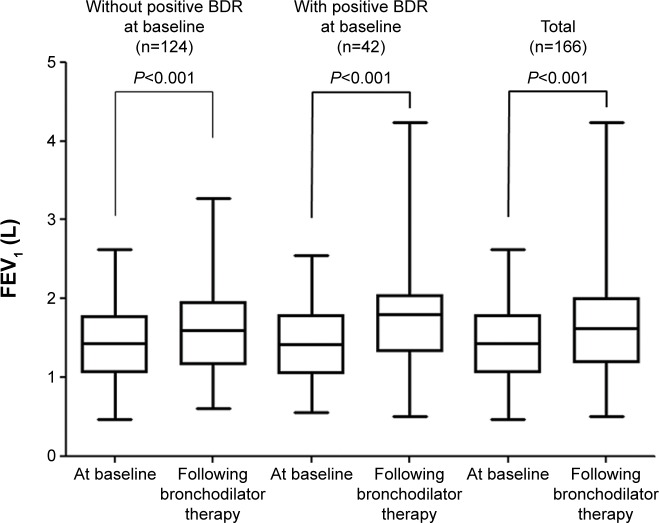
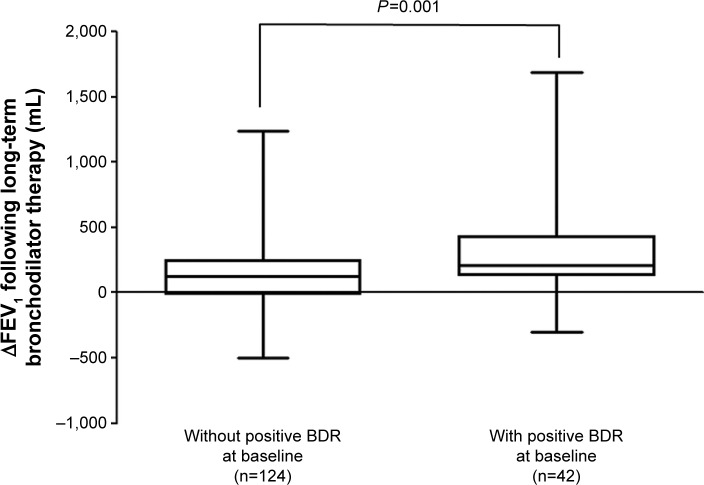
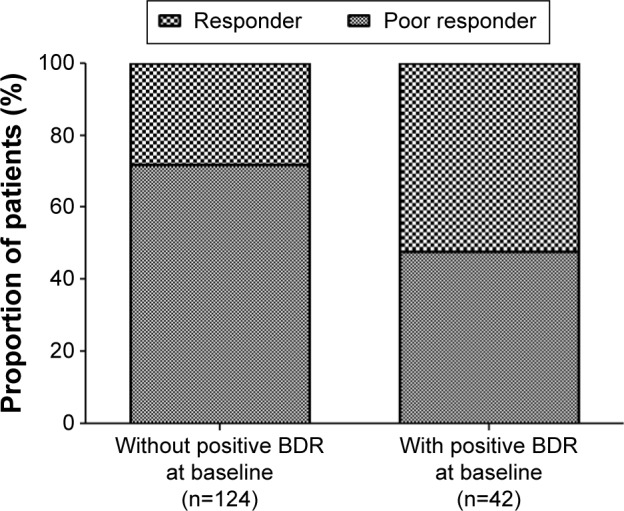
A total of 57 patients (34.3%) were responders. These patients were more likely to have positive BDR at baseline than poor responders (38.6% [22 of 57] vs 18.3% [20 of 109], =0.004). This association persisted after adjustment for other confounding factors (adjusted odds ratio 2.298, =0.034). However, we found FEV improved significantly following long-term bronchodilator therapy, even in patients without positive BDR at baseline (change in FEV 130 mL, interquartile range -10 to 250 mL; <0.001).
Positive BDR at baseline was independently associated with responsiveness to long-term bronchodilator therapy in bronchiectasis patients with airflow limitation. However, FEV improvement was also evident in bronchiectasis patients without positive BDR at baseline, suggesting that these patients can benefit from long-term bronchodilator therapy.
在支气管扩张症患者中,基线时支气管扩张剂反应阳性(BDR)与长期支气管扩张剂治疗效果之间的关联尚未得到充分阐明。我们研究的目的是探讨在有气流受限的支气管扩张症患者中,基线时BDR阳性与长期(3 - 12个月)支气管扩张剂治疗后肺功能改善之间的关联。
回顾性分析了166例临床稳定的支气管扩张症患者的病历,这些患者在基线时接受了支气管扩张剂使用前后的肺量计检查,并在支气管扩张剂治疗3 - 12个月后进行了重复肺量计检查。为了进行分析,根据支气管扩张剂治疗后第一秒用力呼气容积(FEV)较基线FEV增加至少12%且增加200 mL,将患者分为两组,即反应者和反应不佳者。
共有57例患者(34.3%)为反应者。这些患者在基线时比反应不佳者更有可能出现BDR阳性(38.6% [57例中的22例] 对18.3% [109例中的20例],P = 0.004)。在对其他混杂因素进行调整后,这种关联仍然存在(调整后的优势比为2.298,P = 0.034)。然而,我们发现即使在基线时没有BDR阳性的患者中,长期支气管扩张剂治疗后FEV也有显著改善(FEV变化为130 mL,四分位间距为 - 10至250 mL;P < 0.001)。
在有气流受限的支气管扩张症患者中,基线时BDR阳性与对长期支气管扩张剂治疗的反应独立相关。然而,在基线时没有BDR阳性的支气管扩张症患者中,FEV改善也很明显,这表明这些患者可以从长期支气管扩张剂治疗中获益。