Sawada Ryusuke, Ke Runcong, Tsuji Toshiyuki, Sonoyama Masashi, Mitaku Shigeki
Department of Applied Physics, Graduate School of Engineering, Nagoya University, Furocho, Chikusa-ku, Nagoya 464-8606, Japan.
Biophysics (Nagoya-shi). 2007 Aug 31;3:37-45. doi: 10.2142/biophysics.3.37. eCollection 2007.
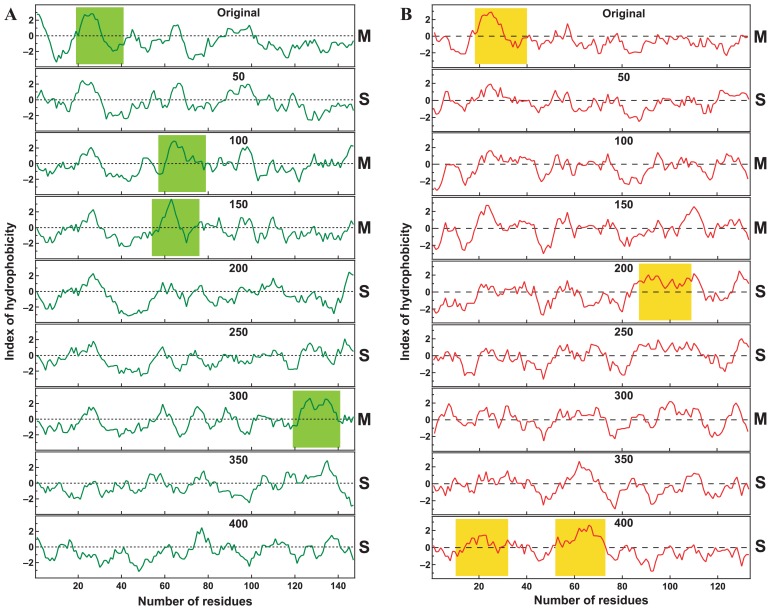
The numbers of membrane proteins in the current genomes of various organisms provide an important clue about how the protein world has evolved from the aspect of membrane proteins. Numbers of membrane proteins were estimated by analyzing the total proteomes of 248 prokaryota, using the SOSUI system for membrane proteins (Hirokawa , , 1998) and SOSUI-signal for signal peptides (Gomi , , 2004). The results showed that the ratio of membrane proteins to total proteins in these proteomes was almost constant: 0.228. When amino acid sequences were randomized, setting the probability of occurrence of all amino acids to 5%, the membrane protein/total protein ratio decreased to about 0.085. However, when the same simulation was carried out, but using the amino acid composition of the above proteomes, this ratio was 0.218, which is nearly the same as that of the real proteomic systems. This fact is consistent with the birth, death and innovation (BDI) model for membrane proteins, in which transmembrane segments emerge and disappear in accordance with random mutation events.
各种生物体当前基因组中的膜蛋白数量,从膜蛋白的角度为蛋白质世界的进化方式提供了重要线索。通过使用膜蛋白的SOSUI系统(Hirokawa等,1998年)和信号肽的SOSUI信号(Gomi等,2004年)分析248种原核生物的总蛋白质组,估算出膜蛋白的数量。结果表明,这些蛋白质组中膜蛋白与总蛋白的比例几乎恒定:0.228。当氨基酸序列随机化,将所有氨基酸出现的概率设定为5%时,膜蛋白/总蛋白比例降至约0.085。然而,当使用上述蛋白质组的氨基酸组成进行相同模拟时,该比例为0.218,与真实蛋白质组系统的比例几乎相同。这一事实与膜蛋白的诞生、死亡和创新(BDI)模型一致,在该模型中,跨膜片段根据随机突变事件出现和消失。