Kwon Min Jung, Yoon Hyuk Jun, Kim Byung Gon
Department of Brain Science, Ajou University School of Medicine, Suwon, Republic of Korea; Neuroscience Graduate Program, Department of Biomedical Sciences, Ajou University Graduate School of Medicine, Suwon, Republic of Korea.
Department of Brain Science, Ajou University School of Medicine, Suwon, Republic of Korea; Department of Neurology, Ajou University School of Medicine, Suwon, Republic of Korea; Neuroscience Graduate Program, Department of Biomedical Sciences, Ajou University Graduate School of Medicine, Suwon, Republic of Korea.
Neural Regen Res. 2016 Sep;11(9):1368-1371. doi: 10.4103/1673-5374.191194.
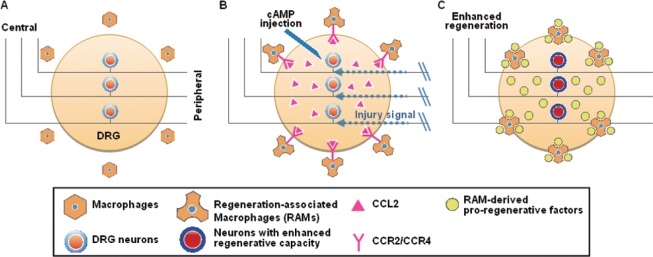
Axons in central nervous system (CNS) do not regenerate spontaneously after injuries such as stroke and traumatic spinal cord injury. Both intrinsic and extrinsic factors are responsible for the regeneration failure. Although intensive research efforts have been invested on extrinsic regeneration inhibitors, the extent to which glial inhibitors contribute to the regeneration failure still remains elusive. Recent experimental evidence has rekindled interests in intrinsic factors for the regulation of regeneration capacity in adult mammals. In this review, we propose that activating macrophages with pro-regenerative molecular signatures could be a novel approach for boosting intrinsic regenerative capacity of CNS neurons. Using a conditioning injury model in which regeneration of central branches of dorsal root ganglia sensory neurons is enhanced by a preceding injury to the peripheral branches, we have demonstrated that perineuronal macrophages surrounding dorsal root ganglia neurons are critically involved in the maintenance of enhanced regeneration capacity. Neuron-derived chemokine (C-C motif) ligand 2 (CCL2) seems to mediate neuron-macrophage interactions conveying injury signals to perineuronal macrophages taking on a soley pro-regenerative phenotype, which we designate as regeneration-associated macrophages (RAMs). Manipulation of the CCL2 signaling could boost regeneration potential mimicking the conditioning injury, suggesting that the chemokine-mediated RAM activation could be utilized as a regenerative therapeutic strategy for CNS injuries.
中枢神经系统(CNS)中的轴突在遭受中风和创伤性脊髓损伤等损伤后不会自发再生。内在因素和外在因素均导致了再生失败。尽管人们对外在再生抑制剂进行了大量研究,但神经胶质抑制剂在多大程度上导致再生失败仍不清楚。最近的实验证据重新激发了人们对调节成年哺乳动物再生能力的内在因素的兴趣。在这篇综述中,我们提出用具有促再生分子特征激活巨噬细胞可能是增强中枢神经系统神经元内在再生能力的一种新方法。使用一种条件性损伤模型,其中背根神经节感觉神经元的中枢支再生通过先前对外周支的损伤而增强,我们已经证明,围绕背根神经节神经元的神经元周围巨噬细胞在维持增强的再生能力中起关键作用。神经元衍生的趋化因子(C-C基序)配体2(CCL2)似乎介导神经元-巨噬细胞相互作用,将损伤信号传递给呈现单一促再生表型的神经元周围巨噬细胞,我们将其称为再生相关巨噬细胞(RAMs)。操纵CCL2信号传导可以增强再生潜力,模拟条件性损伤,这表明趋化因子介导的RAM激活可以用作中枢神经系统损伤的再生治疗策略。