Heng Yujing J, Lester Susan C, Tse Gary Mk, Factor Rachel E, Allison Kimberly H, Collins Laura C, Chen Yunn-Yi, Jensen Kristin C, Johnson Nicole B, Jeong Jong Cheol, Punjabi Rahi, Shin Sandra J, Singh Kamaljeet, Krings Gregor, Eberhard David A, Tan Puay Hoon, Korski Konstanty, Waldman Frederic M, Gutman David A, Sanders Melinda, Reis-Filho Jorge S, Flanagan Sydney R, Gendoo Deena Ma, Chen Gregory M, Haibe-Kains Benjamin, Ciriello Giovanni, Hoadley Katherine A, Perou Charles M, Beck Andrew H
Cancer Research Institute, Beth Israel Deaconess Cancer Center, Boston, MA, USA.
Department of Pathology, Harvard Medical School, Beth Israel Deaconess Medical Center, Boston, MA, USA.
J Pathol. 2017 Feb;241(3):375-391. doi: 10.1002/path.4847. Epub 2016 Dec 29.
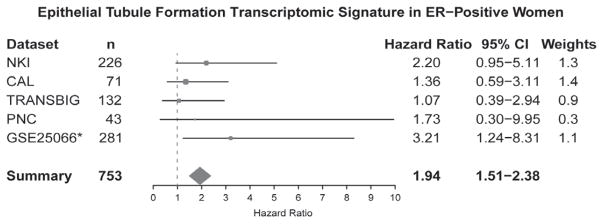
The histopathological evaluation of morphological features in breast tumours provides prognostic information to guide therapy. Adjunct molecular analyses provide further diagnostic, prognostic and predictive information. However, there is limited knowledge of the molecular basis of morphological phenotypes in invasive breast cancer. This study integrated genomic, transcriptomic and protein data to provide a comprehensive molecular profiling of morphological features in breast cancer. Fifteen pathologists assessed 850 invasive breast cancer cases from The Cancer Genome Atlas (TCGA). Morphological features were significantly associated with genomic alteration, DNA methylation subtype, PAM50 and microRNA subtypes, proliferation scores, gene expression and/or reverse-phase protein assay subtype. Marked nuclear pleomorphism, necrosis, inflammation and a high mitotic count were associated with the basal-like subtype, and had a similar molecular basis. Omics-based signatures were constructed to predict morphological features. The association of morphology transcriptome signatures with overall survival in oestrogen receptor (ER)-positive and ER-negative breast cancer was first assessed by use of the Molecular Taxonomy of Breast Cancer International Consortium (METABRIC) dataset; signatures that remained prognostic in the METABRIC multivariate analysis were further evaluated in five additional datasets. The transcriptomic signature of poorly differentiated epithelial tubules was prognostic in ER-positive breast cancer. No signature was prognostic in ER-negative breast cancer. This study provided new insights into the molecular basis of breast cancer morphological phenotypes. The integration of morphological with molecular data has the potential to refine breast cancer classification, predict response to therapy, enhance our understanding of breast cancer biology, and improve clinical management. This work is publicly accessible at www.dx.ai/tcga_breast. Copyright © 2016 Pathological Society of Great Britain and Ireland. Published by John Wiley & Sons, Ltd.
对乳腺肿瘤形态学特征进行组织病理学评估可为治疗提供预后信息。辅助分子分析可提供更多的诊断、预后和预测信息。然而,对于浸润性乳腺癌形态学表型的分子基础,我们了解有限。本研究整合了基因组、转录组和蛋白质数据,以全面分析乳腺癌形态学特征的分子概况。15位病理学家对来自癌症基因组图谱(TCGA)的850例浸润性乳腺癌病例进行了评估。形态学特征与基因组改变、DNA甲基化亚型、PAM50和微小RNA亚型、增殖评分、基因表达及/或反相蛋白质分析亚型显著相关。明显的核多形性、坏死、炎症和高有丝分裂计数与基底样亚型相关,且具有相似的分子基础。构建了基于组学的特征来预测形态学特征。首先利用国际乳腺癌分子分类联盟(METABRIC)数据集评估形态学转录组特征与雌激素受体(ER)阳性和ER阴性乳腺癌总生存的相关性;在METABRIC多变量分析中仍具有预后意义的特征在另外五个数据集中进一步评估。低分化上皮小管的转录组特征在ER阳性乳腺癌中具有预后意义。在ER阴性乳腺癌中没有特征具有预后意义。本研究为乳腺癌形态学表型的分子基础提供了新的见解。形态学与分子数据的整合有可能优化乳腺癌分类、预测治疗反应、增进我们对乳腺癌生物学的理解并改善临床管理。这项工作可在www.dx.ai/tcga_breast上公开获取。版权所有© 2016英国及爱尔兰病理学会。由约翰·威利父子有限公司出版。