Jiang Wen Zhi, Henry Isabelle M, Lynagh Peter G, Comai Luca, Cahoon Edgar B, Weeks Donald P
Department of Biochemistry and Center for Plant Science Innovation, University of Nebraska, Lincoln, NE, USA.
Department of Plant Biology and UC Davis Genome Center, University of California, Davis, CA, USA.
Plant Biotechnol J. 2017 May;15(5):648-657. doi: 10.1111/pbi.12663. Epub 2017 Jan 12.
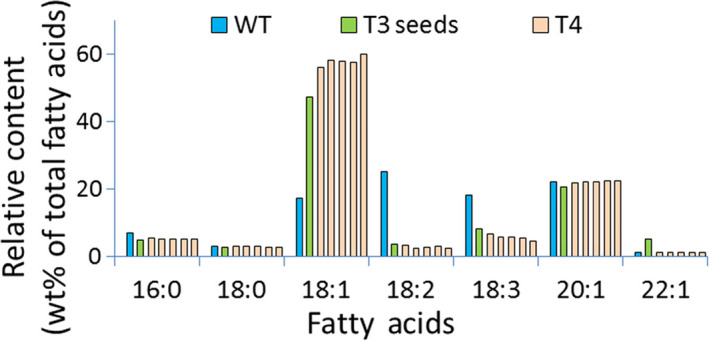
The CRISPR/Cas9 nuclease system is a powerful and flexible tool for genome editing, and novel applications of this system are being developed rapidly. Here, we used CRISPR/Cas9 to target the FAD2 gene in Arabidopsis thaliana and in the closely related emerging oil seed plant, Camelina sativa, with the goal of improving seed oil composition. We successfully obtained Camelina seeds in which oleic acid content was increased from 16% to over 50% of the fatty acid composition. These increases were associated with significant decreases in the less desirable polyunsaturated fatty acids, linoleic acid (i.e. a decrease from ~16% to <4%) and linolenic acid (a decrease from ~35% to <10%). These changes result in oils that are superior on multiple levels: they are healthier, more oxidatively stable and better suited for production of certain commercial chemicals, including biofuels. As expected, A. thaliana T and T generation seeds exhibiting these types of altered fatty acid profiles were homozygous for disrupted FAD2 alleles. In the allohexaploid, Camelina, guide RNAs were designed that simultaneously targeted all three homoeologous FAD2 genes. This strategy that significantly enhanced oil composition in T and T generation Camelina seeds was associated with a combination of germ-line mutations and somatic cell mutations in FAD2 genes in each of the three Camelina subgenomes.
CRISPR/Cas9核酸酶系统是一种用于基因组编辑的强大且灵活的工具,该系统的新应用正在迅速发展。在此,我们使用CRISPR/Cas9靶向拟南芥和与之密切相关的新兴油料作物亚麻荠中的FAD2基因,目的是改善种子油成分。我们成功获得了亚麻荠种子,其中油酸含量在脂肪酸组成中的占比从16%增加到了50%以上。这些增加伴随着较不理想的多不饱和脂肪酸亚油酸(即从约16%降至<4%)和亚麻酸(从约35%降至<10%)的显著减少。这些变化使得种子油在多个层面上更具优势:它们更健康、氧化稳定性更高,并且更适合用于生产某些商业化学品,包括生物燃料。正如预期的那样,表现出这类脂肪酸谱改变的拟南芥T代和T代种子对于FAD2等位基因的破坏是纯合的。在异源六倍体亚麻荠中,设计了同时靶向所有三个同源FAD2基因的引导RNA。这一显著提高T代和T代亚麻荠种子油成分的策略与三个亚麻荠亚基因组中每个亚基因组的FAD2基因中的种系突变和体细胞突变的组合相关。