Belon Ana Paula, Nieuwendyk Laura M, Vallianatos Helen, Nykiforuk Candace I J
University of Alberta, Canada.
University of Alberta, Canada.
Soc Sci Med. 2016 Dec;171:18-29. doi: 10.1016/j.socscimed.2016.11.004. Epub 2016 Nov 4.
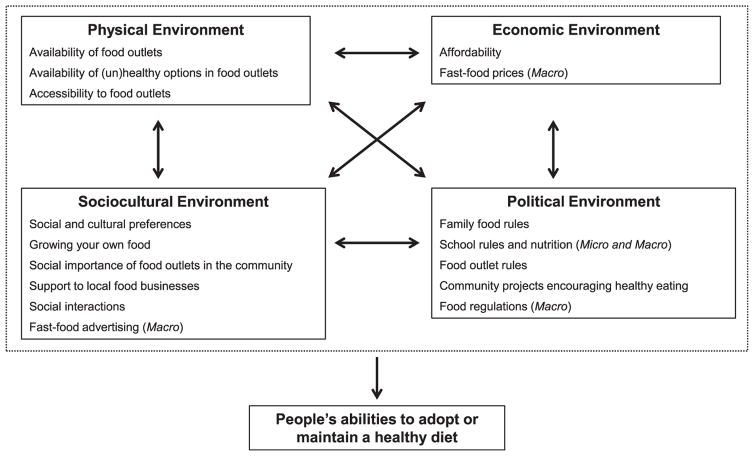
People's perceptions of local food environments influence their abilities to eat healthily. PhotoVoice participants from four communities in Alberta, Canada took pictures of barriers and opportunities for healthy eating and shared their stories in one-on-one semi-structured interviews. Using a socioecological framework, emergent themes were organized by type and size of environment. Findings show that, while availability and access to food outlets influence healthy eating practices, these factors may be eclipsed by other non-physical environmental considerations, such as food regulations and socio-cultural preferences. This study identifies a set of meta-themes that summarize and illustrate the interrelationships between environmental attributes, people's perceptions, and eating behaviors: a) availability and accessibility are interrelated and only part of the healthy eating equation; b) local food is synonymous with healthy eating; c) local food places for healthy eating help define community identity; d) communal dining (commensality) does not necessarily mean healthy eating; e) rewarding an achievement or celebrating special occasions with highly processed foods is socially accepted; f) food costs seemed to be driving forces in food decisions; g) macro-environmental influences are latent in food decisions. Recognizing the interrelationship among multiple environmental factors may help efforts to design effective community-based interventions and address knowledge gaps on how sociocultural, economic, and political environments intersect with physical worlds.
人们对当地食物环境的认知会影响他们健康饮食的能力。来自加拿大艾伯塔省四个社区的“照片之声”参与者拍摄了健康饮食的障碍和机遇照片,并在一对一的半结构化访谈中分享了他们的故事。利用社会生态框架,根据环境的类型和规模对浮现出的主题进行了整理。研究结果表明,虽然食品店的可及性和可得性会影响健康饮食行为,但这些因素可能会被其他非物质环境因素所掩盖,比如食品法规和社会文化偏好。本研究确定了一组元主题,这些主题总结并阐明了环境属性、人们的认知和饮食行为之间的相互关系:a)可及性和可得性相互关联,且只是健康饮食等式的一部分;b)本地食物等同于健康饮食;c)提供健康饮食的本地场所有助于界定社区身份;d) communal dining(共餐)不一定意味着健康饮食;e)用高度加工食品奖励成就或庆祝特殊场合在社会上是被接受的;f)食品成本似乎是食物决策的驱动因素;g)宏观环境影响在食物决策中是潜在的。认识到多种环境因素之间的相互关系,可能有助于设计有效的基于社区的干预措施,并填补关于社会文化、经济和政治环境如何与物质世界相互交织的知识空白。