Hendrickx S, Guerin P J, Caljon G, Croft S L, Maes L
Laboratory for Microbiology,Parasitology and Hygiene (LMPH),University of Antwerp,Antwerp,Belgium.
Nuffield Department of Clinical Medicine,Centre for Tropical Medicine and Global Health,University of Oxford,Oxford,UK.
Parasitology. 2018 Apr;145(4):453-463. doi: 10.1017/S0031182016002031. Epub 2016 Nov 21.
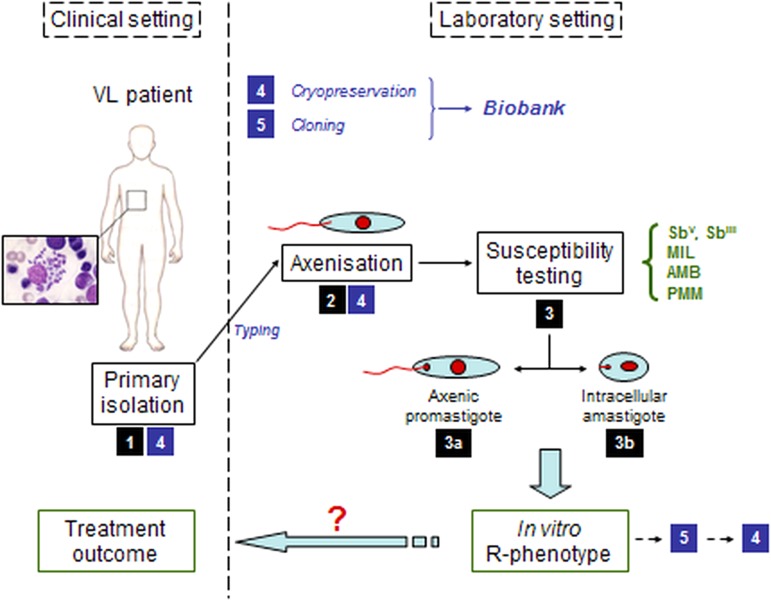
For decades antimonials were the drugs of choice for the treatment of visceral leishmaniasis (VL), but the recent emergence of resistance has made them redundant as first-line therapy in the endemic VL region in the Indian subcontinent. The application of other drugs has been limited due to adverse effects, perceived high cost, need for parenteral administration and increasing rate of treatment failures. Liposomal amphotericin B (AmB) and miltefosine (MIL) have been positioned as the effective first-line treatments; however, the number of monotherapy MIL-failures has increased after a decade of use. Since no validated molecular resistance markers are yet available, monitoring and surveillance of changes in drug sensitivity and resistance still depends on standard phenotypic in vitro promastigote or amastigote susceptibility assays. Clinical isolates displaying defined MIL- or AmB-resistance are still fairly scarce and fundamental and applied research on resistance mechanisms and dynamics remains largely dependent on laboratory-generated drug resistant strains. This review addresses the various challenges associated with drug susceptibility and -resistance monitoring in VL, with particular emphasis on the choice of strains, susceptibility model selection and standardization of procedures with specific read-out parameters and well-defined threshold criteria. The latter are essential to support surveillance systems and safeguard the limited number of currently available antileishmanial drugs.
几十年来,锑剂一直是治疗内脏利什曼病(VL)的首选药物,但最近耐药性的出现使其在印度次大陆VL流行地区作为一线治疗药物变得多余。由于不良反应、高昂的成本、需要肠胃外给药以及治疗失败率上升,其他药物的应用受到限制。脂质体两性霉素B(AmB)和米替福新(MIL)已被定位为有效的一线治疗药物;然而,使用十年后,米替福新单药治疗失败的病例有所增加。由于尚未有经过验证的分子耐药标志物,药物敏感性和耐药性变化的监测和监督仍依赖于标准的体外前鞭毛体或无鞭毛体药敏试验。显示明确米替福新或两性霉素B耐药性的临床分离株仍然相当稀少,关于耐药机制和动态的基础和应用研究在很大程度上仍依赖于实验室产生的耐药菌株。本综述阐述了与VL药物敏感性和耐药性监测相关的各种挑战,特别强调了菌株的选择、药敏模型的选择以及具有特定读出参数和明确阈值标准的程序标准化。后者对于支持监测系统和保护目前可用的有限数量的抗利什曼药物至关重要。