de Souza Theo Luiz Ferraz, de Lima Sheila Maria Barbosa, Braga Vanessa L de Azevedo, Peabody David S, Ferreira Davis Fernandes, Bianconi M Lucia, Gomes Andre Marco de Oliveira, Silva Jerson Lima, de Oliveira Andréa Cheble
Faculdade de Farmácia, Universidade Federal do Rio de Janeiro, Rio de Janeiro, Brazil.
Instituto Nacional de Ciência e Tecnologia de Biologia Estrutural e Bioimagem, Universidade Federal do Rio de Janeiro, Rio de Janeiro, Brazil.
PeerJ. 2016 Nov 9;4:e2670. doi: 10.7717/peerj.2670. eCollection 2016.
Hepatitis C virus (HCV) core protein, in addition to its structural role to form the nucleocapsid assembly, plays a critical role in HCV pathogenesis by interfering in several cellular processes, including microRNA and mRNA homeostasis. The C-terminal truncated HCV core protein (C124) is intrinsically unstructured in solution and is able to interact with unspecific nucleic acids, in the micromolar range, and to assemble into nucleocapsid-like particles (NLPs) . The specificity and propensity of C124 to the assembly and its implications on HCV pathogenesis are not well understood.
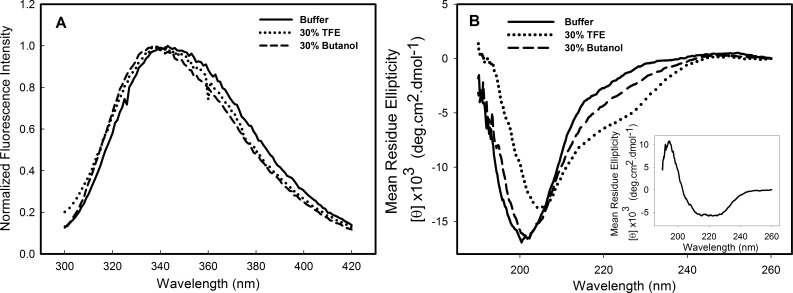
Spectroscopic techniques, transmission electron microscopy and calorimetry were used to better understand the propensity of C124 to fold or to multimerize into NLPs when subjected to different conditions or in the presence of unspecific nucleic acids of equivalent size to cellular microRNAs.
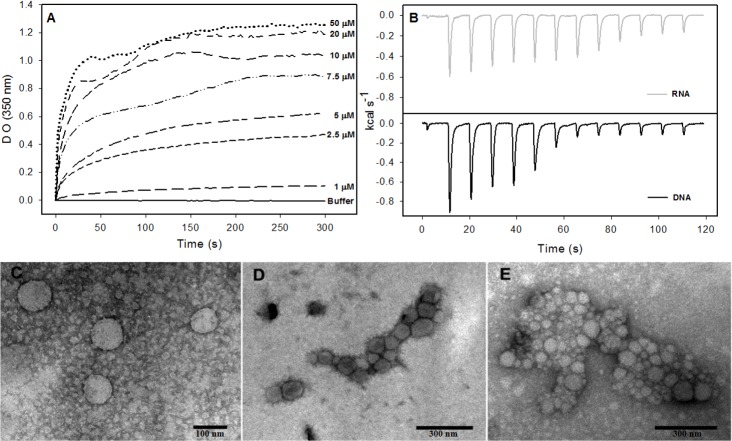
The structural analysis indicated that C124 has low propensity to self-folding. On the other hand, for the first time, we show that C124, in the absence of nucleic acids, multimerizes into empty NLPs when subjected to a pH close to its isoelectric point (pH ≈ 12), indicating that assembly is mainly driven by charge neutralization. Isothermal calorimetry data showed that the assembly of NLPs promoted by nucleic acids is enthalpy driven. Additionally, data obtained from fluorescence correlation spectroscopy show that C124, in nanomolar range, was able to interact and to sequester a large number of short unspecific nucleic acids into NLPs.
Together, our data showed that the charge neutralization is the major factor for the nucleocapsid-like particles assembly from C-terminal truncated HCV core protein. This finding suggests that HCV core protein may physically interact with unspecific cellular polyanions, which may correspond to microRNAs and mRNAs in a host cell infected by HCV, triggering their confinement into infectious particles.
丙型肝炎病毒(HCV)核心蛋白除了在形成核衣壳组装体中发挥结构作用外,还通过干扰包括微小RNA和信使核糖核酸(mRNA)稳态在内的多种细胞过程,在HCV发病机制中起关键作用。C端截短的HCV核心蛋白(C124)在溶液中本质上是无序的,能够与微摩尔浓度范围内的非特异性核酸相互作用,并组装成核衣壳样颗粒(NLP)。C124组装的特异性和倾向及其对HCV发病机制的影响尚不清楚。
使用光谱技术、透射电子显微镜和量热法,以更好地了解C124在不同条件下或存在与细胞微小RNA大小相当的非特异性核酸时折叠或多聚化形成NLP的倾向。
结构分析表明,C124自我折叠的倾向较低。另一方面,我们首次表明,在没有核酸的情况下,当C124处于接近其等电点的pH值(pH≈12)时,会多聚化形成空的NLP,这表明组装主要由电荷中和驱动。等温量热数据表明,核酸促进的NLP组装是由焓驱动的。此外,从荧光相关光谱获得的数据表明,纳摩尔浓度的C124能够与大量短的非特异性核酸相互作用,并将它们隔离到NLP中。
总之,我们的数据表明,电荷中和是C端截短的HCV核心蛋白形成核衣壳样颗粒组装的主要因素。这一发现表明,HCV核心蛋白可能与非特异性细胞聚阴离子发生物理相互作用,在被HCV感染的宿主细胞中,这些聚阴离子可能对应于微小RNA和mRNA,从而促使它们被限制在感染性颗粒中。