Ben Yahia Bassem, Gourevitch Boris, Malphettes Laetitia, Heinzle Elmar
Biochemical Engineering Institute, Saarland University, Campus A1.5, D-66123 Saarbrücken, Germany.
Upstream Process Sciences Biotech Sciences, UCB Pharma S.A., Avenue de l'Industrie, Braine l'Alleud B-1420, Belgium.
Biotechnol Bioeng. 2017 Apr;114(4):785-797. doi: 10.1002/bit.26214. Epub 2016 Nov 21.
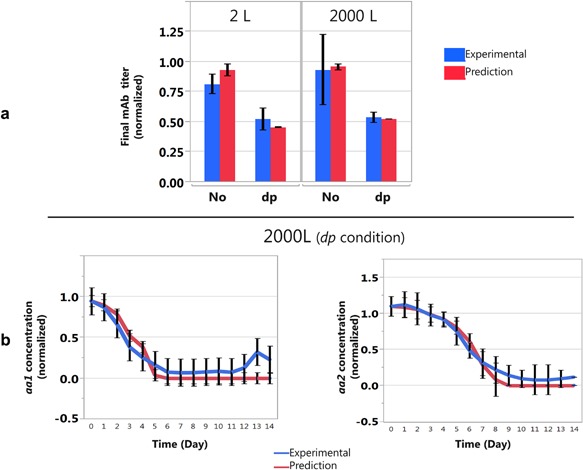
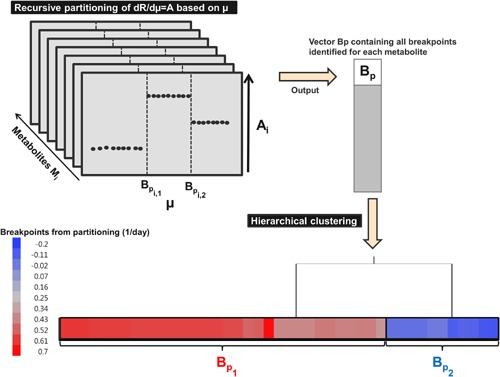
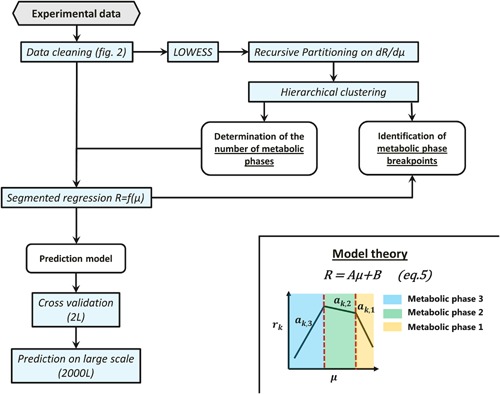
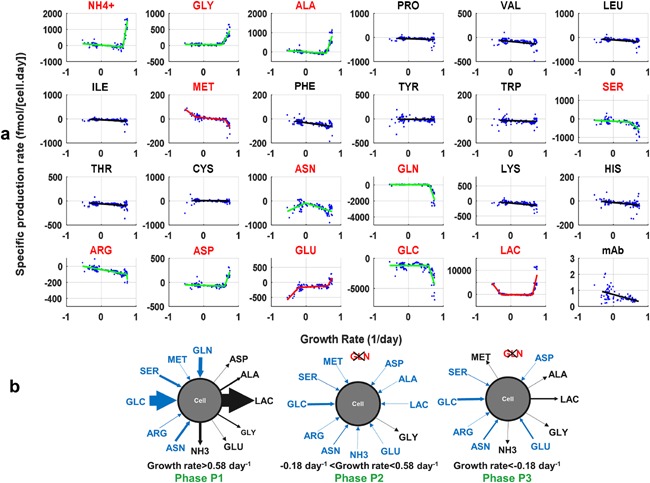
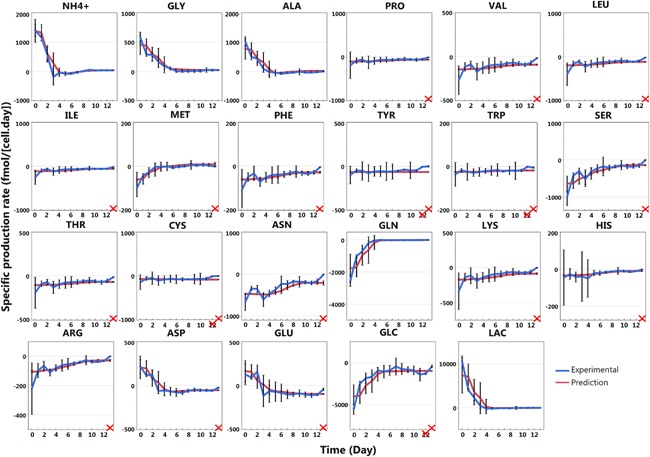
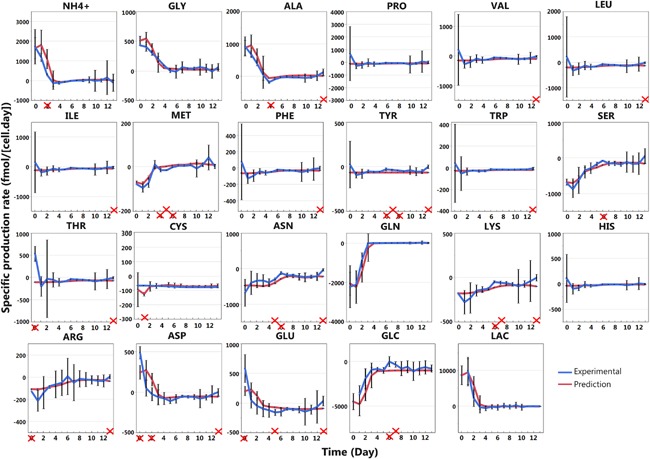
We describe a systematic approach to model CHO metabolism during biopharmaceutical production across a wide range of cell culture conditions. To this end, we applied the metabolic steady state concept. We analyzed and modeled the production rates of metabolites as a function of the specific growth rate. First, the total number of metabolic steady state phases and the location of the breakpoints were determined by recursive partitioning. For this, the smoothed derivative of the metabolic rates with respect to the growth rate were used followed by hierarchical clustering of the obtained partition. We then applied a piecewise regression to the metabolic rates with the previously determined number of phases. This allowed identifying the growth rates at which the cells underwent a metabolic shift. The resulting model with piecewise linear relationships between metabolic rates and the growth rate did well describe cellular metabolism in the fed-batch cultures. Using the model structure and parameter values from a small-scale cell culture (2 L) training dataset, it was possible to predict metabolic rates of new fed-batch cultures just using the experimental specific growth rates. Such prediction was successful both at the laboratory scale with 2 L bioreactors but also at the production scale of 2000 L. This type of modeling provides a flexible framework to set a solid foundation for metabolic flux analysis and mechanistic type of modeling. Biotechnol. Bioeng. 2017;114: 785-797. © 2016 The Authors. Biotechnology and Bioengineering Published by Wiley Periodicals, Inc.
我们描述了一种系统方法,用于在广泛的细胞培养条件下对生物制药生产过程中的中国仓鼠卵巢(CHO)细胞代谢进行建模。为此,我们应用了代谢稳态概念。我们分析并模拟了代谢产物的生成速率作为比生长速率的函数。首先,通过递归划分确定代谢稳态阶段的总数和断点位置。为此,使用代谢速率相对于生长速率的平滑导数,然后对所得划分进行层次聚类。然后,我们对代谢速率应用分段回归,其中阶段数是预先确定的。这使得能够确定细胞发生代谢转变时的生长速率。所得的代谢速率与生长速率之间具有分段线性关系的模型很好地描述了补料分批培养中的细胞代谢。使用来自小规模细胞培养(2L)训练数据集的模型结构和参数值,仅使用实验比生长速率就可以预测新补料分批培养的代谢速率。这种预测在2L生物反应器的实验室规模以及2000L的生产规模上均取得了成功。这种类型的建模提供了一个灵活的框架,为代谢通量分析和机理类型的建模奠定了坚实的基础。《生物技术与生物工程》2017年;114:785 - 797。©2016作者。由威利期刊公司出版的《生物技术与生物工程》