Romley John, Goutam Prodyumna, Sood Neeraj
Price School of Public Policy, University of Southern California, Los Angeles, California, United States of America.
School of Pharmacy, University of Southern California, Los Angeles, California, United States of America.
PLoS One. 2016 Nov 21;11(11):e0166858. doi: 10.1371/journal.pone.0166858. eCollection 2016.
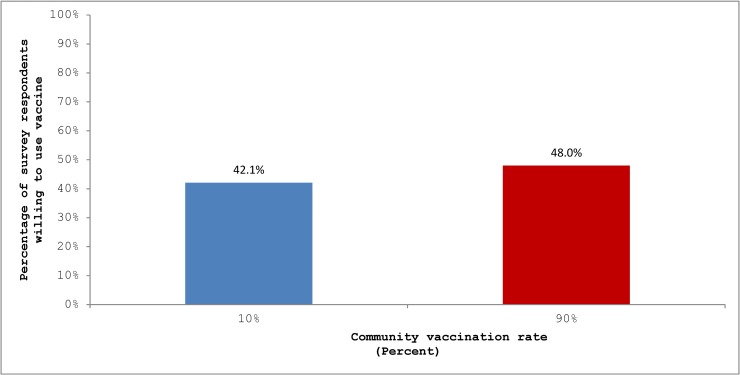
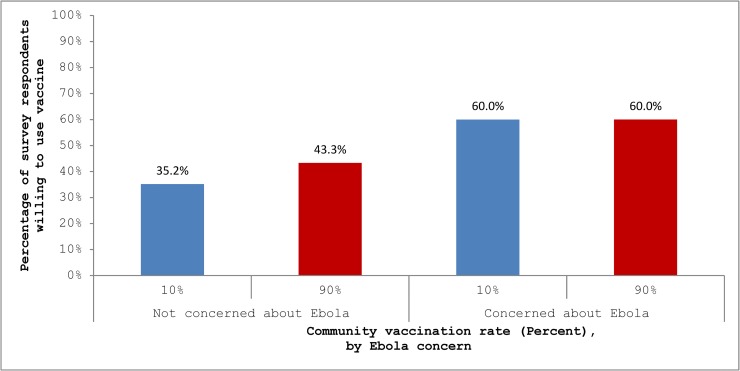
Some models of vaccination behavior imply that an individual's willingness to vaccinate could be negatively correlated with the vaccination rate in her community. The rationale is that a higher community vaccination rate reduces the risk of contracting the vaccine-preventable disease and thus reduces the individual's incentive to vaccinate. At the same time, as for many health-related behaviors, individuals may want to conform to the vaccination behavior of peers, counteracting a reduced incentive to vaccinate due to herd immunity. Currently there is limited empirical evidence on how individual vaccination decisions respond to the vaccination decisions of peers. In the fall of 2014, we used a rapid survey technology to ask a large sample of U.S. adults about their willingness to use a vaccine for Ebola. Respondents expressed a greater inclination to use the vaccine in a hypothetical scenario with a high community vaccination rate. In particular, an increase in the community vaccination rate from 10% to 90% had the same impact on reported utilization as a nearly 50% reduction in out-of-pocket cost. These findings are consistent with a tendency to conform with vaccination among peers, and suggest that policies promoting vaccination could be more effective than has been recognized.
一些疫苗接种行为模型表明,个体的疫苗接种意愿可能与其所在社区的疫苗接种率呈负相关。其基本原理是,较高的社区疫苗接种率会降低感染疫苗可预防疾病的风险,从而降低个体接种疫苗的动机。与此同时,就许多与健康相关的行为而言,个体可能希望与同伴的疫苗接种行为保持一致,以抵消由于群体免疫而降低的接种疫苗动机。目前,关于个体疫苗接种决策如何响应同伴的疫苗接种决策的实证证据有限。2014年秋季,我们使用快速调查技术,询问了大量美国成年人关于他们使用埃博拉疫苗的意愿。在社区疫苗接种率较高的假设情景中,受访者表示更倾向于使用该疫苗。特别是,社区疫苗接种率从10%提高到90%,对报告的疫苗使用率的影响与自付费用降低近50%相同。这些发现与同伴间疫苗接种的从众倾向一致,并表明促进疫苗接种的政策可能比人们认识到的更有效。