Zucchelli Silvia, Patrucco Laura, Persichetti Francesca, Gustincich Stefano, Cotella Diego
Department of Health Sciences, Università del Piemonte Orientale, Novara, Italy; Area of Neuroscience, SISSA, Trieste, Italy.
Department of Health Sciences, Università del Piemonte Orientale, Novara, Italy.
Comput Struct Biotechnol J. 2016 Oct 27;14:404-410. doi: 10.1016/j.csbj.2016.10.004. eCollection 2016.
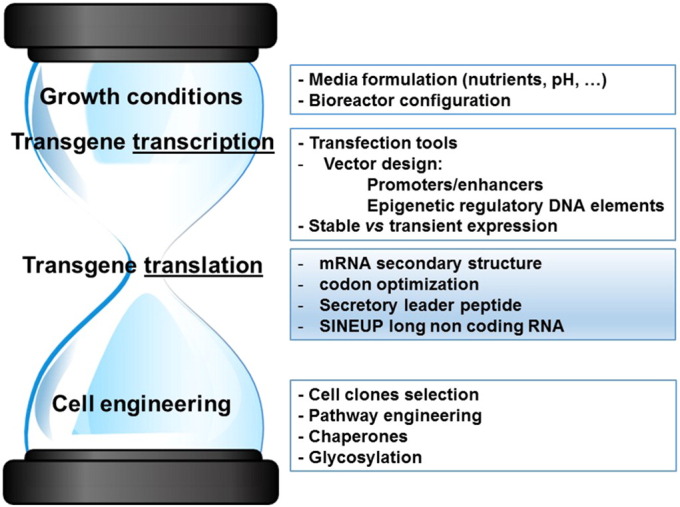
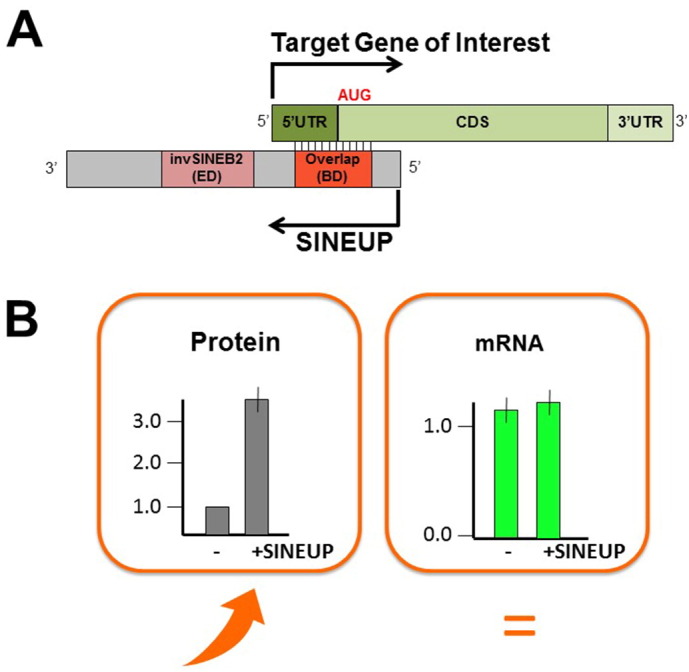
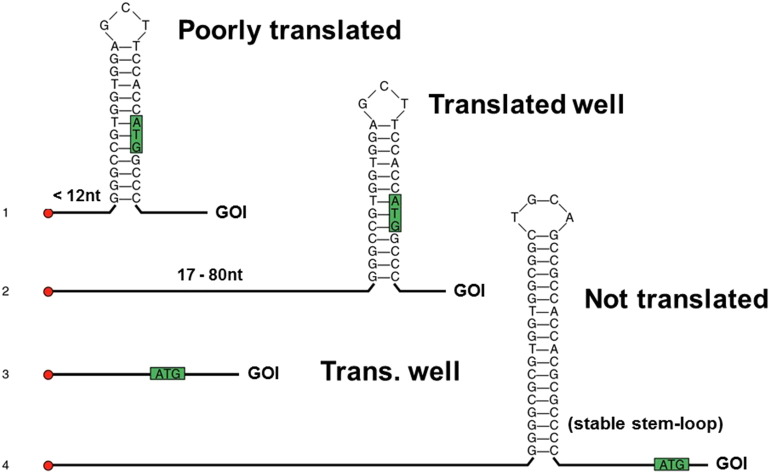
Mammalian cells are an indispensable tool for the production of recombinant proteins in contexts where function depends on post-translational modifications. Among them, Chinese Hamster Ovary (CHO) cells are the primary factories for the production of therapeutic proteins, including monoclonal antibodies (MAbs). To improve expression and stability, several methodologies have been adopted, including methods based on media formulation, selective pressure and cell- or vector engineering. This review presents current approaches aimed at improving mammalian cell factories that are based on the enhancement of translation. Among well-established techniques (codon optimization and improvement of mRNA secondary structure), we describe SINEUPs, a family of antisense long non-coding RNAs that are able to increase translation of partially overlapping protein-coding mRNAs. By exploiting their modular structure, SINEUP molecules can be designed to target virtually any mRNA of interest, and thus to increase the production of secreted proteins. Thus, synthetic SINEUPs represent a new versatile tool to improve the production of secreted proteins in biomanufacturing processes.
在功能依赖于翻译后修饰的情况下,哺乳动物细胞是生产重组蛋白不可或缺的工具。其中,中国仓鼠卵巢(CHO)细胞是生产治疗性蛋白(包括单克隆抗体)的主要工厂。为了提高表达和稳定性,人们采用了多种方法,包括基于培养基配方、选择压力以及细胞或载体工程的方法。本综述介绍了当前旨在通过增强翻译来改进哺乳动物细胞工厂的方法。在成熟的技术(密码子优化和mRNA二级结构改善)中,我们描述了SINEUPs,这是一类反义长链非编码RNA,能够增加部分重叠的蛋白质编码mRNA的翻译。通过利用其模块化结构,SINEUP分子可以被设计成靶向几乎任何感兴趣的mRNA,从而增加分泌蛋白的产量。因此,合成SINEUPs是一种新型通用工具,可用于提高生物制造过程中分泌蛋白的产量。