Li Huixia, Luo Miyang, Luo Jiayou, Zheng Jianfei, Zeng Rong, Du Qiyun, Fang Junqun, Ouyang Na
Department of Maternal and Children Health, Xiangya School of Public Health, Central South University, No.110, Xiangya Road, Kaifu District, Changsha, 410008, Hunan Province, China.
Department of Child Health Care, Hunan Provincial Maternal and Child Health Care Hospital, No.53, Xiangchun Road, Kaifu District, Changsha, 410008, Hunan Province, China.
BMC Pregnancy Childbirth. 2016 Nov 23;16(1):368. doi: 10.1186/s12884-016-1116-4.
A risk prediction model of non-syndromic cleft lip with or without cleft palate (NSCL/P) was established by a discriminant analysis to predict the individual risk of NSCL/P in pregnant women.
A hospital-based case-control study was conducted with 113 cases of NSCL/P and 226 controls without NSCL/P. The cases and the controls were obtained from 52 birth defects' surveillance hospitals in Hunan Province, China. A questionnaire was administered in person to collect the variables relevant to NSCL/P by face to face interviews. Logistic regression models were used to analyze the influencing factors of NSCL/P, and a stepwise Fisher discriminant analysis was subsequently used to construct the prediction model.
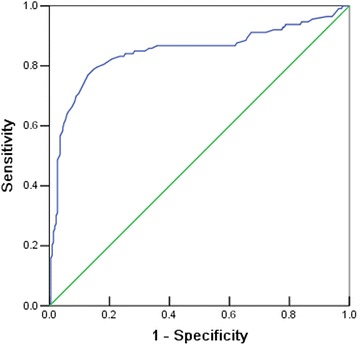
In the univariate analysis, 13 influencing factors were related to NSCL/P, of which the following 8 influencing factors as predictors determined the discriminant prediction model: family income, maternal occupational hazards exposure, premarital medical examination, housing renovation, milk/soymilk intake in the first trimester of pregnancy, paternal occupational hazards exposure, paternal strong tea drinking, and family history of NSCL/P. The model had statistical significance (lambda = 0.772, chi-square = 86.044, df = 8, P < 0.001). Self-verification showed that 83.8 % of the participants were correctly predicted to be NSCL/P cases or controls with a sensitivity of 74.3 % and a specificity of 88.5 %. The area under the receiver operating characteristic curve (AUC) was 0.846.
The prediction model that was established using the risk factors of NSCL/P can be useful for predicting the risk of NSCL/P. Further research is needed to improve the model, and confirm the validity and reliability of the model.
通过判别分析建立了非综合征性唇裂伴或不伴腭裂(NSCL/P)的风险预测模型,以预测孕妇发生NSCL/P的个体风险。
开展了一项基于医院的病例对照研究,纳入113例NSCL/P病例和226例无NSCL/P的对照。病例和对照来自中国湖南省52家出生缺陷监测医院。通过面对面访谈亲自发放问卷,收集与NSCL/P相关的变量。采用Logistic回归模型分析NSCL/P的影响因素,随后采用逐步Fisher判别分析构建预测模型。
在单因素分析中,13个影响因素与NSCL/P相关,其中以下8个影响因素作为预测指标确定了判别预测模型:家庭收入、母亲职业危害暴露、婚前医学检查、房屋装修、孕早期牛奶/豆浆摄入量、父亲职业危害暴露、父亲饮用浓茶以及NSCL/P家族史。该模型具有统计学意义(λ = 0.772,卡方 = 86.044,自由度 = 8,P < 0.001)。自我验证显示,83.8%的参与者被正确预测为NSCL/P病例或对照,灵敏度为74.3%,特异度为88.5%。受试者工作特征曲线(AUC)下面积为0.846。
利用NSCL/P危险因素建立的预测模型可用于预测NSCL/P风险。需要进一步研究以改进该模型,并确认其有效性和可靠性。