Wray Katherine, Allen Angela, Evans Emma, Fisher Chris, Premawardhena Anuja, Perera Lakshman, Rodrigo Rexan, Goonathilaka Gayan, Ramees Lebbe, Webster Craig, Armitage Andrew E, Prentice Andrew M, Weatherall David J, Drakesmith Hal, Pasricha Sant-Rayn
MRC Human Immunology Unit, MRC Weatherall Institute of Molecular Medicine, University of Oxford, Oxford, UK.
BRC Blood Theme, NIHR Oxford Biomedical Research Centre, Oxford, UK.
Am J Hematol. 2017 Feb;92(2):196-203. doi: 10.1002/ajh.24617.
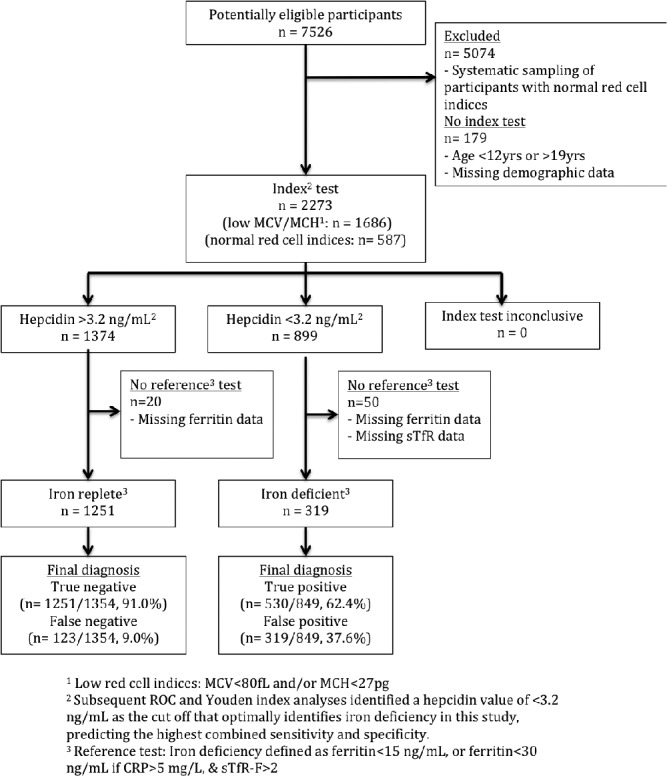
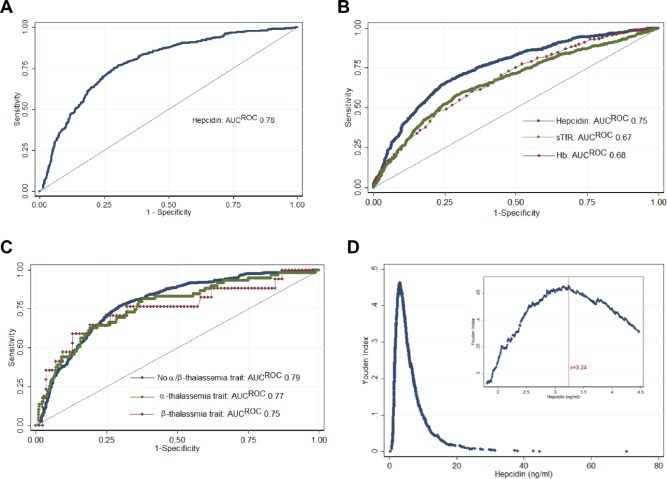
Anemia affects over 800 million women and children globally. Measurement of hepcidin as an index of iron status shows promise, but its diagnostic performance where hemoglobinopathies are prevalent is unclear. We evaluated the performance of hepcidin as a diagnostic test of iron deficiency in adolescents across Sri Lanka. We selected 2273 samples from a nationally representative cross-sectional study of 7526 secondary schoolchildren across Sri Lanka and analyzed associations between hepcidin and participant characteristics, iron indices, inflammatory markers, and hemoglobinopathy states. We evaluated the diagnostic accuracy of hepcidin as a test for iron deficiency with estimation of the AUC , sensitivity/specificity at each hepcidin cutoff, and calculation of the Youden Index to find the optimal threshold. Hepcidin was associated with ferritin, sTfR, and hemoglobin. The AUC for hepcidin as a test of iron deficiency was 0.78; hepcidin outperformed Hb and sTfR. The Youden index-predicted cutoff to detect iron deficiency (3.2 ng/mL) was similar to thresholds previously identified to predict iron utilization and identify deficiency in African populations. Neither age, sex, nor α- or β-thalassemia trait affected diagnostic properties of hepcidin. Hepcidin pre-screening would prevent most iron-replete thalassemia carriers from receiving iron whilst still ensuring most iron deficient children were supplemented. Our data indicate that the physiological relationship between hepcidin and iron status transcends specific populations. Measurement of hepcidin in individuals or populations could establish the need for iron interventions. Am. J. Hematol. 92:196-203, 2017. © 2016 Wiley Periodicals, Inc.
全球有超过8亿妇女和儿童受到贫血的影响。将铁调素作为铁状态指标进行测量显示出了前景,但其在血红蛋白病流行地区的诊断性能尚不清楚。我们评估了铁调素作为斯里兰卡青少年缺铁诊断测试的性能。我们从对斯里兰卡7526名中学生进行的一项具有全国代表性的横断面研究中选取了2273个样本,并分析了铁调素与参与者特征、铁指标、炎症标志物和血红蛋白病状态之间的关联。我们通过估计曲线下面积(AUC)、每个铁调素临界值处的敏感性/特异性以及计算约登指数来寻找最佳阈值,从而评估铁调素作为缺铁测试的诊断准确性。铁调素与铁蛋白、可溶性转铁蛋白受体(sTfR)和血红蛋白相关。铁调素作为缺铁测试的AUC为0.78;铁调素的表现优于血红蛋白和sTfR。约登指数预测的检测缺铁的临界值(3.2纳克/毫升)与先前确定的预测非洲人群铁利用和识别缺铁的阈值相似。年龄、性别以及α或β地中海贫血特征均未影响铁调素的诊断特性。铁调素预筛查将防止大多数铁充足的地中海贫血携带者接受铁剂治疗,同时仍确保大多数缺铁儿童得到补充。我们的数据表明,铁调素与铁状态之间的生理关系超越了特定人群。对个体或人群进行铁调素测量可以确定是否需要进行铁干预。《美国血液学杂志》92:196 - 203,2017年。©2016威利期刊公司