Filtjens Jessica, Coltel Nicolas, Cencig Sabrina, Taveirne Sylvie, Van Ammel Els, Van Acker Aline, Kerre Tessa, Matthys Patrick, Taghon Tom, Vandekerckhove Bart, Carlier Yves, Truyens Carine, Leclercq Georges
Laboratory of Experimental Immunology, Ghent University , Ghent , Belgium.
Laboratory of Parasitology, Faculty of Medicine, Université Libre de Bruxelles , Brussels , Belgium.
Front Immunol. 2016 Nov 10;7:472. doi: 10.3389/fimmu.2016.00472. eCollection 2016.
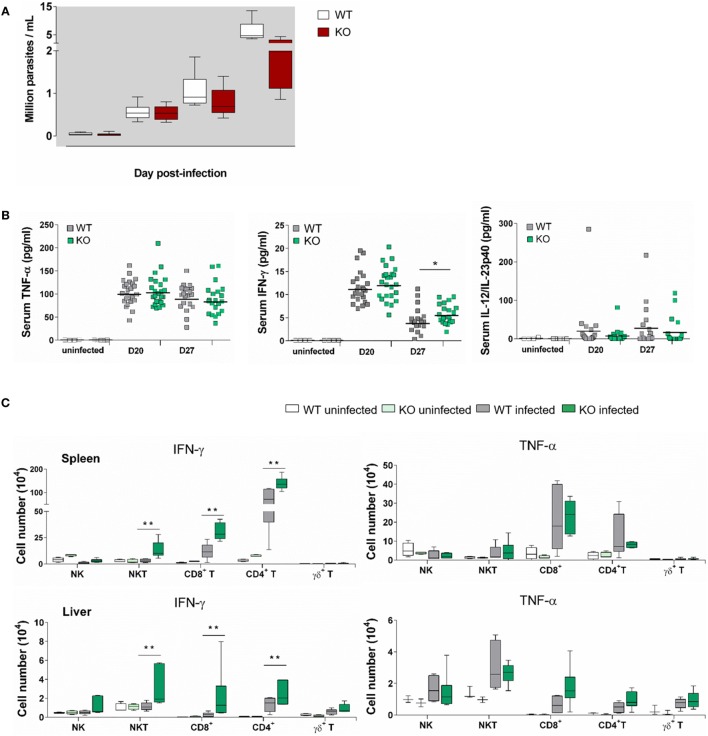
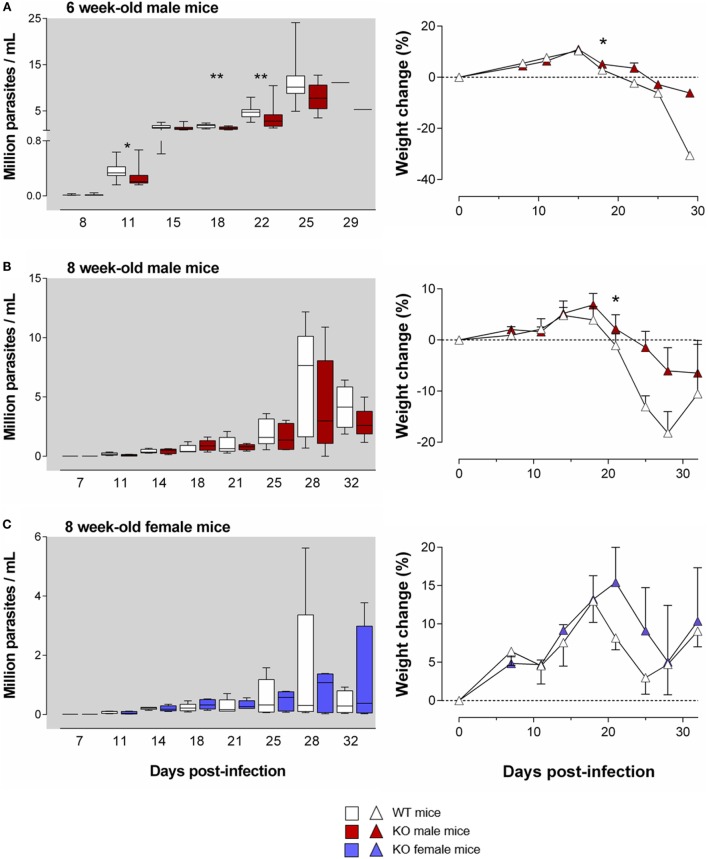
The protozoan parasite circulates in the blood upon infection and invades various cells. Parasites intensively multiply during the acute phase of infection and persist lifelong at low levels in tissues and blood during the chronic phase. Natural killer (NK) and NKT cells play an important role in the immune control of infection, mainly by releasing the cytokine IFN-γ that activates the microbicidal action of macrophages and other cells and shapes a protective type 1 immune response. The mechanisms by which immune cells are regulated to produce IFN-γ during infection are still incompletely understood. Here, we show that urokinase plasminogen activator (uPA) is induced early upon infection and remains elevated until day 20 post-infection. We previously demonstrated that the inhibitory receptor Ly49E, which is expressed, among others, on NK and NKT cells, is triggered by uPA. Therefore, we compared wild type (WT) to Ly49E knockout (KO) mice for their control of experimental infection. Our results show that young, i.e., 4- and 6-week-old, Ly49E KO mice control the infection better than WT mice, indicated by a lower parasite load and less cachexia. The beneficial effect of Ly49E depletion is more obvious in 4-week-old male than in female mice and weakens in 8-week-old mice. In young mice, the lower parasitemia in Ly49E KO mice is paralleled by higher IFN-γ production compared to their WT controls. Our data indicate that Ly49E receptor expression inhibits the immune control of infection. This is the first demonstration that the inhibitory Ly49E receptor can interfere with the immune response to a pathogen .
这种原生动物寄生虫在感染后会在血液中循环并侵入各种细胞。寄生虫在感染急性期大量繁殖,并在慢性期以低水平在组织和血液中持续终生。自然杀伤(NK)细胞和NKT细胞在感染的免疫控制中起重要作用,主要是通过释放细胞因子IFN-γ来激活巨噬细胞和其他细胞的杀菌作用,并形成保护性的1型免疫反应。在感染期间免疫细胞被调节以产生IFN-γ的机制仍未完全了解。在这里,我们表明尿激酶型纤溶酶原激活剂(uPA)在感染早期被诱导,并在感染后第20天之前一直保持升高。我们之前证明,抑制性受体Ly49E,尤其在NK细胞和NKT细胞上表达,可被uPA触发。因此,我们比较了野生型(WT)小鼠和Ly49E基因敲除(KO)小鼠对实验性感染的控制情况。我们的结果表明,年轻的,即4周龄和6周龄的Ly49E基因敲除小鼠比野生型小鼠能更好地控制感染,这表现为较低的寄生虫负荷和较少的恶病质。Ly49E缺失的有益效果在4周龄雄性小鼠中比雌性小鼠更明显,并且在8周龄小鼠中减弱。在年轻小鼠中,与野生型对照相比,Ly49E基因敲除小鼠较低的寄生虫血症与较高的IFN-γ产生同时出现。我们的数据表明Ly49E受体表达抑制了对感染的免疫控制。这是首次证明抑制性Ly49E受体可干扰对病原体的免疫反应。