Hariharan I K, Harris A W, Crawford M, Abud H, Webb E, Cory S, Adams J M
Walter and Eliza Hall Institute of Medical Research, Royal Melbourne Hospital, Victoria, Australia.
Mol Cell Biol. 1989 Jul;9(7):2798-805. doi: 10.1128/mcb.9.7.2798-2805.1989.
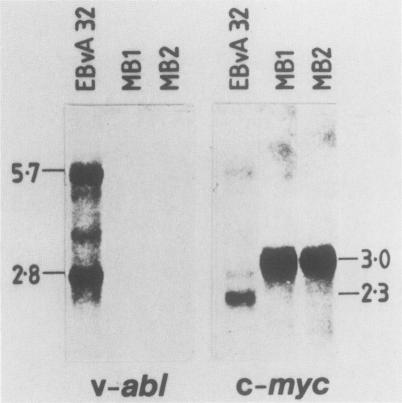
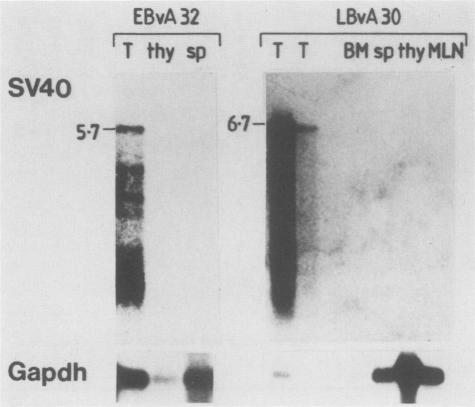
In chronic myeloid leukemia and some cases of acute lymphoblastic leukemia, a 9;22 chromosome translocation has fused most of the c-abl oncogene to a gene designated bcr. To explore in vivo the biological effects of the chimeric gene, we introduced a facsimile of the translocation product, a bcr-v-abl gene, into the mouse germ line under the control of the immunoglobulin heavy-chain enhancer or a retroviral long terminal repeat. Some transgenic mice bearing either construct developed clonal lymphoid tumors. T lymphomas predominated, but some pre-B lymphomas developed. The transgenes were expressed in the tumors but not detectably in the lymphoid tissues of nontumorous transgenic animals, implying that transcription is activated by a low-frequency somatic event. These results demonstrate that bcr-v-abl is tumorigenic in vivo and provide a new animal model for lymphomagenesis.
在慢性粒细胞白血病和某些急性淋巴细胞白血病病例中,9号与22号染色体易位使得大部分c-abl癌基因与一个名为bcr的基因融合。为了在体内探究嵌合基因的生物学效应,我们在免疫球蛋白重链增强子或逆转录病毒长末端重复序列的控制下,将易位产物的一个类似物——bcr-v-abl基因导入小鼠种系。携带任一构建体的一些转基因小鼠发生了克隆性淋巴瘤。以T淋巴瘤为主,但也有一些前B淋巴瘤出现。转基因在肿瘤中表达,但在无肿瘤转基因动物的淋巴组织中未检测到表达,这意味着转录是由低频体细胞事件激活的。这些结果表明bcr-v-abl在体内具有致瘤性,并为淋巴瘤发生提供了一种新的动物模型。