Boeddha Navin P, Driessen Gertjan J, Cnossen Marjon H, Hazelzet Jan A, Emonts Marieke
Intensive Care and Department of Pediatric Surgery, Erasmus MC-Sophia Children's Hospital, University Medical Center Rotterdam, Rotterdam, the Netherlands.
Department of Pediatrics, Division of Pediatric Infectious Diseases & Immunology, Erasmus MC-Sophia Children's Hospital, University Medical Center Rotterdam, Rotterdam, the Netherlands.
PLoS One. 2016 Nov 28;11(11):e0167004. doi: 10.1371/journal.pone.0167004. eCollection 2016.
To study whether the circadian variation of plasminogen-activator-inhibitor-1 (PAI-1) levels, with high morning levels, is associated with poor outcome of children with meningococcal sepsis presenting in the morning hours.
Retrospective analysis of prospectively collected clinical and laboratory data.
Single center study at Erasmus MC-Sophia Children's Hospital, Rotterdam, the Netherlands.
184 patients aged 3 weeks to 18 years with meningococcal sepsis. In 36 of these children, PAI-1 levels at admission to the PICU were measured in plasma by ELISA.
None.
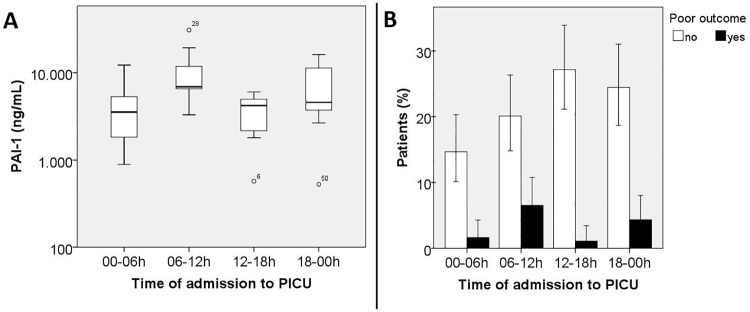
Circadian variation was studied by dividing one day in blocks of 6 hours. Patients admitted between 6:00 am and 12:00 am had increased illness severity scores and higher PAI-1 levels (n = 9, median 6912 ng/mL, IQR 5808-15600) compared to patients admitted at night (P = 0.019, n = 9, median 3546 ng/mL, IQR 1668-6118) or in the afternoon (P = 0.007, n = 7, median 4224 ng/mL, IQR 1804-5790). In 184 patients, analysis of circadian variation in relation to outcome showed more deaths, amputations and need for skin grafts in patients admitted to the PICU between 6:00 am and 12:00 am than patients admitted during the rest of the day (P = 0.009).
Circadian variation of PAI-1 levels is present in children with meningococcal sepsis and is associated with illness severity, with a peak level in the morning. Whether circadian variation is an independent risk factor for morbidity and mortality in meningococcal sepsis needs to be explored in future studies.
研究纤溶酶原激活物抑制剂-1(PAI-1)水平的昼夜变化(早晨水平较高)是否与早晨出现的脑膜炎球菌败血症患儿的不良预后相关。
对前瞻性收集的临床和实验室数据进行回顾性分析。
荷兰鹿特丹伊拉斯姆斯医学中心索菲亚儿童医院的单中心研究。
184例年龄在3周至18岁的脑膜炎球菌败血症患者。其中36例患儿在入住儿科重症监护病房(PICU)时通过酶联免疫吸附测定法(ELISA)检测血浆中的PAI-1水平。
无。
通过将一天分为6小时的时间段来研究昼夜变化。与夜间(P = 0.019,n = 9,中位数3546 ng/mL,四分位间距1668 - 6118)或下午(P = 0.007,n = 7,中位数4224 ng/mL,四分位间距1804 - 5790)入院的患者相比,上午6:00至中午12:00入院的患者疾病严重程度评分更高,PAI-1水平更高(n = 9,中位数6912 ng/mL,四分位间距5808 - 15600)。在184例患者中,分析昼夜变化与预后的关系发现,上午6:00至中午12:00入住PICU的患者比一天中其他时间入院的患者有更多死亡、截肢和需要植皮的情况(P = 0.009)。
脑膜炎球菌败血症患儿存在PAI-1水平的昼夜变化,并与疾病严重程度相关,早晨水平达到峰值。昼夜变化是否为脑膜炎球菌败血症发病和死亡的独立危险因素,有待未来研究进一步探索。